Understanding the Irish Revenue Form for the Declaration of Usage of Solid Fuel as a Raw Material
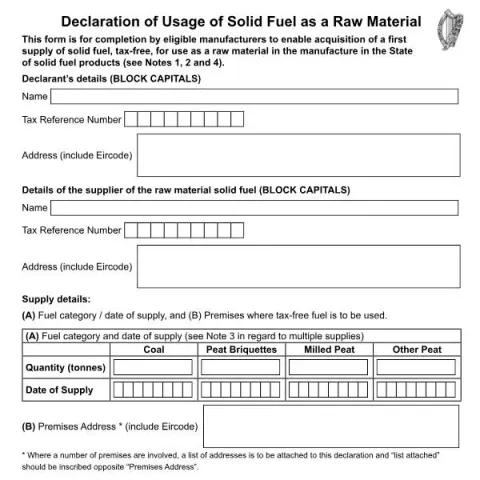
The Irish Revenue Commissioners require eligible manufacturers to complete the Declaration of Usage of Solid Fuel as a Raw Material (form code: SFCT-DecRM) to facilitate the tax-free acquisition of solid fuel for manufacturing purposes. This official form plays a crucial role in ensuring compliance with the Solid Fuel Carbon Tax (SFCT) regulations, specifically under Section 79(2) of the Finance Act 2010.
Purpose and When to Use the Form
This declaration is intended for manufacturers who intend to purchase solid fuel without paying the SFCT, provided the fuel is used exclusively as a raw material in manufacturing solid fuel products within Ireland. It is a prerequisite for obtaining the first supply of tax-free solid fuel from a supplier. The form must be completed and submitted to the supplier prior to any tax-free supply, and a copy retained by the manufacturer for their records and potential inspection by the Revenue Commissioners.
The form is to be filled out for each supply of solid fuel received on a tax-free basis, unless a composite declaration covering multiple supplies within a calendar month is appropriate and supported by adequate records. The declaration ensures that the fuel is used strictly for manufacturing and not for other purposes, aligning with legal obligations under the SFCT legislation.
Key Information Required on the Form
1. Declaring Manufacturer Details
- Name: The full legal name of the manufacturer.
- Tax Reference Number: The company's tax registration number issued by Revenue.
- Address: Including the Eircode, for official correspondence.
2. Supplier Details
- Name: The supplier of the solid fuel.
- Tax Reference Number: The supplier’s tax registration number.
- Address: Including the Eircode.
3. Supply Details
- Fuel Category: Such as coal, peat briquettes, milled peat, or other peat.
- Date of Supply: The specific date when the supply occurs or is scheduled.
- Quantity: The amount of solid fuel in tonnes.
- Premises Address: The location where the raw material will be used, including the Eircode. If multiple premises are involved, a list should be attached.
Legal and Administrative Considerations
The declaration must be signed by an authorized individual within the manufacturing company, such as a director or company secretary, who states their position within the business. The signed form confirms that the solid fuel will be used solely for manufacturing purposes in accordance with the legislation. The manufacturer also agrees to pay the SFCT if the fuel is not used as declared, and to register with Revenue as a supplier of solid fuel if they subsequently sell the manufactured product within Ireland.
It is essential for manufacturers to maintain detailed records of all receipts and uses of solid fuel, including the manufacturing process and the characteristics of the final products. These records support compliance and facilitate audits by Revenue.
How to Submit and Use the Form
The completed original declaration must be given to the solid fuel supplier before any tax-free supply occurs. The manufacturer should retain a copy for their records and provide a copy to Revenue if requested. The form covers each supply unless a composite declaration is used for multiple supplies within a month, provided that supporting records are available to reconcile supplies with the declaration.
Fill in your form directly online
No printing: type your details into the boxes of the official form, tick, then download the PDF ready to send.
- 1Type into the form boxes
- 2Tick in one click
- 3Save and download the PDF
Failure to comply with the declaration requirements or misuse of the tax-free fuel could result in liability for the SFCT, penalties, or other legal consequences. Manufacturers should ensure their records are accurate and up to date to demonstrate compliance with the legislation.
Conclusion
The SFCT-DecRM form is a vital administrative tool for Irish manufacturers involved in the production of solid fuel products. Proper completion and adherence to the legal obligations associated with this declaration help ensure smooth procurement of raw materials and compliance with tax regulations.