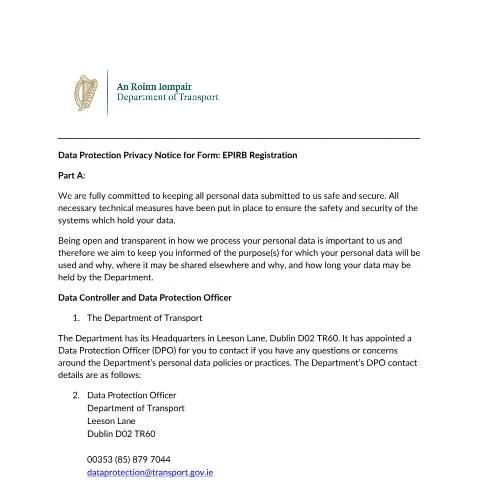
The Vital Role of EPIRB Registration: Understanding Data Protection in Maritime Safety
In the realm of maritime operations, the registration of Emergency Position Indicating Radio Beacons (EPIRB) serves as a critical component for ensuring the safety of vessels and their crews. However, the registration process involves the handling of personal data, which necessitates rigorous data protection measures. This article explores the intricacies of the Data Protection Privacy Notice associated with the EPIRB registration form as outlined by the Department of Transport.
Why the EPIRB Registration Data Privacy Notice Matters
Maritime safety regulations require that EPIRBs be registered to facilitate accurate location tracking during emergencies. The Data Protection Privacy Notice is designed to inform individuals about how their personal data will be handled during this registration process. It is not merely a formality, but a fundamental aspect that sets the groundwork for trust and transparency between the department and the data subjects.
Understanding Personal Data in Context
When registering an EPIRB, specific personal data must be submitted. This data is not just collected for administrative purposes but is mandated by various legal frameworks including the Wireless Telegraphy Act, 1926 and the Merchant Shipping Act, 1894. The notice serves to clarify:
- The types of personal data collected
- The rationale behind the data collection
- The sharing and retention policies of the data
Key Data Processing Principles Underpinning EPIRB Registration
The notification outlines how the Department of Transport adheres to data protection principles, as defined in law. Here are the principles that govern data processing:
- Legitimate Purpose: Data collected for EPIRB registration is only used for purposes directly related to maritime safety.
- Data Minimization: Only the necessary personal data will be collected to achieve the registration objectives.
- Transparency: Individuals will be informed about how their data is processed, enhancing trust.
- Security Measures: Adequate technical and organizational measures are implemented to protect personal data.
Communicating with the Data Protection Officer (DPO)
The Data Protection Officer plays a crucial role in overseeing compliance with data protection laws. Individuals with queries about their personal data or the privacy notice can reach out directly:
Contact Information: Department of Transport Leeson Lane, Dublin D02 TR60 Phone: 00353 (85) 879 7044 Email: [email protected]
This open channel of communication ensures that concerns can be addressed promptly, reaffirming the department's commitment to data protection.
Rights of Data Subjects: Empowering Individuals
As a data subject, individuals have specific rights concerning their personal data as stipulated in the privacy notice. Understanding these rights is vital:
- The right to be informed: Individuals have the right to know how their data will be used.
- The right of access: Data subjects can request access to the personal data held about them.
- The right to rectification: Individuals have the right to correct inaccuracies in their data.
- The right to erasure: Under certain conditions, individuals may request the deletion of their data.
- The right to restrict processing: Data subjects can ask for their data to be restricted from processing.
- The right to data portability: Individuals can request their data in a format that is transferable to another data controller.
- The right to object: Data subjects can object to data processing under specific circumstances.
- Rights concerning automated decision-making: Individuals are protected from decisions made solely based on automated processes.
The Legal Framework Surrounding EPIRB Data Collection
The legal basis for collecting personal data through the EPIRB registration form is anchored in several statutes. A thorough understanding of these legal foundations not only aids compliance but also informs the data subjects about their rights and obligations:
| Legislation | Purpose |
|---|---|
| Wireless Telegraphy Act, 1926 | Regulates wireless telecommunications, including EPIRB operation. |
| Merchant Shipping Act, 1894 | Establishes requirements for the safety of maritime operations. |
| Marine Equipment Directive (MED) | Ensures safety standards for marine equipment including EPIRBs. |
| Radio Equipment and Telecommunications Terminal Equipment (R&TTE) Regulations | Sets standards for telecommunications equipment to ensure safety and reliability. |
Guidelines for Data Retention and Destruction
Data retention policies outline how long personal data collected during the EPIRB registration will be held. It is important to note that:
- The Department retains data only as long as necessary for the intended purpose.
- Once the data is no longer needed, it will be marked for destruction following internal guidelines.
- The destruction of data is conducted in accordance with statutory requirements and standards set by the National Archives Office.
Understanding the Non-Transfer of Data Outside the EU/EEA
A key aspect of the privacy notice is the affirmation that personal data collected during the EPIRB registration will not be transferred to countries outside the EU or EEA. This is crucial for maintaining data protection standards, as:
- Data transfer outside these areas may expose data to varying levels of protection.
- Ensuring data integrity and privacy is a primary concern of the Department.
The Intersection of Technical Security and Data Protection
The security of data is paramount, especially when dealing with personal information. The Department of Transport has implemented robust technical measures to safeguard personal data:
- Encryption: Sensitive information is often encrypted to prevent unauthorized access.
- Access Controls: Strict access controls are enforced to limit data viewing to authorized personnel only.
- Regular Audits: The department conducts regular audits of its data protection practices.
These measures not only comply with data protection laws but also enhance the credibility of the registration process.
The Importance of Awareness and Compliance
Ultimately, understanding the Data Protection Privacy Notice related to the EPIRB registration form is essential for all stakeholders involved. It fosters greater awareness about data rights and promotes compliance with established legal frameworks. In maritime operations, where safety and timely response can be matters of life and death, diligence in handling personal data ensures that safety measures are not compromised.
Individuals engaging with the Department of Transport for EPIRB registration are encouraged to familiarize themselves with these guidelines, ensuring a smooth process that respects and protects their personal data.
Understanding Data Protection Regulations in Ireland
In Ireland, the framework governing data protection is primarily set by the General Data Protection Regulation (GDPR), which became enforceable on May 25, 2018. This regulation is crucial for individuals and organizations dealing with personal data, ensuring that citizens' privacy rights are upheld. It is essential to understand how these regulations impact the data collected through the EPIRB (Emergency Position Indicating Radio Beacon) registration process.
The GDPR establishes clear guidelines regarding the collection, processing, and storage of personal information. When registering an EPIRB, individuals are typically required to submit personal information, such as names, addresses, and contact details. Under GDPR, individuals have the right to be informed about how their data will be used, which includes the necessity for a clear privacy notice accompanying the registration form.
Fill in your form directly online
No printing: type your details into the boxes of the official form, tick, then download the PDF ready to send.
- 1Type into the form boxes
- 2Tick in one click
- 3Save and download the PDF
The privacy notice should include specific information: the identity of the data controller (in this case, the relevant maritime authority), the purposes of data processing, the legal basis for processing, storage duration, and the rights of data subjects. For instance, individuals must be informed of their right to access their data, rectify inaccuracies, or request deletion under certain circumstances.
Crafting an Effective Privacy Notice for EPIRB Registration
A well-structured privacy notice is vital for compliance with data protection laws and fosters trust between the authority and the public. When crafting a privacy notice for the EPIRB registration form, certain key elements should be incorporated to ensure clarity and transparency:
- Identification of the Data Controller: Clearly state who is collecting the data and how they can be contacted. This may include the Department of Transport or relevant maritime agencies.
- Purpose of Data Collection: Articulate why the data is being collected. For EPIRB registrations, the purpose typically includes emergency response coordination and ensuring compliance with maritime safety regulations.
- Legal Basis for Processing: Explain the basis under which the data is processed, such as compliance with legal obligations, vital interests, or consent.
- Data Retention Period: Provide information on how long the data will be stored and the criteria used to determine that period. This is essential in ensuring users understand their data's lifecycle.
- Rights of Data Subjects: Detail the rights individuals have under GDPR, such as the right to access, the right to rectification, and the right to erasure, among others.
- Data Sharing Information: If applicable, inform users whether their data will be shared with third parties and the purposes of such sharing.
By addressing these elements, authorities can create a comprehensive privacy notice that not only fulfills legal requirements but also reassures users about the safety and purpose of their personal data.
Consequences of Non-Compliance with Data Protection Laws
Failure to comply with data protection regulations, including GDPR and the Data Protection Act 2018, can result in significant implications for both individuals and organizations. Entities that do not adhere to these laws when handling EPIRB registration data may face administrative fines, legal actions, and reputational damage.
The penalties for non-compliance can vary substantially depending on the severity of the breach. For instance, organizations could face fines up to €20 million or 4% of their global annual turnover, whichever is higher. This brings a critical need for organizations managing EPIRB registrations to implement robust data protection measures to safeguard personal data.
In addition to financial penalties, organizations may encounter reputational risks. Trust is a fundamental component of the relationship between authorities and the public. A breach of data protection can lead to a loss of public confidence, resulting in decreased registration compliance and potentially compromising safety and emergency response efforts.
Moreover, individuals affected by data breaches have the right to lodge complaints with the Data Protection Commission (DPC) in Ireland or seek compensation for damages caused by such breaches. Authorities must therefore prioritize data protection to prevent negative outcomes for both themselves and the individuals whose data they handle.