Navigating the SIS 4 Privacy Notice: Key Insights for Seafarers
Seafarers often face unique challenges when it comes to maintaining their credentials and navigating the bureaucratic processes that underpin their professional lives. One vital document in this journey is the SIS 4 Privacy Notice, issued by the Department of Transport. This notice outlines how personal data is handled during the revalidation of Certificates of Competency or Proficiency, ensuring transparency and compliance with data protection laws. Understanding its content and implications is essential for seafarers seeking to maintain their qualifications.
Understanding the Framework of Data Protection
Data protection in Ireland is governed by stringent laws aiming to safeguard personal information. The SIS 4 Privacy Notice operates within this legal framework, specifically touching upon the General Data Protection Regulation (GDPR) and national legislation such as the Data Protection Act 2018. The Department of Transport has established several protocols to ensure data safety, which are elaborated in the notice.
The Role of the Data Protection Officer
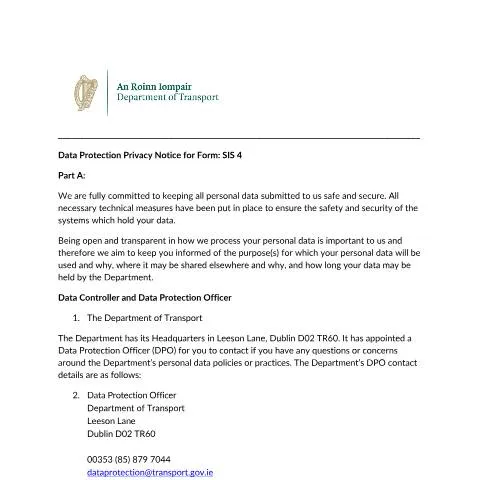
The Data Protection Officer (DPO) plays a crucial role in overseeing data handling practices within the Department. Seafarers with queries regarding the processing of their data can directly contact the DPO at:
- Location: Leeson Lane, Dublin D02 TR60
- Phone: 00353 (85) 879 7044
- Email: [email protected]
Reaching out to the DPO provides an avenue for addressing concerns regarding personal data usage within the context of the SIS 4 notice.
Scope and Purpose of the SIS 4 Privacy Notice
The SIS 4 Privacy Notice is specifically designed for seafarers who are in the process of revalidating their Certificates of Competency or Proficiency. This certificate is essential for individuals operating in marine environments, ensuring they meet international standards for training and safety.
Legal Basis for Data Collection
The legal foundation for collecting personal data under the SIS 4 notice stems from several legislative sources, including:
- The International Convention on Standards of Training, Certification and Watchkeeping for Seafarers (STCW)
- The Merchant Shipping Act, 1894
- The Mercantile Marine Act, 1955
- Additional regulations pertaining to merchant shipping fees
This framework not only legitimizes the data collection process but also sets boundaries for how the information can be utilized.
Your Rights as a Data Subject
As a seafarer submitting personal data through the SIS 4 process, you are entitled to a series of rights designed to protect your information. The notice outlines these rights explicitly, encouraging individuals to take an active role in safeguarding their personal data. These include:
- The right to be informed: You have the right to understand how your data will be used.
- The right of access: You can request access to your personal data held by the Department.
- The right to rectification: You can request corrections to inaccuracies in your data.
- The right to erasure: Under certain conditions, you can request the deletion of your data.
- The right to restrict processing: You can limit how your data is processed under specific circumstances.
- The right to data portability: You can request your data be transferred to another organization.
- The right to object: You can object to the processing of your personal data.
- Rights regarding automated decision-making: You have protections related to decisions made solely by automated means.
Seafarers who feel that their rights have been infringed can lodge a complaint with the Data Protection Commission, the Irish authority that oversees data protection matters.
Data Retention Policies: What You Need to Know
Understanding how long your personal data will be stored is critical in navigating your rights. According to the SIS 4 Privacy Notice, the Department retains personal data only for as long as it is necessary for the purpose for which it was collected. This practice aligns with data minimization principles and ensures that unnecessary data is not retained indefinitely.
Destruction of Data
Once the data is no longer needed, it is marked for destruction, following guidelines provided by the National Archives Office or other statutory requirements. This structured approach helps maintain the integrity of personal data management.
Practical Steps for Seafarers Using the SIS 4 Privacy Notice
For seafarers, effectively utilizing the SIS 4 Privacy Notice involves understanding your obligations and rights throughout the revalidation process. Here’s a step-by-step guide:
- Review the Notice: Before submitting any data, thoroughly read the SIS 4 Privacy Notice. Ensure you understand the purposes for which your data will be used.
- Gather Necessary Information: Compile all required personal information, such as your current Certificates of Competency or Proficiency.
- Contact the DPO if Unsure: If you have any questions or concerns about your personal data, reach out to the Data Protection Officer for clarification.
- Submit Your Data: Complete the necessary forms and submit your data through the proper channels as outlined by the Department.
- Exercise Your Rights: Remember that you have rights concerning your personal data. If at any point you feel your data is mishandled, do not hesitate to exercise these rights.
Interconnections with Other Documents
The SIS 4 Privacy Notice does not exist in isolation; it is part of a broader suite of documentation related to maritime qualifications and data protection. Familiarity with associated documents can enhance understanding and compliance. Key related documents include:
- Application Forms: Any additional application forms related to the revalidation process should be reviewed in conjunction with the SIS 4 document.
- Annual Training Records: Ensure that you keep updated records of training and qualifications that could be relevant to your revalidation.
- Maritime Regulations: Stay informed about broader maritime laws and regulations that may affect your qualifications.
Understanding how these documents interconnect can streamline the revalidation process and enhance your compliance with data protection standards.
The Importance of Transparency and Security
In today’s data-driven landscape, transparency and security are paramount. The SIS 4 Privacy Notice emphasizes the Department’s commitment to safeguarding personal data. Strong technical measures have been implemented to protect data from unauthorized access and breaches. Seafarers can rest assured that their information is in safe hands as long as they are aware of their rights and the procedures to follow.
Technical Safeguards
The Department utilizes various technical safeguards to protect personal data, including:
Fill in your form directly online
No printing: type your details into the boxes of the official form, tick, then download the PDF ready to send.
- 1Type into the form boxes
- 2Tick in one click
- 3Save and download the PDF
- Encryption: Data encryption ensures that personal information is unreadable without the correct decryption key.
- Access Controls: Strict access controls prevent unauthorized personnel from accessing sensitive data.
- Regular Audits: Ongoing audits help identify any vulnerabilities in data handling practices.
Being aware of these safeguards can provide additional reassurance to seafarers concerning the security of their personal information.
Conclusion: Empowering Seafarers Through Knowledge
The SIS 4 Privacy Notice serves as a foundational document for seafarers navigating the complexities of revalidation in line with international standards. With a clear understanding of the notice's content, the legal context, and the rights afforded to individuals, seafarers can engage more confidently in the revalidation process. Knowledge is power; thus, embracing the information outlined in the SIS 4 Privacy Notice can significantly enhance one’s ability to manage personal data effectively within the maritime industry.
Understanding the Privacy Notice: A Crucial Step in Data Protection
In Ireland, the implementation of data protection principles is governed primarily by the General Data Protection Regulation (GDPR) along with the Data Protection Act 2018. The Privacy Notice form, notably the SIS 4 COC COP Revalidation form, serves as an essential tool for organizations to communicate how personal data is utilized, stored, and safeguarded. This form must comply with the transparency obligations set forth by the GDPR, ensuring that data subjects are informed about their rights and the processing of their personal data.
When completing the SIS 4 COC COP Revalidation form, it is crucial to provide clear, concise information that adheres to several key principles outlined in the GDPR:
- Lawfulness, Fairness, and Transparency: Clearly state the legal basis for data processing (e.g., consent, contractual obligation, legal requirement) and ensure that the data subject understands this basis.
- Purpose Limitation: Specify the purpose of processing the data, ensuring it is compatible with how the data was initially collected.
- Data Minimization: Only collect data that is necessary for the specified purpose, avoiding excessive or irrelevant data.
- Accuracy: Maintain accurate data, allowing individuals to rectify any inaccuracies promptly.
- Storage Limitation: Indicate how long the data will be retained and the criteria for determining retention periods.
- Integrity and Confidentiality: Detail the measures taken to ensure the security of personal data against unauthorized access or processing.
Practical Steps for Completing the SIS 4 COC COP Revalidation Form
Completing the SIS 4 COC COP Revalidation form necessitates a comprehensive understanding of the data being processed and a coordinated approach to information management. Below are practical steps to ensure compliance and effectiveness:
- Identify Data Categories: Begin by cataloging the types of personal data your organization processes. This can include names, addresses, emails, and any sensitive data such as health information. Having a clear inventory facilitates accurate completion of the form.
- Assess Data Processing Activities: Evaluate the different processing activities in which personal data is involved. Consider whether this data is being stored, shared, deleted, or processed for analytics. Make sure to align these activities with the purposes listed in the form.
- Consult Stakeholders: Engage with internal stakeholders such as IT, legal, and compliance teams. Their insights can help ensure that the form accurately reflects your organization's data processing practices and complies with legal obligations.
- Document Everything: Maintain detailed records of all completed forms and any correspondence related to the data processing activities. This documentation is vital for demonstrating compliance during audits or regulatory reviews.
- Review and Update Regularly: Data processing practices can evolve; hence, it is essential to review and update the Privacy Notice regularly, especially in response to changes in legislation or organizational policies.
- Training and Awareness: Ensure that all employees involved in data processing are adequately trained on data protection principles and understand the importance of completing the SIS 4 COC COP Revalidation form accurately.
Common Pitfalls in Data Protection Compliance and How to Avoid Them
Understanding the requirements of the SIS 4 COC COP Revalidation form is vital; however, organizations often encounter common pitfalls when navigating data protection compliance. Here are some prevalent issues and strategies to mitigate them:
- Neglecting the Importance of Consent: Failure to obtain proper consent from data subjects can lead to non-compliance. Ensure that consent mechanisms are clear and specific, allowing individuals to easily understand what they are consenting to. Always provide an option to withdraw consent.
- Inconsistent Data Management Practices: Organizations may struggle with inconsistent data management practices across departments. Implementing a standardized approach to data collection and processing, supported by robust policies and procedures, can help maintain consistency and compliance.
- Inadequate Staff Training: Many data breaches occur due to human error, often stemming from a lack of awareness or training regarding data protection principles. Regular training sessions can empower employees to recognize potential data breaches and understand their responsibilities under data protection law.
- Ignoring Data Subject Rights: Under GDPR, data subjects have specific rights, including the right to access, rectify, or erase their data. Organizations must establish clear processes for individuals to exercise these rights and ensure timely responses to requests.
- Failing to Conduct Risk Assessments: Organizations should conduct regular data protection impact assessments (DPIAs) to evaluate risks associated with processing activities. Identifying potential risks early can lead to more informed decision-making regarding data handling practices.
- Improper Documentation: Keeping clear records of data processing activities is often overlooked. Organizations must maintain detailed documentation to demonstrate compliance and support accountability. Utilizing templates and checklists can aid in ensuring thorough documentation.