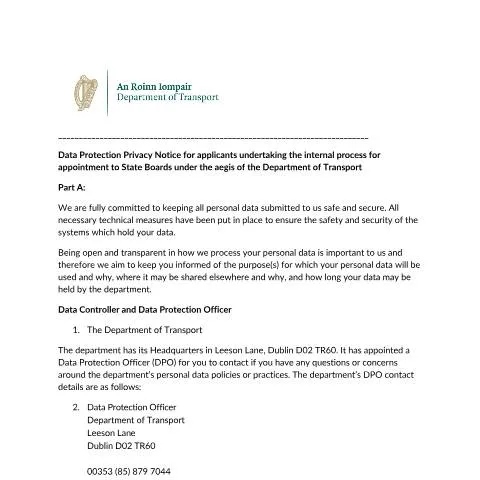
Navigating the Data Protection Privacy Notice for Appointment Applicants
In the realm of public service appointments, understanding the intricacies of data protection is paramount. The Data Protection Privacy Notice provided by the Department of Transport is a vital document for those undertaking the internal process for appointment to State Boards. This notice outlines the procedures, rights, and responsibilities related to personal data collected during this process. Rather than merely a formality, it serves as a comprehensive guide to ensure applicants are informed about how their data is managed, safeguarded, and utilized within the framework of Irish law.
A Deep Dive into the Document’s Core Structure
This privacy notice is divided into two main parts: the commitment to data protection and the specifics concerning the data being collected. Each section plays a critical role in elucidating the department’s policies and practices relevant to applicants.
Part A: Commitment to Data Protection
The first part emphasizes the Department of Transport's unwavering commitment to safeguarding personal data. Here are key highlights:
- Technical Measures: The department ensures that robust technical measures are in place to protect personal data against unauthorized access, loss, or misuse.
- Transparency: The department pledges to maintain transparency about how personal data is processed, including the purpose of data collection and retention periods.
- Data Controller and Officer: The designated Data Protection Officer (DPO) is available for any queries or concerns, indicating a commitment to accountability.
Contacting the Data Protection Officer
The DPO serves as a critical contact point for applicants. For any questions or concerns regarding personal data policies, applicants can reach out via the following:
- Address: Department of Transport, Leeson Lane, Dublin D02 TR60
- Phone: 00353 (85) 879 7044
- Email: [email protected]
Your Rights as a Data Subject
The notice outlines several rights that applicants hold regarding their personal data:
- The right to be informed: Applicants should be aware of how their data will be used.
- The right of access: Individuals can ask for access to their data.
- The right to rectification: Applicants can request corrections to their data.
- The right to erasure: Individuals may seek deletion of their personal data.
- The right to restrict processing: Applicants can limit the processing of their data under certain conditions.
- The right to data portability: Individuals can request the transmission of their data to another controller.
- The right to object: Applicants can challenge the processing of their data.
- Rights in relation to automated decision making: Individuals have rights concerning automated decisions that significantly affect them.
If applicants feel their rights are not being upheld, they have the option to lodge a complaint with the Data Protection Commission—Ireland’s supervisory authority for data protection matters.
The Specifics of Data Collection
Understanding what data is collected and its intended use is crucial for applicants. This section focuses on the nature of the data, its legal basis, and the conditions under which it is processed.
Specific Purposes of Data Collection
The personal data collected during the appointment process serves a particular purpose:
- Development of a Board Member List: The data collected is essential for maintaining a list of appointed Board Members, which is subsequently published on official departmental websites.
Legal Basis for Data Processing
Processing of personal data is grounded in legal frameworks, including:
- Establishing legislation for each agency under the Department of Transport.
- Guidelines from the Department of Public Expenditure concerning appointments to State Boards.
Understanding Data Recipients and Disclosure
An important aspect of the privacy notice is the identification of who may have access to the data collected. This section clarifies the recipients and conditions of data sharing.
Who Receives Your Data?
The personal data gathered may be disclosed to various entities for specific purposes, including:
- The Minister for Public Expenditure, National Development Plan Delivery and Reform.
- The Public Appointments Service, which facilitates recruitment and appointment to boards.
- The New Economy and Recovery Authority (NewERA), providing advisory services related to commercial State bodies.
Data Security Measures
Ensuring the security of personal data is paramount. The department’s State Board Liaison Officer manages the data securely, employing strict access controls and validation measures to protect sensitive information.
Retention and Destruction of Personal Data
Clarity on how long personal data is held and the procedures for destruction constitutes a critical aspect of the notice.
Retention Periods Defined
The Department of Transport retains personal data only as long as necessary for the specific purposes outlined. Key elements include:
- Data is retained in line with business needs.
- Once the data is no longer required, it is marked for destruction following internal guidelines or statutory requirements.
Statutory Obligations for Data Provision
In certain instances, providing personal data may be a statutory obligation. This includes:
- Requirements under relevant legislation governing each agency under the department's aegis.
- Possible consent requirements from the Minister for Public Expenditure.
The Impact of Automated Decision Making
A significant aspect of data privacy within the notice is the reference to automated decision-making processes. Understanding this concept is vital for applicants.
Your Rights in Automated Processes
Applicants have the right to not be subjected to decisions made solely through automated processing when such decisions could significantly affect them. This provision ensures a level of human oversight and accountability in decision-making.
Handling Third-Party Information
An essential consideration in data processes is the handling of information provided by third parties. This transparency is crucial in maintaining trust and accountability.
Implications of Third-Party Data
The notice indicates that if data is collected from third parties, applicants will receive clear communication regarding this data’s nature and purpose, ensuring their rights remain protected throughout the process. This aligns with the overarching principles of data protection and the commitment to transparency.
Practical Steps for Applicants
For individuals navigating the appointment process, understanding how to effectively utilize the information contained within the Data Protection Privacy Notice is essential. Here’s how to approach it:
Step-by-Step Guidance
- Read the Notice Thoroughly: Familiarize yourself with all aspects of the notice, including your rights and the department's commitments.
- Engage with the Data Protection Officer: Should any questions arise, do not hesitate to contact the DPO for clarification.
- Exercise Your Rights: Be proactive in exercising your rights if you feel your data is being mishandled or if you need access to your personal information.
- Follow Up on Data Retention Queries: If you are uncertain about how long your data will be retained or the destruction process, ask for explicit details from the department.
By following these practical steps, applicants can ensure they are well-informed and equipped to handle their personal data securely throughout the appointment process.
Conclusion: Empowering Applicants Through Knowledge
The Data Protection Privacy Notice is not merely a bureaucratic requirement; it is an empowering document designed to equip applicants with the necessary knowledge to navigate the complexities of data protection effectively. By understanding its contents, applicants can advocate for their rights, assure their data’s safety, and engage confidently in the process of seeking appointment to State Boards under the Department of Transport.
Fill in your form directly online
No printing: type your details into the boxes of the official form, tick, then download the PDF ready to send.
- 1Type into the form boxes
- 2Tick in one click
- 3Save and download the PDF
Ultimately, the commitment to transparency, coupled with robust data protection policies, reflects a broader understanding of the importance of personal information in the public domain. As such, this notice stands as a testament to the Department of Transport's dedication to safeguarding applicants' rights while facilitating an essential public service.
Understanding Data Protection Rights in Employment Applications
In Ireland, the processing of personal data during employment application processes is primarily governed by the General Data Protection Regulation (GDPR) and the Data Protection Act 2018. Applicants have specific rights that organizations must uphold when handling their personal information. These rights include the right to access, rectify, delete, restrict processing, and object to processing of their personal data.
When applying for a position, it is crucial for applicants to understand their right to access the data held about them. This includes obtaining a copy of their personal data, the purposes for which it is processed, and the recipients of such data. Organizations must provide this information in a clear and concise manner, typically through a privacy notice.
Moreover, applicants have the right to request rectification of inaccurate or incomplete personal data. This is especially relevant as incorrect information can lead to unfair biases in hiring decisions. To exercise this right, applicants should contact the data protection officer (DPO) of the organization directly, detailing the specific inaccuracies and providing any necessary evidence.
The right to erasure, sometimes referred to as the "right to be forgotten," allows applicants to request the deletion of their personal data under certain conditions. If an applicant withdraws their application or if the data is no longer necessary for the purposes for which it was collected, the organization is obliged to delete that data promptly.
It's important to note that applicants should always be aware of their rights and the processes to exercise them. Organizations are legally required to inform applicants of their rights in a transparent manner, which usually will be included in the privacy notice provided during the application process.
What Should Be Included in a Privacy Notice for Job Applications?
A privacy notice serves as a key document that outlines how an organization collects, uses, and protects personal data during the recruitment process. Here are essential elements that should be included in any privacy notice provided to applicants:
- Identity and Contact Details of the Data Controller: The notice should clearly state the name and contact information of the organization responsible for processing the data, including details of the DPO if applicable.
- Purpose of Data Processing: Organizations must specify the reasons for collecting personal data. Common reasons include evaluating qualifications, managing recruitment processes, and ensuring compliance with employment laws.
- Legal Basis for Processing: The GDPR requires organizations to identify the legal basis for processing personal data. For job applications, this may include the need to process data for the performance of a contract or compliance with a legal obligation.
- Types of Personal Data Collected: The privacy notice should detail what types of personal information are being collected, such as contact details, educational background, work history, and references.
- Retention Period: It's essential to inform applicants how long their data will be retained and the criteria for determining this period. For example, data may be retained for a specific timeframe after the recruitment process concludes or in accordance with legal requirements.
- Data Sharing and Transfers: If the organization shares applicants' data with third parties, such as recruitment agencies or regulators, this should be explicitly stated along with details about any international data transfers.
- Rights of the Applicants: As mentioned earlier, applicants must be informed of their rights regarding their personal data, including access, rectification, and deletion rights.
- Complaints Procedure: The privacy notice should include information about how applicants can lodge a complaint regarding data protection issues, typically with the Data Protection Commission (DPC) in Ireland.
By including these components, organizations can ensure compliance with data protection legislation while fostering transparency and trust during the application process.
Best Practices for Implementing Data Protection in Recruitment Processes
To ensure compliance with data protection laws and maintain the privacy of applicants, organizations should adopt best practices throughout their recruitment processes. Here are several recommendations:
- Conduct Data Protection Impact Assessments (DPIAs): Before initiating recruitment processes that involve processing personal data, organizations should conduct DPIAs to identify and mitigate potential risks to applicants' data privacy.
- Limit Data Collection: Organizations should only collect data that is necessary for the recruitment process. Avoid asking for unrelated personal information that does not pertain to the job application.
- Implement Secure Data Storage Solutions: Ensure that personal data is stored securely, both digitally and physically, to prevent unauthorized access. This includes using encryption for digital data and restricting access to only those who require it for legitimate recruitment purposes.
- Provide Training to Recruitment Personnel: All staff involved in the recruitment process should receive training on data protection principles and practices. This includes understanding applicants' rights, data handling procedures, and how to respond to data requests.
- Regularly Review Data Protection Policies: Organizations should regularly review and update their data protection policies and privacy notices to ensure they remain compliant with evolving regulations and best practices.
- Communicate Clearly with Applicants: Transparency is crucial. Clear communication about how personal data will be used, stored, and protected helps build trust with applicants and enhances the overall candidate experience.
By following these best practices, organizations can not only comply with legal requirements but also create a positive impression on potential candidates and foster a culture of respect for personal data rights.