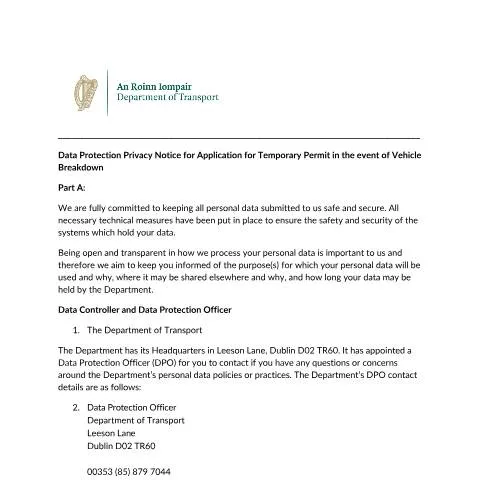
Understanding the Data Protection Privacy Notice for Temporary Permit Applications
When applying for a temporary permit from the Department of Transport due to a vehicle breakdown, it is essential to familiarize yourself with the Data Protection Privacy Notice. This document outlines how your personal data is handled, ensuring transparency and security throughout the process. Understanding this notice not only protects your rights but also enables you to navigate your application more efficiently.
Key Principles of Personal Data Processing
The Department of Transport emphasizes a commitment to keeping all personal data secure and private. Here are critical principles highlighted in the privacy notice:
- Transparency: The Department is open about how your data is processed, including its purpose and sharing practices.
- Data Security: Technical measures are implemented to ensure the safety of systems that hold your data.
- Purpose Limitation: Data collected is used strictly for the specified reasons stated in the notice.
Data Controller and Officer
The Department of Transport serves as the Data Controller, located at:
Department of Transport Leeson Lane Dublin D02 TR60You can reach out to the appointed Data Protection Officer (DPO) for any queries regarding your personal data:
- Phone: 00353 (85) 879 7044
- Email: [email protected]
Your Rights as a Data Subject
As a data subject, you possess several rights concerning your personal data. It is important to know these rights so you can exercise them effectively:
- The right to be informed: You have the right to be informed about how your data is used.
- The right of access: You can request access to your personal data held by the Department.
- The right to rectification: If your data is inaccurate or incomplete, you can request corrections.
- The right to erasure: You can have your data deleted in certain circumstances.
- The right to restrict processing: You can limit how your data is used.
- The right to data portability: You can request your data in a format that allows it to be transferred to another service.
- The right to object: You can object to your data being processed for specific purposes.
- Rights in relation to automated decision making: You have rights concerning decisions made solely by automated processes.
Specific Context of Data Collection
The notice explicitly details the context in which your personal data is collected during the application for a temporary permit:
Purpose of Data Collection
When a holder of a Road Haulage Operator Licence or Road Passenger Transport Operator Licence experiences a vehicle breakdown, they may apply for a temporary replacement vehicle. The data collected serves the specific purpose of processing this application.
Legal Basis for Data Use
The Road Transport Act 1999 provides the legal framework that enables the issuance of temporary permits for replacement vehicles undergoing repairs. This ensures that your application aligns with existing legislation.
Confidentiality and Data Sharing Practices
The privacy notice clarifies that the information regarding temporary replacement vehicles does not get shared outside the Department of Transport. Specifically:
- Registration numbers of temporary vehicles are kept confidential and do not appear in public license registers.
- Data collected will not be transferred outside the EU/EEA or to countries lacking an adequacy agreement.
Retention and Destruction of Personal Data
The retention period for your data is dictated by business need. Here are essential aspects regarding the duration your data may be held:
Retention Guidelines
The Department will retain the data only as long as necessary for the purpose of the application. Once the data is no longer needed, it will be marked for destruction in accordance with:
- Internal guidelines
- Guidelines from the National Archives Office
- Other statutory requirements
Data Provision Requirement
It is crucial to understand that providing the requested data in the application for a temporary permit is a statutory obligation. Failure to provide the necessary information may hinder the issuance of the temporary permit you seek.
Clarifying Automated Decision-Making in Data Processing
One significant aspect highlighted in the privacy notice is the absence of automated decision-making processes. Unlike other instances where algorithms determine outcomes, the processing of personal data for temporary permit applications does not involve automated systems.
Technical Aspects and Data Security Measures
The Department of Transport has taken various technical measures to secure the data collected. Understanding these measures can help users appreciate the protection of their information:
Data Security Measures
- Encryption: Data is encrypted during transmission to prevent unauthorized access.
- Access Controls: Only authorized personnel have access to sensitive data.
- Regular Audits: The Department conducts regular audits to assess data security protocols.
Cookies and Website Security
For those interacting with the Department's website, information regarding cookies used is available on the official website. This technical information aims to inform users about data collection through online interactions and ensure a secure browsing experience.
Understanding the Importance of This Notice in Your Application Process
This privacy notice is not merely legal jargon; it serves as a vital component in your application process. Familiarizing yourself with its content empowers you to:
- Understand your rights and how to exercise them.
- Know what data is collected and for what purpose.
- Ensure that your personal information remains secure and confidential.
- Navigate potential hurdles effectively should issues arise during the application process.
Practical Steps for Applicants
Here are some practical steps to consider while applying for a temporary permit:
- Review the Privacy Notice: Before submitting your application, carefully read the privacy notice to understand how your data will be processed.
- Prepare Your Data: Ensure you have all required information and documents readily available to facilitate a smooth application process.
- Contact the DPO: Should you have any concerns or questions regarding your data, do not hesitate to reach out to the Department's DPO.
- Keep Records: Maintain a record of your application and any communications with the Department for your reference.
Conclusion: Empowering Yourself Through Knowledge
The Data Protection Privacy Notice for Temporary Permit Applications is an essential resource for applicants. By understanding its contents and implications, you can ensure that your application process is straightforward and that your personal data rights are respected. Take the time to read and comprehend the notice—it is your right and your data at stake.
Understanding Your Rights Under Data Protection Legislation
In Ireland, data protection is anchored in both domestic and European law, particularly the General Data Protection Regulation (GDPR) and the Data Protection Act 2018. When applying for a temporary permit, it’s vital to understand your rights concerning your personal data. Under these regulations, you have the right to access your data, rectify inaccuracies, erase your information, and restrict its processing. This empowers you to manage how your personal information is used throughout the application process.
As an applicant, you can request to view the personal data held about you by the relevant authorities. This is generally done through a Subject Access Request (SAR), where you specify the information you wish to access. The authorities have a maximum of one month to respond to your request. It is advisable to keep copies of all correspondence related to your SAR.
Rectification is another important right; if you identify inaccuracies in your personal data, you can request corrections. The process usually involves notifying the department where you submitted your application, such as the Department of Justice, along with proof of the correct information you wish to provide. It’s advisable to follow up on this request to ensure your data is updated accordingly.
The right to erasure, commonly known as the "right to be forgotten," allows you to request the deletion of your personal data under certain circumstances. If your application for the temporary permit is denied or if you withdraw your application, you may want to exercise this right. However, be aware that certain data may need to be retained for legal compliance purposes. Always inquire about what specific data can be deleted and how.
Fill in your form directly online
No printing: type your details into the boxes of the official form, tick, then download the PDF ready to send.
- 1Type into the form boxes
- 2Tick in one click
- 3Save and download the PDF
Understanding these rights and actively exercising them can enhance your experience and trust in the administrative processes surrounding your temporary permit application.
Data Protection Impact Assessments (DPIAs) and Your Application
When processing applications for temporary permits, the relevant authorities, such as the Department of Justice, must conduct Data Protection Impact Assessments (DPIAs). DPIAs are essential when the processing is likely to result in a high risk to the rights and freedoms of individuals. For instance, if the application involves sensitive personal data, a DPIA is mandatory.
A DPIA assesses the potential risks associated with handling personal data and helps to identify measures to mitigate these risks. As an applicant, you may not be directly involved in this assessment, but understanding its significance can provide insights into the protections around your data. DPIAs ensure that your data is processed securely and responsibly, aligning with the principles outlined in GDPR.
Should you feel that your rights are at risk or that appropriate measures have not been taken, you can raise your concerns with the relevant authority. They are required to take your feedback into account and may need to revisit their data processing measures if your concerns substantiate a high risk of data breach or misuse.
It is also worth noting that if you are applying for a temporary permit under a specific category, such as employment or residency, any DPIAs conducted can affect the urgency and processing times of your application. Being informed allows you to manage your expectations and make proactive inquiries about the status of your application.
How to Report a Data Breach
If you believe that your personal data has been mishandled during the temporary permit application process, it is crucial to know how to report a data breach effectively. According to the GDPR, a data breach occurs when there is an unauthorized access to, loss of, or destruction of personal data.
Firstly, you should contact the relevant authority immediately. For temporary permits, this could be the Department of Justice. Notify them in writing, detailing the nature of the breach, any personal data involved, and the impact you believe it may have on you. Keeping a record of your communication is essential.
In cases where the breach poses a significant risk to your rights and freedoms, the authority is required to inform you without undue delay. This notification should include a description of the breach, including its likely consequences, and the measures taken to address it.
If you are unsatisfied with the response from the relevant authority, or if you believe that your rights are still being violated, you have the option to escalate the matter to the Data Protection Commission (DPC). The DPC acts as an independent authority, overseeing compliance with data protection laws in Ireland. Their role includes investigating complaints, issuing guidance, and imposing fines for breaches, ensuring that entities adhere to compliance obligations.
To file a complaint with the DPC, you will need to provide comprehensive details regarding the breach and any previous communication with the authority involved. The DPC will assess your complaint and determine whether to take further action. Awareness of this process empowers you as an applicant and reinforces your rights regarding data protection.