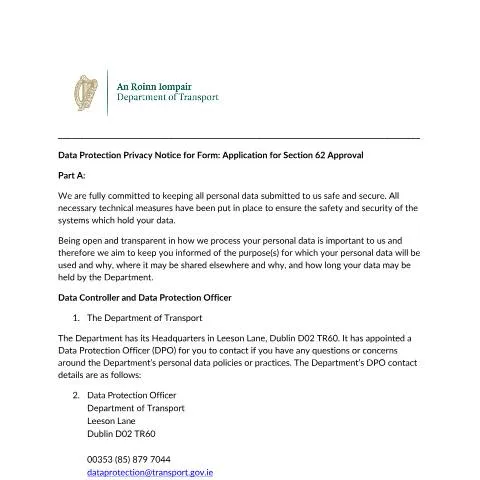
Understanding the Data Protection Privacy Notice for Section 62 Approval Applications
When applying for the Ministerial approval required to transfer ownership of an Irish registered vessel outside the State, it is crucial to understand the Data Protection Privacy Notice provided by the Department of Transport. This document outlines how your personal data will be processed and what rights you have as a data subject. By grasping its contents, applicants can ensure compliance and safeguard their personal information throughout the application process.
Who is the Data Controller and How can You Reach the Data Protection Officer?
The Department of Transport, with its headquarters located at Leeson Lane, Dublin D02 TR60, serves as the data controller for any personal data collected through the Application for Section 62 Approval. Understanding the role of the department is essential for any applicant who wishes to inquire about their data processing policies.
If you have questions or concerns, you can contact the Data Protection Officer (DPO) using the following details:
- Position: Data Protection Officer
- Address: Department of Transport, Leeson Lane, Dublin D02 TR60
- Phone: 00353 (85) 879 7044
- Email: [email protected]
Personal Data Rights: What You Need to Know
As a data subject, you are entitled to several rights concerning your personal data. These rights are essential for ensuring transparency and accountability in data processing. You can exercise these rights by contacting the DPO, as outlined above. The rights available to you include:
- The right to be informed: You have the right to know how your data will be used.
- The right of access: You can request access to your personal data.
- The right to rectification: If your data is inaccurate, you can request corrections.
- The right to erasure: Under certain conditions, you can request that your data be deleted.
- The right to restrict processing: You can request that your data not be used for certain purposes.
- The right to data portability: You can request your data in a structured format for use elsewhere.
- The right to object: You may object to the processing of your data for particular reasons.
- Rights in relation to automated decision-making: You have rights concerning decisions made without human intervention.
If you feel dissatisfied with how your information has been handled, you also have the right to lodge a complaint with the Data Protection Commission, which acts as Ireland’s supervisory authority for data protection.
The Specifics of Data Collection in the Section 62 Approval Application
The Application for Section 62 Approval necessitates the collection of specific personal data, which is essential for the processing of the application according to the Mercantile Marine Act of 1955. Understanding the nature of this data and its intended use is crucial for applicants.
| Data Type | Purpose |
|---|---|
| Owner's Name | To identify the applicant and process the application. |
| Contact Information | To communicate any updates or requests regarding the application. |
| Vessel Details | To provide specifics about the vessel being transferred. |
The specific purpose of collecting data in this context is to ensure compliance with legislative requirements while facilitating the necessary approvals for vessel ownership transfer.
Legal Framework: The Basis for Data Processing
The Mercantile Marine Act of 1955 serves as the legal foundation for data collection and processing in the context of the Section 62 approval applications. It is imperative for applicants to recognize that the provision of personal data is not merely a formality but a statutory obligation. Failing to provide the necessary data may hinder the progress of your application.
Retention Period: Understanding How Long Your Data is Held
Once your personal data is collected, it will only be retained by the Department of Transport for as long as there is a business need to do so, in alignment with the purpose of data collection. Following the operational necessity, your data will be marked for destruction and disposed of according to internal guidelines or regulations provided by the National Archives Office.
This retention policy emphasizes the department's commitment to data minimization and ensures that personal information is not held longer than necessary.
Clarifying Misconceptions: Automated Decision Making in the Approval Process
It is essential to clarify that automated decision-making does not play a role in the processing of your data for the Application for Section 62 Approval. All decisions regarding your application will involve human oversight, reinforcing the department's dedication to fair and transparent processing.
Technical Measures and Security: Keeping Your Data Safe
The Department of Transport places a high priority on the security of personal data. The notice assures applicants that all necessary technical measures are in place to safeguard the systems that hold your data. This commitment to security ensures that personal information is protected against unauthorized access or data breaches.
For additional details on the technical aspects of data security, applicants can visit the official government website, where information regarding cookies and online data protection practices is available.
Conclusion: Engaging with the Data Protection Privacy Notice Effectively
Engaging with the Data Protection Privacy Notice for the Application for Section 62 Approval is crucial for any applicant looking to transfer the ownership of an Irish registered vessel. By understanding your rights, the specifics of data collection, and the legal framework surrounding the application, you can navigate the process with confidence.
Remember, the privacy notice serves not only as a guideline for compliance but also as a resource for protecting your personal data throughout the application process. Should you have further questions or require clarification, do not hesitate to reach out to the Data Protection Officer, who is there to assist you.
Understanding Section 62 Approval in the Context of Data Protection
Section 62 of the Data Protection Act 2018 pertains to the processing of personal data for the purposes of employment and related matters. Organizations must ensure that they comply with the requirements set out in this section when they wish to handle employee information. This approval is critical for any organization, particularly those employing a significant number of staff, as it outlines the legal framework for processing personal data. Section 62 is particularly relevant for businesses that must balance their operational requirements with their employees' rights to privacy.
Fill in your form directly online
No printing: type your details into the boxes of the official form, tick, then download the PDF ready to send.
- 1Type into the form boxes
- 2Tick in one click
- 3Save and download the PDF
Before applying for Section 62 approval, organizations should conduct a thorough assessment of their data processing activities. This includes identifying the types of personal data they handle, the purposes for processing that data, and the legal basis under which the data processing falls. It is also advisable to carry out a Data Protection Impact Assessment (DPIA) to ascertain risks and mitigations associated with data processing activities.
The application process for Section 62 approval involves submitting a detailed privacy notice to the Data Protection Commission (DPC). This notice should clearly outline how personal data will be used, stored, and secured. It is essential that organizations provide sufficient information to employees regarding their rights, including the right to access their data, the right to rectify inaccurate data, and the right to erasure under specific circumstances. Additionally, transparency about data retention periods and the potential sharing of data with third parties is crucial.
Creating an Effective Privacy Notice: Key Components
A well-structured privacy notice is pivotal for compliance with data protection laws and for fostering trust between organizations and their employees. The DPC emphasizes that a privacy notice should be concise, transparent, and easily accessible. Here are the key components that should be included in a privacy notice when applying for Section 62 approval:
- Identity and Contact Information: Clearly state the identity of the data controller, including their contact details and, if applicable, the contact details of the Data Protection Officer (DPO).
- Purpose of Processing: Outline the specific purposes for which personal data will be processed. This should include, for example, recruitment, payroll processing, and performance management.
- Legal Basis for Processing: Specify the legal grounds under which personal data is processed. For employment-related data, this typically includes contractual necessity and compliance with legal obligations.
- Data Retention Periods: Provide details on how long personal data will be retained, and the criteria used for determining retention periods.
- Rights of Data Subjects: Inform employees of their rights under the GDPR, including the right to access, rectify, or erase their personal data, and how they can exercise these rights.
- Data Sharing and Transfers: Disclose any third parties with whom personal data may be shared and whether data will be transferred outside the European Economic Area (EEA).
- Security Measures: Describe the security measures implemented to protect personal data against unauthorized access, accidental loss, or destruction.
Incorporating these elements not only aids in compliance but also enhances the organization’s credibility in handling sensitive employee information.
Monitoring and Review of Data Processing Activities
Once Section 62 approval is granted, it is essential for organizations to establish a monitoring and review process to ensure ongoing compliance with data protection regulations. This involves regularly auditing data processing activities, assessing the effectiveness of security measures, and updating the privacy notice as required. Organizations should also be attentive to changes in the law or guidance from the DPC, as these may necessitate adjustments to data processing practices.
Additionally, organizations should ensure that all employees are trained on data protection principles and the importance of maintaining confidentiality. This can be achieved through regular training sessions, workshops, or e-learning modules that cover data protection obligations, handling of personal data, and reporting procedures for data breaches.
It is also advisable to appoint a data protection manager or DPO responsible for overseeing compliance efforts and acting as a point of contact for employees regarding any data protection queries. This role is crucial in fostering a culture of privacy within the organization and ensuring that data protection becomes an integral part of the organizational processes.