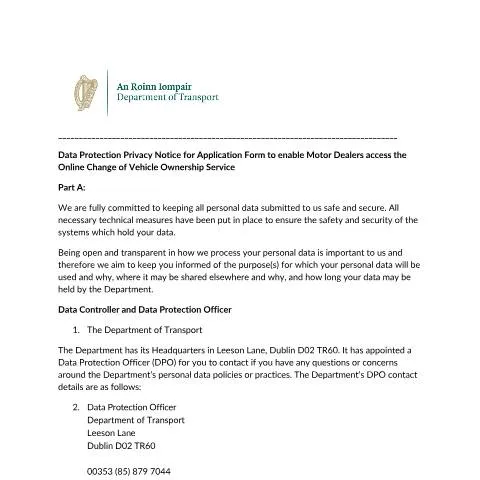
Navigating the Data Protection Landscape: A Guide for Motor Dealers
Understanding the intricacies of data protection is essential for motor dealers applying for access to the Online Change of Vehicle Ownership Service. The privacy notice document from the Department of Transport plays a pivotal role in ensuring that dealers not only comply with regulations but also protect the sensitive information of their clients. This comprehensive guide will walk you through the key elements of the notice, how to effectively utilize it in your applications, and what you need to keep in mind throughout the process.
Understanding the Purpose of the Privacy Notice
The privacy notice provides critical insights into how the Department of Transport handles personal data submitted by motor dealers. It outlines the commitment to data security and transparency, explaining how personal data will be processed, shared, and retained. Knowing the purpose of this notice can help dealers align their operations with legal requirements and foster trust with clients.
Data Security and Integrity
First and foremost, the notice emphasizes the Department's commitment to keeping all submitted personal data secure. This includes implementing necessary technical measures to protect the systems where data is stored. A clear understanding of these security protocols can enhance a dealer's confidence in using the Online Change of Vehicle Ownership Service.
Data Controller and Contact Information
The notice designates the Department of Transport as the data controller, meaning it is responsible for managing how personal data is handled. For any inquiries or concerns regarding personal data policies, the Data Protection Officer (DPO) is the primary contact. Dealers should ensure they are familiar with the DPO’s contact details for any clarifications regarding their data practices.
- Department of Transport: Leeson Lane, Dublin D02 TR60
- Phone: 00353 (85) 879 7044
- Email: [email protected]
Data Subject Rights Explained
As data subjects, individuals have specific rights concerning their personal data. Understanding these rights is crucial for motor dealers, as it helps them navigate their obligations when collecting and processing client information.
Comprehensive Overview of Rights
The privacy notice enumerates the following data rights:
- The right to be informed: Users must be aware of how their data is being treated.
- The right of access: Individuals can request to see their personal data.
- The right to rectification: Users have the right to correct inaccurate data.
- The right to erasure: Individuals can ask for their data to be deleted under certain conditions.
- The right to restrict processing: Users can limit how their data is used.
- The right to data portability: Individuals can request their data in a format that allows it to be transferred to another service.
- The right to object: Users can object to the processing of their personal data.
- Rights related to automated decision-making: Individuals can challenge automated decisions based on their data.
Motor dealers should ensure they have processes in place to facilitate these rights, as failure to comply could lead to significant penalties.
Utilizing the Online Change of Vehicle Ownership Service
The primary aim of the privacy notice is to facilitate motor dealers in applying for access to the Online Change of Vehicle Ownership Service. Understanding how to navigate this system is critical for successful applications.
Step-by-Step Process for Access
- Initial Application: Motor dealers must complete the designated application form to request access to the system.
- Data Submission: Ensure that all personal data submitted adheres to the guidelines outlined in the privacy notice.
- Approval Process: The Department will review the application and data for compliance with legal standards.
- Access Granted: Upon approval, dealers will receive the necessary credentials to access the online service.
- Usage of NVDF: Dealers can then use the National Vehicle and Driver File (NVDF) to notify ownership changes.
Each step in this process is vital to ensure compliance with data protection laws, as well as facilitating a smooth transaction for clients.
Scope and Limitations of the Privacy Notice
While the privacy notice provides extensive information on data processing, it also outlines the limitations of what is covered. Understanding these boundaries can help motor dealers avoid potential pitfalls.
Key Limitations to Acknowledge
- Data Collection Scope: The notice details specific information collected for processing but does not cover data not directly related to the ownership change, such as financial records.
- Retention Period: Data collected will only be held for as long as necessary, after which it will be marked for destruction according to established guidelines.
- Jurisdictional Boundaries: Personal information provided is not transferred outside the EU/EEA, ensuring compliance with European data protection regulations.
By recognizing these limitations, motor dealers can better understand their responsibilities and reduce the risk of non-compliance.
Collaborative Relationships: Understanding Data Sharing
Another critical aspect outlined in the privacy notice is data sharing. The notice explains who may receive data collected through the application form and why this sharing occurs.
Authorized Recipients of Data
According to the notice, personal data may be shared with the following entities:
- Government Bodies: Various departments and agencies that utilize the NVDF data for regulatory and compliance purposes.
- Commercial Services: Other entities providing services that are deemed to be in the public interest.
Motor dealers should ensure that they inform their clients about the potential sharing of their data and clarify the purpose behind it, as this is essential for maintaining transparency and trust.
Connecting the Dots: Related Documentation and Legal Framework
The privacy notice does not exist in isolation; it is part of a broader legal framework defined by various acts and regulations. Familiarity with these legal documents is essential for motor dealers to ensure comprehensive compliance.
Important Legal References
Motor dealers should pay particular attention to the following legal foundations:
- Section 60 of the Finance Act 1993: This section provides the legal basis for the existence and operation of the NVDF.
- Road Vehicles (Registration and Licensing) (Amendment) Regulations 2008: This regulation outlines the procedures for notifying ownership changes online.
Being informed about these regulations helps dealers navigate their responsibilities and ensures adherence to the law when processing personal data.
Real-World Implications and Best Practices
Lastly, understanding the practical implications of the data protection privacy notice can significantly benefit motor dealers. Implementing best practices can enhance compliance and optimize operations.
Best Practices for Handling Personal Data
- Implement Robust Data Protocols: Ensure that all personnel handling personal data are trained on proper procedures and data protection regulations.
- Maintain Transparency with Clients: Clearly communicate data usage policies to clients to foster trust and confidence.
- Regularly Review Data Practices: Periodically assess data handling practices to ensure compliance with the latest laws and regulations.
- Engage with the DPO: Reach out to the Department's Data Protection Officer for guidance on data issues or compliance questions.
By following these best practices, motor dealers can effectively navigate the complexities of data protection in their operations, ensuring compliance while enhancing their service delivery.
Understanding the Importance of Data Protection for Motor Dealers
Data protection is of paramount importance in the automotive industry, particularly for motor dealers who handle sensitive personal information. The EU General Data Protection Regulation (GDPR) provides a robust framework for protecting individuals' privacy rights, and it imposes strict obligations on businesses, including motor dealerships, in how they collect, store, and process personal data. In Ireland, the Data Protection Commission (DPC) oversees compliance with these regulations.
Fill in your form directly online
No printing: type your details into the boxes of the official form, tick, then download the PDF ready to send.
- 1Type into the form boxes
- 2Tick in one click
- 3Save and download the PDF
When completing an application form to enable access to the online change of ownership system, motor dealers must ensure that they are fully compliant with data protection laws. This involves providing clear and concise information to customers about how their data will be used. The privacy notice should outline what personal information is collected, the purpose of collecting this information, who it may be shared with, and how long it will be retained. Failure to adequately protect personal data can result in significant fines and reputational damage.
Motor dealers should also implement robust data protection measures, including staff training on data handling practices, secure storage solutions, and regular audits of data processing activities. This proactive approach not only ensures compliance with GDPR but also helps to build trust with customers, thereby enhancing the dealer's reputation in the marketplace.
Key Components of a Privacy Notice for Motor Dealers
A well-crafted privacy notice is essential for motor dealers who wish to maintain transparency and trust with their clients. The notice should address several key components to meet both legal requirements and customer expectations. Firstly, it should clearly identify the data controller, which in this case would typically be the motor dealership itself, along with contact details or a designated data protection officer (DPO) if applicable.
Secondly, the purpose of data collection must be explicitly stated. For motor dealers, this could include facilitating vehicle registration changes, managing customer inquiries, and improving services offered. Additionally, the notice should elaborate on the legal basis for processing personal data, such as consent or necessity for the performance of a contract.
Another critical component is detailing how long personal data will be retained. Businesses are required to store personal data only for as long as necessary to fulfill the purposes for which it was collected. Therefore, a motor dealer's privacy notice should include information on retention periods and the criteria used to determine them, ensuring compliance with the principle of storage limitation.
Moreover, data subjects should be informed of their rights under GDPR. This includes the right to access their personal data, request rectification, object to processing, and the right to data portability. Providing clear instructions on how customers can exercise these rights enhances transparency and empowers individuals regarding their personal information.
Practical Steps for Implementing Data Protection Practices
Implementing effective data protection practices is vital for motor dealers looking to access sensitive online systems such as the change of ownership portal. Here are some practical steps that can be taken to ensure compliance with data protection regulations:
- Conduct a Data Audit: Identify what personal data is collected, how it is processed, and where it is stored. This audit should cover all aspects of data handling within the dealership.
- Develop a Data Protection Policy: Create a comprehensive policy that outlines the dealership's approach to data protection, including the roles and responsibilities of staff, data handling procedures, and incident response plans.
- Staff Training: Regular training sessions should be conducted to keep staff informed about data protection obligations and best practices. This training should cover topics such as data security, recognizing breaches, and customer rights.
- Implement Technical Measures: Invest in secure systems for storing personal data, including encryption and access controls. Regularly update software and systems to protect against vulnerabilities.
- Establish a Breach Response Plan: Develop a protocol for responding to data breaches, ensuring that all staff are aware of the procedures to follow in the event of a breach.
By taking these steps, motor dealers can not only comply with legal requirements but also foster a culture of data protection within their organization, ultimately benefiting both the business and its customers.