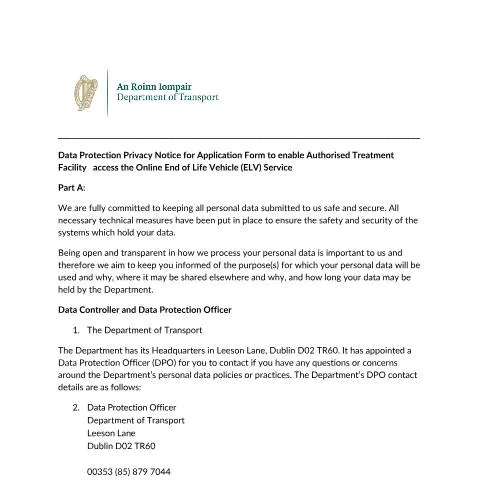
Navigating the Data Protection Landscape in Ireland: A Deep Dive into the Privacy Notice for Authorised Treatment Facility Access
When engaging with the Irish Department of Transport's processes, especially in relation to end-of-life vehicles, understanding the Data Protection Privacy Notice is crucial. This document not only outlines how personal data is handled but also emphasizes the importance of compliance with data protection legislation. This guide will unpack the intricacies of the privacy notice, assisting stakeholders in comprehending their rights and obligations while navigating this essential process.
Understanding the Core Purpose of the Privacy Notice
The Significance of the Privacy Notice
The privacy notice serves as a vital communication tool, ensuring transparency regarding the handling of personal data collected through the application form for Authorised Treatment Facilities (ATFs). It elucidates the purposes for which personal data is processed, the legal framework underpinning these actions, and the rights afforded to individuals. The overarching aim is to foster trust between the Department of Transport and the entities, including ATFs, engaged in the online End of Life Vehicle (ELV) service.
Scope of Data Collection
The data collected comprises information pertinent to the operation of the ELV service, specifically to enable ATFs to notify the National Vehicle and Driver File (NVDF) of vehicle destructions. Understanding the scope of this data is pivotal for ATFs to ensure compliance and protect the personal information they handle.
Decoding the Legal Framework: Why It Matters
Key Legislation Governing Data Protection
Brazil's privacy notice is steeped in legal obligations stemming from various acts, most notably:
- Section 60 of the Finance Act 1993: This act normalizes the NVDF database and mandates the notification of vehicle end-of-life instances.
- The Waste Management (End-of-Life Vehicles) Regulations 2006: This regulation specifically obligates ATFs to notify the Department regarding vehicle destructions.
Understanding these legal underpinnings is essential for ATFs, ensuring they fulfill their statutory obligations while protecting the data of the vehicle owners they serve.
The Role of the Data Controller
The Department of Transport is the data controller responsible for managing personal data. Contact details for the Data Protection Officer (DPO) are explicitly provided, establishing a clear channel for inquiries and concerns regarding data handling practices. This transparency bolsters confidence in the Department’s commitment to data protection.
Your Rights as a Data Subject: An Essential Guide
Empowerment through Data Subject Rights
As an individual whose data is processed, you are endowed with several rights, including:
- The right to be informed: You have the right to be made aware of how your personal data is being used and for what purposes.
- The right of access: You can request access to your personal data held by the Department.
- The right to rectification: If your data is incorrect, you have the right to have it corrected.
- The right to erasure: You can ask for your data to be deleted under certain conditions.
- The right to restrict processing: You can request that the processing of your data be limited.
- The right to data portability: You can request to receive your data in a structured, commonly used format.
- The right to object: You can object to the processing of your data in certain circumstances.
- Rights in relation to automated decision making: You have rights concerning decisions made solely by automated processes.
Awareness and understanding of these rights empower individuals, allowing them to take proactive steps in managing their personal data.
Data Retention and Destruction: What You Should Know
The Lifespan of Your Data
The privacy notice explicitly states that personal data will only be retained as long as necessary in line with business needs. This ensures a focused approach to data management, minimizing risks associated with unnecessary data retention.
Destruction Protocols
Once the data is no longer needed, the Department follows rigorous internal guidelines for destruction, ensuring compliance with statutory requirements. This is crucial for protecting individuals' privacy and adhering to best practices in data governance.
Engaging with the Process: A Step-by-Step Approach
Starting the Application Process
For ATFs looking to access the Online ELV service, commencing the application process involves several key steps:
- Review the Privacy Notice: Familiarize yourself with the details outlined in the privacy notice to understand your responsibilities.
- Prepare Necessary Documentation: Ensure all required documentation is in order before initiating the application.
- Submit Application: Follow the protocol for submitting your application as specified by the Department.
- Maintain Data Security: Ensure that any personal data collected during the process is stored securely, in compliance with data protection standards.
This structured approach not only facilitates compliance but also ensures that all parties involved are aware of their roles and responsibilities throughout the application process.
Limitations and Exclusions: What the Notice Doesn’t Cover
Understanding the Boundaries
While the privacy notice provides extensive information, it is essential to acknowledge its limitations. For instance, the notice does not cover situations outside the scope of the ELV application process. If you are looking to engage with other services or departments, additional privacy notices may apply.
Non-Applicability of Third-Party Information
The privacy notice specifies that information from third parties is not applicable in this context, emphasizing the focus on direct data provided by the data subjects themselves. This distinction clarifies the expectations for ATFs regarding data handling.
The Essential Role of the Data Protection Officer
Contacting the DPO: A Resource for Clarity
The Data Protection Officer serves as a key resource for any queries relating to the privacy notice. Engaging with the DPO can enhance understanding and compliance, ensuring that any concerns regarding data processing are adequately addressed. Contact details have been clearly outlined, reinforcing the Department’s commitment to transparency.
The DPO can assist with specific questions such as:
- Clarification of data processing procedures
- Guidance on exercising data subject rights
- Support regarding data security measures
Final Thoughts: Engaging Responsibly with Data Protection
As Ireland strides forward in a data-driven world, the emphasis on robust data protection practices becomes increasingly paramount. For ATFs and other stakeholders engaged in the ELV service, the Data Protection Privacy Notice is not merely a compliance document but a framework for responsible data stewardship. Understanding this notice is essential for navigating the complexities of data protection and ensuring that personal information is handled with the utmost care and respect.
In a landscape where data privacy concerns loom large, adhering to the principles laid out within the privacy notice equips ATFs with the knowledge needed to operate responsibly, maintain compliance, and ultimately, protect the rights of individuals in Ireland.
Understanding Data Protection in Ireland
Data protection in Ireland is governed primarily by the General Data Protection Regulation (GDPR) alongside the Data Protection Act 2018. These regulations ensure that individuals' personal data is processed lawfully, transparently, and for specified purposes. In the context of applying for access to an authorised treatment facility, it is crucial to understand how your data will be managed, your rights regarding this data, and the measures in place to protect it.
When you submit your application form, you may provide various types of personal information, including your name, contact details, PPSN (Personal Public Service Number), and possibly health information. The law requires that this data is collected only for legitimate purposes, such as assessing eligibility for access to treatment facilities. Furthermore, it must be kept secure and not retained for longer than necessary.
Your application will typically involve a statement outlining the legal basis for data processing, which could be based on consent, contractual necessity, or compliance with a legal obligation. It is essential to read through this privacy notice carefully, as it outlines your rights to access your data, rectify inaccuracies, and request erasure under certain conditions.
Additionally, Ireland's Data Protection Commission (DPC) plays a pivotal role in overseeing data protection compliance. Should you feel any aspect of your data has been mishandled, you have the right to lodge a complaint with the DPC, making them a key agency in ensuring accountability for data processors.
Fill in your form directly online
No printing: type your details into the boxes of the official form, tick, then download the PDF ready to send.
- 1Type into the form boxes
- 2Tick in one click
- 3Save and download the PDF
Role of Privacy Notices in Data Handling
A privacy notice is a critical document that provides individuals with information about how their personal data is collected, used, and protected. In the case of an application form to enable access to an authorised treatment facility, this notice is not only a legal requirement but also a cornerstone of ethical data handling.
When you receive a privacy notice, it should include several key elements: the identity of the data controller (typically the organisation managing the treatment facility), the purposes of processing, the lawful basis for processing, recipients of the data, retention periods, and information on individuals' rights regarding their data. For example, you should expect to see details on how to exercise your rights to access and rectify your data or how to lodge a complaint if you believe your data is being processed unlawfully.
It is also common for privacy notices to explain the measures taken to secure your data. This could involve encryption protocols, access controls, and staff training on data protection. This transparency is vital for building trust between individuals and the organisations they interact with, as it reassures applicants that their sensitive information will be handled responsibly.
In the context of healthcare, privacy notices may also touch upon the sharing of data with other health service providers or entities involved in your treatment. It is essential to understand who will have access to your data and under what circumstances, especially considering the sensitive nature of medical information.
Finally, remember that a well-crafted privacy notice empowers individuals. It not only informs you of your rights but also encourages proactive engagement with organisations, enabling you to take control of your personal information.
Implications of Data Breaches and Reporting Procedures
A data breach occurs when there is an unauthorised access, disclosure, alteration, or destruction of personal data. Under GDPR, organisations are obligated to report certain types of data breaches to the Data Protection Commission and, in some cases, to the affected individuals.
When applying for access to an authorised treatment facility, understanding the implications of data breaches is essential. If your personal data is compromised, it could lead to identity theft, financial loss, or reputational damage, particularly in sensitive contexts such as health information.
In the event of a breach, the data controller must inform the DPC within 72 hours if the breach is likely to result in a risk to individuals' rights and freedoms. Additionally, if there is a high risk posed to your rights, you must be informed without undue delay. Such notifications are vital, as they allow you to take necessary steps to protect yourself, such as monitoring your personal accounts for unusual activity.
Organisations are also required to have incident response plans in place, detailing how they will manage a data breach, including containment, assessment, notification, and remediation. This proactive approach not only mitigates potential damage but also demonstrates a commitment to data protection principles.
If you suspect that your data has been compromised while applying to access an authorised treatment facility, it is advisable to act quickly. Contact the facility to inquire about the breach, and consider reporting the incident to the DPC. Being informed and vigilant about your rights and the procedures in place will empower you to respond effectively in the event of a data breach.