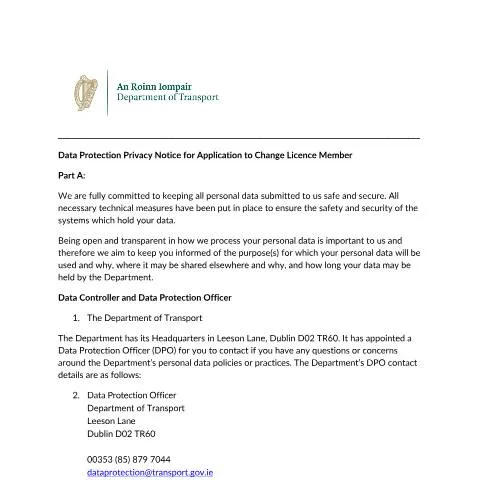
Understanding the Data Protection Privacy Notice for Changing Licence Members
The Data Protection Privacy Notice provided by the Department of Transport is a critical document for individuals involved with Road Haulage Operator Licences or Road Passenger Transport Operator Licences. Whether you are a director, secretary, or a member of the management committee, understanding this notice is vital to ensure compliance with data protection regulations.
Who Needs This Notice and When
Primarily, this privacy notice is tailored for individuals involved in the administration of a Road Haulage Operator Licence or Road Passenger Transport Operator Licence. If you are changing a director, secretary, or committee member associated with these licences, this notice becomes essential.
- Directors and Secretaries: If you are responsible for the management of a transport operation, you must be aware of your data rights and obligations when applying for membership changes.
- Management Committees: Changes in committee membership necessitate adherence to the protocols outlined in the notice to protect personal data.
The Purpose of Collecting Personal Data
When you submit an application to change licence members, the Department of Transport collects specific personal data. This data is utilized to verify and process the changes regarding the licence members efficiently.
- Processing Applications: The information is examined by the Road Transport Operator Licensing Unit to ensure compliance with legal requirements.
- Legal Obligations: Under Section 8(1) of the Road Transport Act 2011, operators must notify the Minister of any changes within one month.
The Rights of Data Subjects in Ireland
As a data subject, your rights concerning the personal data you provide are protected under the data protection legislation in force. The notice provides clarity on these rights:
- The Right to be Informed: You have the right to know how your data will be used.
- The Right of Access: You can request access to your personal information held by the Department.
- The Right to Rectification: If your data is inaccurate, you can ask for it to be corrected.
- The Right to Erasure: You may request the deletion of your personal data under certain conditions.
- The Right to Restrict Processing: You can limit the processing of your data.
- The Right to Data Portability: When applicable, you can transfer your data to another service provider.
- The Right to Object: You can object to the processing of your data at any time.
- Rights Related to Automated Decision Making: Your data will not be subject to automated decision-making processes.
Sharing and Retention of Your Personal Data
One of the key aspects of this privacy notice is the information regarding data sharing and retention:
Information Sharing
Your personal data regarding licence changes is not shared outside the Department of Transport. This is critical to ensure that your information remains confidential and secure.
Retention Period
The department retains your personal data only for as long as necessary for business needs related to the specific purposes of data collection. After the retention period, data will be marked for destruction according to internal guidelines or statutory requirements.
How to Navigate the Privacy Notice
To effectively utilize the privacy notice when applying for a change of licence member, follow these steps:
- Review Your Data Rights: Familiarize yourself with your rights as outlined in the document.
- Understand the Information Collected: Know what data the Department will collect and why.
- Contact the Data Protection Officer: If you have questions or concerns, reach out using the provided contact details.
Specific Information for Application to Change Licence Member
The notice describes the specific data processed during your application:
| Data Type | Purpose | Legal Basis |
|---|---|---|
| Personal Details | To facilitate the processing of licence changes | Road Transport Act 2011 |
| Management Roles | To verify the legitimacy of the changes made | Legal obligation to notify the Minister |
Exceptions and Limitations
While the privacy notice is comprehensive, there are areas where it may not cover all scenarios:
- No Automated Decision Making: The department clarifies that automated decision-making processes are not employed in the treatment of your data.
- Third-Party Information: The collection of personal data from third parties is not applicable in this context.
It is crucial to understand that while the Department is committed to protecting your data, compliance with legal obligations means that certain data must be provided as required.
Contacting the Data Protection Officer
For any queries related to the privacy notice or your data, you may contact the Data Protection Officer at:
Department of Transport Leeson Lane Dublin D02 TR60 Tel: 00353 (85) 879 7044 Email: [email protected]
This contact point is vital for addressing any concerns you may have regarding your personal data rights and the handling of your information.
Final Thoughts on Data Protection in Transport Licensing
As the transport sector in Ireland continues to evolve, adherence to data protection standards is paramount. The Data Protection Privacy Notice provides essential guidance for individuals involved in transport licensing. Understanding how to navigate this document not only ensures compliance with legal obligations but also safeguards your personal information in a landscape where data security is increasingly critical. Remember to remain informed and proactive about your data rights as you engage with the necessary processes.
Understanding Your Rights Under Data Protection Legislation
In Ireland, the Data Protection Act 2018, which implements the General Data Protection Regulation (GDPR), outlines the rights of individuals when it comes to their personal data. When you apply for a change of licence member application, it is essential to be aware of these rights as they directly pertain to how your information is handled.
Firstly, you have the right to access your personal data. This means you can request information about what data is being processed, why it is being processed, and who it is being shared with. To exercise this right, you may submit a Subject Access Request (SAR) to the relevant authority, which, for licensing purposes, typically could be a professional body or regulatory authority governing your specific field.
Secondly, you have the right to rectification. If your application contains any errors or if your personal data changes (for example, a change of address or name), you can request that the authority corrects this information. It is advisable to provide supporting documentation to expedite this process.
Moreover, you have the right to erasure, often referred to as the "right to be forgotten." Under certain conditions, you can request that your personal data be deleted, particularly if you no longer need the data for the purposes for which it was collected or if you withdraw your consent for processing. However, this right is not absolute; certain legal obligations may require retention of some personal data.
Lastly, you have the right to object to the processing of your personal data in certain circumstances. If you believe that your data is being processed unlawfully or beyond its intended purpose, you can lodge an objection. The authority must then assess your request and inform you of their decision.
Understanding these rights is crucial for ensuring your data protection when engaging with licensing authorities, and it empowers you to take action if you believe your rights are infringed upon.
Key Considerations for Data Minimization in Licensing Applications
Data minimization is a fundamental principle of the GDPR, which mandates that only data necessary for the purposes of processing should be collected and maintained. In the context of a change of licence member application, this principle plays a critical role in how organizations manage applicants' data.
When completing your application, consider what information is truly essential for processing. For instance, while personal details such as your name, contact information, and PPSN are necessary, supplementary data that does not contribute to the licensing decision or verification should be avoided. This includes excessive information about your educational history or employment that may not be relevant to the licensing requirements.
Moreover, applicants should be conscious of providing information that could lead to discrimination or bias. For example, demographic details such as age, gender, or marital status might not be pertinent to the licensing authority's decision-making process. Limiting the amount of sensitive personal data shared not only complies with data protection laws but also reduces the risk of breaches and enhances your privacy.
Licensing bodies are also responsible for adhering to data minimization principles. They must ensure that their application forms do not ask for unnecessary information and that their data collection practices align with this principle. Regular audits of data practices can help ensure compliance with GDPR requirements and foster a culture of data protection within the organization.
Fill in your form directly online
No printing: type your details into the boxes of the official form, tick, then download the PDF ready to send.
- 1Type into the form boxes
- 2Tick in one click
- 3Save and download the PDF
In summary, by prioritizing data minimization in your change of licence member application, you protect your information and contribute to a more efficient data processing environment.
The Role of Privacy Notices in Data Protection Compliance
Privacy notices are a critical component of data protection compliance. They inform individuals about how their personal data will be processed, and they must be provided at the time of data collection. When applying for a change of licence member application, understanding the role of privacy notices can help you ascertain your data rights and the responsibilities of the collecting authority.
A comprehensive privacy notice will typically include several key pieces of information:
Identity of the Data Controller: This section identifies the organization responsible for processing your data and provides contact information should you have queries or concerns regarding your data.
Purpose of Data Processing: The notice should clearly outline why your data is being collected and how it will be used in the context of your application for a change of licence membership. It should detail whether your data will be used for assessments, verifications, or other related processes.
Legal Basis for Processing: Under GDPR, organizations must indicate the legal basis for processing your personal data. This could be based on your consent, the necessity for contractual obligations, or compliance with legal obligations.
Data Retention Period: The notice should inform you of how long your data will be retained and the criteria used to determine this period. It should also clarify the circumstances under which your data may be deleted.
Data Sharing: If your data is to be shared with third parties, the privacy notice must specify who these parties are and why the data will be shared. This is crucial for maintaining transparency and trust in the data handling process.
Your Rights: Finally, the privacy notice must inform you of your rights concerning your personal data, as discussed earlier in this article. This will empower you to take control of your data and exercise your rights effectively.
As an applicant, reviewing the privacy notice before submitting your application is vital. It ensures that you are fully aware of how your data will be treated and reassures you that the licensing authority is committed to protecting your privacy in compliance with relevant legislation.
In conclusion, being well-informed about data protection practices can significantly enhance your experience during the licensing application process, ensuring that your rights are upheld and your personal data is handled with the utmost care and responsibility.