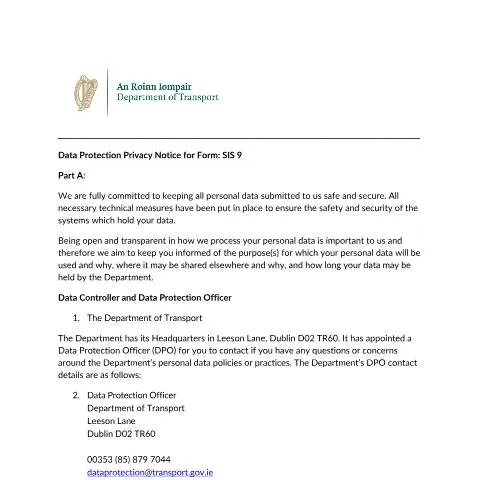
Understanding the SIS 9 Certificate of Competency Privacy Notice
The SIS 9 Privacy Notice serves as a crucial guide for seafarers applying for their Certificate of Competency through the Department of Transport in Ireland. Navigating through maritime regulations and personal data responsibilities can often feel overwhelming. Therefore, being well-informed about this notice not only clarifies your rights but also ensures you make the most out of the process while safeguarding your personal information.
The Importance of Data Protection in Maritime Qualifications
As global standards for seafarers’ education and training become more stringent, understanding the significance of data protection in this context is essential. The SIS 9 form is inherently tied to compliance with the International Convention on Standards of Training, Certification and Watchkeeping for Seafarers (STCW), and the Merchant Shipping Act, 1894. Adhering to these standards means that the information you provide is not simply for administrative purposes; it plays a significant role in ensuring maritime safety and professionalism.
Why Data Protection Matters
- Safeguarding Your Information: The Department of Transport has committed to implementing necessary technical measures to ensure the security of personal data.
- Transparency: Understanding how your data will be used, shared, and stored helps to build trust between you and the authorities.
- Legal Compliance: Awareness of data processing legality ensures that your rights are protected under the Data Protection legislation.
Who Can Benefit from the SIS 9 Certificate?
The SIS 9 Certificate of Competency is primarily targeted towards individuals seeking to work on commercial vessels as part of the maritime industry. This includes not only seafarers at the beginning of their careers but also those who may need to renew or upgrade their certifications. Recognizing the diverse roles within the maritime sector is essential; therefore, understanding who this certificate applies to clarifies your specific obligations and requirements.
Categories of Applicants
- New Applicants: Individuals who have completed training and are seeking their first certification.
- Experienced Seafarers: Those who are looking to renew their certificates or expand their competency in different areas.
- International Candidates: Non-Irish applicants who require certification compliant with international maritime standards.
- Compliance Officers: Individuals responsible for ensuring that crew members adhere to certification requirements.
Key Data Protection Principles
To fully grasp the implications of the SIS 9 Privacy Notice, it is essential to understand the key data protection principles outlined by the Department of Transport. These principles not only govern how your data is handled but also elucidate your rights as a data subject.
Your Rights as a Data Subject
- The Right to Be Informed: You have the right to know how your information will be used and processed.
- The Right of Access: You can request a copy of the data held about you by the Department.
- The Right to Rectification: If any of your data is incorrect or incomplete, you can request that it be updated.
- The Right to Erasure: In certain circumstances, you may request that your personal data be deleted.
- The Right to Restrict Processing: You can ask for your data to only be processed for specific purposes.
- The Right to Data Portability: You have the right to move your data from one service provider to another.
- The Right to Object: You can object to the processing of your data in certain situations.
- Rights in Relation to Automated Decision Making: Understand your rights concerning any automated processes that may affect you.
Procedure for Engaging with the SIS 9 Privacy Notice
Understanding how to effectively engage with the SIS 9 privacy notice can significantly streamline the application process for your Certificate of Competency. Below, we outline a step-by-step procedure designed to ensure smooth navigation through the requirements.
Step-by-Step Engagement
- Review the Privacy Notice: Familiarize yourself with the details contained within the SIS 9 privacy notice. Knowing the required data and your rights will prepare you for what’s ahead.
- Prepare Your Personal Information: Ensure all your personal data is up-to-date and compliant with the requirements as outlined in the notice.
- Gather Supporting Documentation: Collect any necessary documents that may be required during the application process, such as training certificates or proof of identity.
- Submit Your Application: Follow the guidelines for submitting your SIS 9 form to ensure all required data is included.
- Follow Up: Keep in contact with the Data Protection Officer if you have queries or concerns about your application or data.
Data Retention Policies Under SIS 9
Understanding how long your personal data will be retained is crucial for maintaining your privacy. The Department of Transport has established clear guidelines on data retention that are essential to grasp.
Retention Periods Explained
| Data Purpose | Retention Duration | Guidelines for Destruction |
|---|---|---|
| Processing SIS 9 Applications | As long as necessary for the purpose of processing your application | Marked for destruction once the business need has passed, in accordance with internal guidelines. |
| Legal Requirements | As mandated by relevant legislation | Destruction in line with statutory requirements and guidelines from the National Archives Office. |
Understanding the Legal Framework Behind Data Collection
To grasp the full implications of the SIS 9 Privacy Notice, one must appreciate the legal framework that governs data collection within the maritime sector. This landscape is primarily shaped by international conventions and national legislation.
Relevant Legal Instruments
- International Convention on STCW: This convention sets the global standards for training, certification, and watchkeeping for seafarers.
- Merchant Shipping Act, 1894: This act lays the groundwork for the regulation of maritime affairs in Ireland.
- Mercantile Marine Act, 1955: This act governs matters related to merchant shipping and ensures compliance with international standards.
- Merchant Shipping (Fees) Order, 2010: This establishes the fees associated with various maritime applications.
Final Thoughts on Data Compliance and Maritime Safety
Engagement with the SIS 9 Privacy Notice extends beyond compliance; it is about contributing to a safer maritime industry. By understanding your rights as a data subject and the legal framework that governs data handling, you play a vital role in enhancing transparency and accountability within the sector. As you embark on your journey towards obtaining your Certificate of Competency, remember that protecting your personal information is equally important as gaining the qualifications to work safely at sea.
Understanding the Privacy Notice Requirements for SIS 9 Certificates of Competency
The SIS 9 certificate of competency is a crucial document for professionals operating in regulated sectors in Ireland, particularly in the field of health and safety. With the implementation of the General Data Protection Regulation (GDPR), organisations must ensure that they provide comprehensive privacy notices whenever they collect personal data. This obligation is applicable to the process of issuing SIS 9 certificates as well.
When applying for a SIS 9 certificate, applicants must be informed about the types of personal data collected, the purpose of data processing, and the lawful basis for processing their information. A privacy notice should outline how the applicant's data will be used, who it will be shared with, and how long it will be retained. Failure to provide this notice can result in significant non-compliance issues.
Furthermore, organisations are required to keep the privacy notice clear and concise, avoiding legal jargon that may confuse applicants. This fosters transparency and builds trust between the individuals and the issuing body. The notice must also include the rights of individuals regarding their personal data, such as the right to access, rectify, and erase their data, as well as the right to lodge a complaint with the Data Protection Commission (DPC).
For organisations issuing SIS 9 certificates, it is prudent to review and update privacy notices regularly to ensure compliance with any changes in legislation or procedural updates.
Best Practices for Data Minimisation in SIS 9 Certification Process
Data minimisation is a key principle under GDPR, which means that only the necessary personal data required for processing should be collected. This concept is particularly relevant in the context of obtaining a SIS 9 certificate of competency. Applicants may worry about the extent of data collected during this process, and organisations must take steps to alleviate these concerns.
To practice data minimisation, organisations should assess their data collection processes and only gather information that is directly relevant to the certification requirements. For example, while personal identification details and qualification records are essential, it may not be necessary to collect extensive background information that does not pertain to the applicant's competency.
Fill in your form directly online
No printing: type your details into the boxes of the official form, tick, then download the PDF ready to send.
- 1Type into the form boxes
- 2Tick in one click
- 3Save and download the PDF
In addition, organisations should implement measures such as pseudonymisation or anonymisation where feasible, especially if certain data points are not needed for the evaluation of competency. This reduces the risk of personal data breaches and aligns with best practices for data security.
Moreover, organisations should regularly conduct audits of their data collection practices to evaluate whether they are adhering to the principle of data minimisation effectively. Training staff members on the importance of collecting only necessary data can further reinforce this principle throughout the organisation.
The Role of Data Protection Officers in the SIS 9 Certification Process
A Data Protection Officer (DPO) plays a pivotal role in ensuring compliance with data protection laws during the SIS 9 certification process. Under GDPR, certain organisations are required to appoint a DPO, especially those that engage in large scale processing of sensitive personal data or regular and systematic monitoring of individuals.
The DPO's responsibilities include advising on data protection obligations, monitoring compliance, and acting as a point of contact for data subjects and the Data Protection Commission. In the context of SIS 9 certificates, the DPO should be involved in the drafting and reviewing of privacy notices, ensuring they meet legal standards.
Furthermore, the DPO can provide valuable guidance on risk assessments related to data processing activities and help implement data protection policies that safeguard applicants' personal information during the certification process. This not only ensures compliance but also enhances public confidence in the integrity of the certification system.
Having a knowledgeable DPO can also assist in addressing any data subject rights requests effectively, such as requests for access or rectification of personal data, ensuring a smooth and lawful handling of such inquiries.