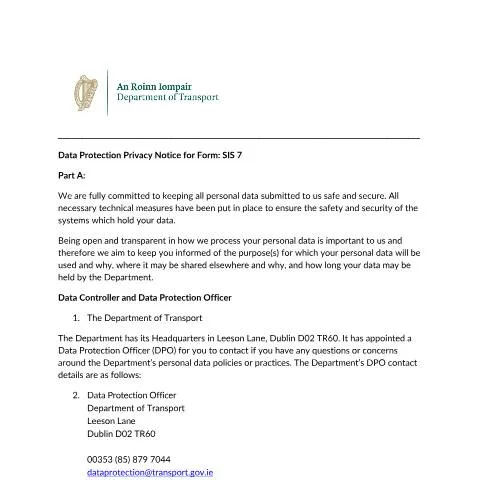
Understanding the Importance of the SIS 7 Privacy Notice
The Data Protection Privacy Notice for the SIS 7 form, issued by the Department of Transport, plays a critical role in safeguarding personal information. This notice is particularly relevant for individuals applying for a Ship’s Cook Certificate or a Certificate of Equivalent Qualification, aligning with international maritime regulations. Given the sensitive nature of personal data, understanding the contents and implications of this notice is essential for applicants.
Who Should Refer to the SIS 7 Privacy Notice?
This privacy notice is indispensable for:
- Seafarers applying for certification as ship's cooks.
- Employers in the maritime sector who facilitate the application process for their employees.
- Training institutions that assist seafarers in obtaining necessary qualifications.
Failure to comprehend the intricacies of this notice may lead to complications in the application process or misunderstandings regarding data handling practices. Therefore, it's advisable for all stakeholders involved in maritime certification to familiarize themselves with this essential document.
Key Components and Scope of the SIS 7 Privacy Notice
The SIS 7 Privacy Notice encompasses several key elements regarding personal data handling:
- Data Controller: The Department of Transport is responsible for managing the data collected through the SIS 7 form.
- Data Protection Officer: An appointed DPO is available for inquiries about the department's data protection policies and practices. The contact details are clearly provided within the notice.
- Purpose of Data Collection: Personal data is collected specifically for processing applications for the Ship’s Cook Certificate as mandated by relevant maritime legislation.
- Legal Basis: The collection and processing of personal data are backed by the International Convention on Standards of Training, Certification, and Watchkeeping for Seafarers (STCW) and other pertinent legislative frameworks.
This framework ensures that personal data is processed fairly and transparently, aligning with both national and international standards. Such clarity helps individuals understand how their data will be treated throughout the application process.
Understanding Your Rights as a Data Subject
As outlined in the privacy notice, individuals who provide personal information have specific rights that can be exercised. These are crucial to ensuring that applicants maintain control over their data:
- The Right to be Informed: Applicants have the right to know how their data will be utilized.
- The Right of Access: Individuals can request to see the information held about them.
- The Right to Rectification: If any data is incorrect, applicants can request corrections.
- The Right to Erasure: Under certain conditions, individuals can request their data be deleted.
- The Right to Restrict Processing: Applicants can ask to limit the use of their data under certain circumstances.
- The Right to Data Portability: Individuals can request their data in a structured, commonly used format for transfer to another service.
- The Right to Object: Applicants can object to the processing of their data under specific conditions.
- Rights in Relation to Automated Decision-Making: This ensures transparency when decisions are made based on algorithms.
These rights serve as a safeguard for applicants, ensuring that their personal data is handled with the highest level of care and respect. Contacting the Data Protection Officer is a straightforward way to exercise these rights if needed.
Interplay with Other Documents and Procedures
The SIS 7 Privacy Notice does not operate in isolation; it interacts with other documentation related to maritime certification:
- Ship’s Cook Certificate Application Form: This is the primary document that requires the SIS 7 Privacy Notice to inform applicants of their rights and the handling of their data.
- Regulatory Compliance Documents: Additional guidelines stemming from the STCW and Merchant Shipping legislations also come into play.
- National Archives Guidelines: Documents related to the retention and destruction of personal data must comply with these regulations.
When preparing an application, it's wise to consult these related documents, ensuring that all requirements are met and that the applicant is fully aware of their rights and obligations within the process.
Practical Steps for Navigating the SIS 7 Process
Understanding the procedure associated with the SIS 7 form can help streamline the application process. Here’s a step-by-step guide:
- Gather Necessary Information: Ensure you have all required personal data ready before starting the application.
- Review the SIS 7 Privacy Notice: Familiarize yourself with your rights and how your data will be used.
- Complete the SIS 7 Application Form: Fill out the application accurately, ensuring all details are correct to avoid processing delays.
- Submit Your Application: Follow the instructions for submission, ensuring that you have met all legislative requirements.
- Contact the Data Protection Officer if Needed: For any queries regarding your data rights or the process, reach out to the DPO.
By following these steps, applicants can ensure a more efficient application process while also safeguarding their personal information.
Common Misinterpretations and Clarifications
Despite having a structured approach, misunderstandings can arise regarding the SIS 7 Privacy Notice. Here are a few common misinterpretations:
Fill in your form directly online
No printing: type your details into the boxes of the official form, tick, then download the PDF ready to send.
- 1Type into the form boxes
- 2Tick in one click
- 3Save and download the PDF
- Data Sharing: Some may assume that providing personal data will automatically lead to it being shared externally. The notice clarifies that data will only be used internally within the Department of Transport.
- Retention Period Misunderstandings: Applicants might think their data is stored indefinitely. In reality, data retention is strictly governed by business needs and statutory obligations.
- Obligation to Provide Data: While personal data is required for processing the SIS 7 application, individuals may not realize that failing to provide the necessary information can halt their application process.
These clarifications are essential for ensuring that applicants approach the process with the right mindset and understanding of their responsibilities.
Technical Information and Security Measures
The security of personal data is a top priority as highlighted in the SIS 7 Privacy Notice. The Department of Transport ensures that:
- Data Security Measures: Robust technical measures are in place to safeguard all personal data submitted.
- Internal Access Controls: Data is only accessible to authorized personnel within the department to prevent unauthorized access.
- No External Transfers: Ensures that personal information provided in the SIS 7 form is not transferred outside the EU/EEA.
Applicants can take comfort in the stringent measures taken to protect their data, reinforcing the integrity of the application process. For further specifics regarding technical safeguards, the notice points to additional resources available on the Department's website.
Final Thoughts on the SIS 7 Data Protection Privacy Notice
Navigating the SIS 7 application process requires a firm understanding of the associated privacy notice. Being aware of your rights, the scope of data usage, and the interplay with other documents can empower applicants to approach the maritime certification process with confidence. It's crucial to engage with the Data Protection Officer for any clarifications or concerns, ensuring that all aspects of data protection are fully understood. This proactive approach not only facilitates a smoother application process but also fosters a culture of transparency and trust within the maritime community.