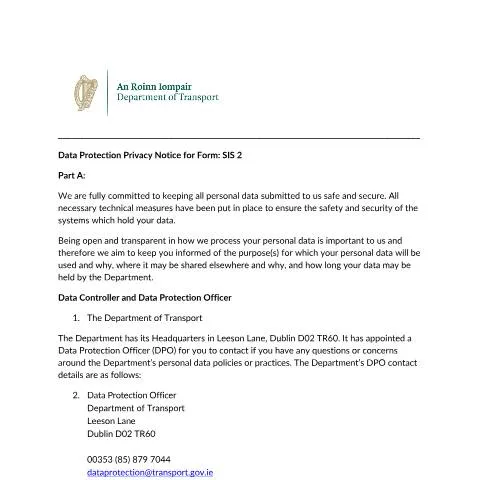
Navigating the Data Protection Privacy Notice: SIS 2 Explained
In an age where personal data security is paramount, understanding the implications and applications of the Data Protection Privacy Notice for Form SIS 2 is crucial. This notice acts as a guide for seafarers who are applying to replace a lost, stolen, or destroyed Certificate of Competency or Proficiency. By delving deeper into this document, individuals can ensure that their rights are protected while fulfilling their obligations under relevant maritime laws.
The Purpose Behind the Notice: Understanding Your Rights
At its core, the SIS 2 privacy notice is designed to maintain transparency in how the Department of Transport processes personal data. Here are the key elements you should be aware of:
- Data Controller: The Department of Transport holds the responsibility of ensuring that your data is secure. It has a dedicated Data Protection Officer (DPO) who can be contacted for any inquiries concerning data usage.
- Data Subject Rights: As someone providing personal data, you possess several rights which include:
- The right to be informed
- The right of access
- The right to rectification
- The right to erasure
- The right to restrict processing
- The right to data portability
- The right to object
- Rights related to automated decision-making and profiling
What Data is Collected and Why It Matters
Form SIS 2 requires specific data to facilitate the processing of applications for the replacement of certificates as mandated by the International Convention on Standards of Training, Certification, and Watchkeeping for Seafarers (STCW). The importance of this data cannot be overstated, as it is essential for maintaining the integrity of maritime operations.
- Legal Basis: The collection of personal data for SIS 2 is supported by several legal frameworks such as the Merchant Shipping Act 1894 and related regulations. This ensures that the data collection process adheres to statutory obligations.
- Scope of Data: The information collected is solely for internal departmental use and is not shared outside the EU/EEA, ensuring a high standard of data protection.
The Significance of Data Retention Policies
Data retention is a critical aspect of the SIS 2 process. The Department of Transport only retains personal information for as long as it is necessary to fulfill the purpose for which it was collected. Once this purpose is achieved, the data is marked for destruction according to internal guidelines. Understanding this timeline can help applicants know what to expect after submitting their forms.
| Retention Period | Action Taken |
|---|---|
| Duration of business need | Data is retained until no longer necessary |
| End of retention period | Data marked for destruction |
Demystifying Automated Decision-Making
For those concerned about how their data may affect decision-making processes, it is essential to note that the SIS 2 privacy notice clarifies that automated decision-making is not utilized in the processing of personal data submitted through this form. This means that applications are assessed based on human judgment rather than algorithms, ensuring a more personalized approach to each case.
Common Scenarios Necessitating Form SIS 2
Certain circumstances may prompt a seafarer to seek the replacement of their Certificate of Competency or Proficiency. Here are some of the most common scenarios:
- Loss of Certificate: Certificates can be lost in various ways, such as during travel or due to unforeseen circumstances.
- Theft: Unfortunately, theft can occur, and if a certificate is stolen, it's imperative for the individual to apply for a replacement immediately.
- Damage: Certificates can become damaged over time, which may render them unusable or unrecognizable.
Practical Steps for Using the Privacy Notice
Understanding how to leverage the information within the SIS 2 privacy notice can greatly enhance your experience with the application process. Here are the practical steps to follow:
- Review the privacy notice thoroughly to comprehend your rights.
- Gather the necessary personal data and documents required for the application.
- Reach out to the DPO if you have any questions or need clarification on data usage.
- Complete Form SIS 2 and ensure that all data is accurate.
- Submit your application and retain a copy of the submitted data for your records.
Understanding the Role of the Data Protection Officer
The Data Protection Officer (DPO) plays a vital role in ensuring that your personal data is managed according to legal and ethical standards. If you have concerns regarding how your data is processed, the DPO can guide you through your rights and responsibilities:
- Contact Information: The DPO can be reached via phone at 00353 (85) 879 7044 or through email at [email protected].
- Support for Data Subjects: Should you feel your rights are being infringed upon, the DPO can assist you in addressing these issues effectively.
Understanding the SIS 2 Replacement Form: Key Components
The SIS 2 Replacement Form is crucial for businesses and organizations that handle personal data in Ireland. It serves as a privacy notice that informs individuals about how their data is processed, stored, and protected. Understanding the key components of this form is essential for compliance with the General Data Protection Regulation (GDPR) and the Data Protection Act 2018.
Firstly, the form must clearly identify the data controller, which is the entity responsible for determining the purposes and means of processing personal data. This includes providing the contact details of the data controller, along with any relevant data protection officer (DPO) information. It is critical to ensure that this information is easily accessible and transparent to individuals, fostering trust and accountability.
Secondly, the privacy notice must outline the legal basis for data processing. Under GDPR, there are several lawful bases for processing personal data, including consent, contractual necessity, legal obligation, vital interests, public task, and legitimate interests. Organizations must explicitly state which basis applies to their data processing activities and, where applicable, provide information on how individuals can withdraw consent or object to processing.
Another important aspect of the SIS 2 Replacement Form is detailing the rights of individuals in relation to their personal data. This includes the right to access their data, the right to rectify inaccurate data, the right to erasure (also known as the 'right to be forgotten'), the right to restrict processing, the right to data portability, and the right to object to processing. Organizations must clearly inform individuals about these rights and provide guidance on how to exercise them.
Lastly, it is essential to outline the retention period for personal data. Organizations are required to retain personal data only for as long as necessary to fulfill the purposes for which it was collected. The privacy notice should provide specific time frames or criteria used to determine the retention period, ensuring that individuals are informed about how long their data will be held.
Best Practices for Implementing Privacy Notices in Ireland
Implementing an effective privacy notice is not just about compliance; it is about building a culture of transparency and trust with your customers and clients. Here are some best practices for developing and deploying privacy notices in Ireland:
1. Tailored Communication: Ensure that your privacy notice is tailored to your specific audience. Avoid overly technical jargon that may confuse individuals. Instead, use plain language that is easy to understand, making it accessible to all demographics.
2. Visual Aids: Consider using visual aids such as infographics or flowcharts to illustrate your data processing activities. Visual representations can simplify complex information and make it more engaging for users. This approach can be particularly beneficial for organizations handling vast amounts of data processing activities.
3. Regular Updates: Data protection laws evolve, and so do organizational practices. Regularly reviewing and updating your privacy notice is essential to reflect any changes in your data processing activities or legal obligations. It is advisable to set a schedule for periodic reviews, which may be annually or bi-annually, ensuring that you remain compliant and transparent.
4. Training for Staff: Ensure that all employees, especially those handling personal data, are trained on the importance of data protection and the specifics of your privacy notice. Staff should be able to explain the privacy notice to customers and respond to any questions or concerns effectively.
Fill in your form directly online
No printing: type your details into the boxes of the official form, tick, then download the PDF ready to send.
- 1Type into the form boxes
- 2Tick in one click
- 3Save and download the PDF
5. User Feedback: Encourage and facilitate feedback on your privacy notice. By soliciting feedback from individuals regarding the clarity and comprehensiveness of your privacy notice, you can identify areas for improvement and enhance user satisfaction.
6. Accessibility: Ensure that your privacy notice is easily accessible on your website or in other communication channels. It should be easy for individuals to find, whether it's linked in your email signatures, prominently displayed on your website, or included in any documentation provided during data collection.
Addressing Common Misconceptions about Data Protection in Ireland
Many organizations struggle with misconceptions regarding data protection, which can lead to compliance issues and mistrust from consumers. Here are some common misconceptions and the truths behind them:
1. "If we don't collect sensitive data, GDPR doesn't apply to us." This is incorrect. GDPR applies to all organizations that handle personal data, which is defined broadly to include any information that relates to an identifiable person. Therefore, even if your organization does not collect sensitive data (such as health information), you must still comply with GDPR provisions.
2. "We can delete data whenever we want." While organizations do have the right to delete data, they must adhere to the legal obligations surrounding data retention. Data must not be retained longer than necessary, and organizations must have a clear policy detailing retention periods and the criteria for deletion. Failure to comply could lead to legal consequences under GDPR.
3. "We only need to inform customers about data collection once." This is a misconception. GDPR requires ongoing transparency. Organizations must keep individuals informed of any changes to their data processing activities, including updates to privacy notices. This ensures that individuals are aware of how their data is handled over time.
4. "Data protection is solely the responsibility of the DPO." While the Data Protection Officer plays a crucial role in ensuring compliance, data protection is a shared responsibility across the organization. All staff members must understand their role in protecting personal data and promoting a culture of privacy and security.
5. "Anonymized data is not subject to data protection laws." This is not entirely true. While fully anonymized data (which cannot be traced back to an individual) is outside the scope of GDPR, pseudonymized data (which can still be linked to an individual with additional information) remains subject to data protection regulations. Organizations must ensure they understand the distinction to remain compliant.