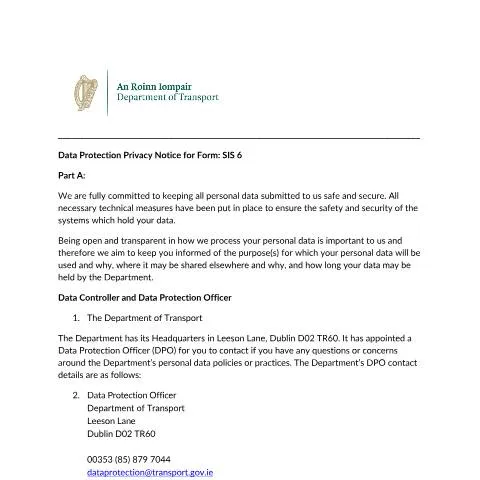
Understanding the Data Protection Privacy Notice of Form SIS 6
The Data Protection Privacy Notice for Form SIS 6 serves as an essential resource for individuals navigating the often complex waters of data handling within the context of maritime qualifications in Ireland. It outlines the Department of Transport's commitment to safeguarding personal information, ensuring that individuals are aware of their rights and responsibilities regarding their data.
The Essence of Data Protection in Maritime Contexts
In maritime industries, where seafarers frequently need to prove their competencies, the SIS 6 form plays a pivotal role. This privacy notice explains how personal data, essential for applying for a Certificate of Equivalent Competency, is collected and processed. To utilize this document effectively, one must grasp key principles of data protection, which include:
- Transparency: The Department strives to be clear about how personal data will be processed.
- Purpose Limitation: Data collected should only be used for the specified reasons outlined.
- Data Minimization: Only data necessary for the intended purpose will be processed.
Scope and Application of Form SIS 6
The SIS 6 privacy notice delineates the boundaries within which the Department of Transport operates concerning personal data. Understanding these limits is crucial for applicants. Here’s what the notice explicitly covers:
- Purpose of Data Collection: Information collected through SIS 6 is vital for evaluating qualifications against international maritime standards.
- Legal Framework: The processing of data is guided by both national laws and international agreements, notably the International Convention on Standards of Training, Certification and Watchkeeping for Seafarers (STCW).
- Data Retention Policy: Personal data will only be held as long as necessary, thereafter subject to stringent destruction guidelines.
Limits and Exclusions
While the SIS 6 privacy notice provides extensive details, it is equally important to recognize what it does not cover. For instance, it does not elaborate on actions taken if an applicant chooses not to provide the required information. Furthermore, the notice emphasizes that data will not be shared externally unless explicitly stated, ensuring that personal information remains protected within the Department’s systems.
Navigating the Application Process with Form SIS 6
To effectively utilize the SIS 6 privacy notice, applicants should follow a structured approach when applying for the Certificate of Equivalent Competency. This includes:
- Gather Necessary Documents: Collect all required personal data and supporting documents that demonstrate your qualifications.
- Understand Legal Obligations: Knowledge of the Merchant Shipping Act and its relevant sections will empower applicants to comprehend their rights and obligations.
- Submit With Confidence: Ensure that the application is complete and accurate, as incomplete submissions may lead to delays or rejections.
Processing Timeline and Key Milestones
| Step | Description | Expected Timeframe |
|---|---|---|
| Application Submission | Submission of Form SIS 6 along with all required documents. | Immediate |
| Data Processing | Review and verification of personal data. | Up to 30 days |
| Issuance of Certificate | Delivery of the Certificate of Equivalent Competency. | Varies by application volume |
Common Pitfalls and Misinterpretations
Despite the clarity of the SIS 6 privacy notice, applicants can still encounter misunderstandings that may hinder their applications. Here are a few common misinterpretations:
- Assuming All Data is Optional: The notice clearly states that providing certain data is a statutory obligation. Failure to provide this information can lead to application denial.
- Overlooking Rights as Data Subjects: Applicants must be aware of their rights and actively engage with the Data Protection Officer if they have concerns.
- Confusing Internal and External Data Use: Many applicants mistakenly believe their data could be shared outside the Department. The notice explicitly states that this is not the case unless otherwise indicated.
Rights and Protections Under the Data Protection Framework
The SIS 6 privacy notice elucidates several rights that individuals possess concerning their personal data. Understanding these rights is crucial for effective advocacy and protection:
- The Right to be Informed: Applicants should always know how their data will be used.
- The Right of Access: Individuals have the right to access their personal data held by the Department.
- The Right to Erasure: Under certain circumstances, individuals can request the deletion of their data.
To assert these rights, contacting the Data Protection Officer is essential. The officer's contact details, included in the notice, provide a direct line for inquiries.
Who Benefits from Form SIS 6 and When is it Crucial?
The SIS 6 privacy notice is particularly relevant for seafarers and maritime professionals seeking to validate their competencies. Several scenarios illustrate when this notice becomes indispensable:
- Applying for New Certifications: Seafarers needing to establish their qualifications must reference SIS 6 to understand the data handling processes involved.
- Updating Records: Maritime professionals who have changes in their qualifications must ensure they adhere to the notice when resubmitting personal data.
- Resolving Data Disputes: If there are concerns over how data has been handled, the notice provides vital information for pursuing grievances.
Intersections with Other Official Documents
The SIS 6 notice does not exist in isolation; it intersects with various other regulatory frameworks and documents governing maritime practices in Ireland. Understanding these connections enables applicants to navigate more effectively:
- Merchant Shipping (Fees) Regulations: Compliance with these regulations is integral when completing SIS 6, as fees may apply.
- Other Certification Forms: Various forms exist for different levels of competencies, and understanding their relationship with SIS 6 can clarify the overall application landscape.
- Data Protection Legislation: This notice ties into broader EU data protection rules, ensuring that applicants are aware of their data rights in a European context.
As seafarers embark on their journey towards obtaining the Certificate of Equivalent Competency, understanding and leveraging the SIS 6 privacy notice is not merely beneficial—it's essential. With a clear grasp of the implications, rights, and responsibilities that accompany the submission of personal data, applicants can navigate the maritime certification process with confidence and assurance.
Understanding Data Protection within the Context of SIS 6 Certificate Applications
When applying for the SIS 6 Certificate of Equivalent Competency, applicants should be aware of the implications of data protection laws in Ireland, particularly the General Data Protection Regulation (GDPR) and the Data Protection Acts 1988 to 2018. These regulations govern how personal data is collected, stored, and processed by various entities, including educational institutions and certifying bodies.
The SIS 6 Certificate application process requires the submission of personal information, which necessitates a clear understanding of how this data will be used. Applicants must ensure that the issuing authority provides a comprehensive privacy notice that outlines the purposes for data collection, the legal basis for processing, and the retention period for the data. This privacy notice should also inform applicants of their rights regarding their personal information, including the right to access, rectify, or erase their data.
It is crucial for applicants to carefully read the privacy notice before submitting their application. Understanding what data is being shared and how it will be managed is key to maintaining individual privacy rights under Irish law. Additionally, any overseas qualifications presented alongside the SIS 6 application may also involve data protection considerations, especially when dealing with international education bodies.
Fill in your form directly online
No printing: type your details into the boxes of the official form, tick, then download the PDF ready to send.
- 1Type into the form boxes
- 2Tick in one click
- 3Save and download the PDF
Practical Steps for Ensuring Compliance with Data Protection Requirements
As part of the application process for the SIS 6 Certificate of Equivalent Competency, it's important for applicants to take proactive steps to ensure compliance with data protection requirements. Here are some practical recommendations:
- Review Privacy Notices: Before providing any personal information, make it a priority to review the privacy notices of the relevant certifying body. Ensure that the notice includes details on how your data will be handled, who will have access to it, and how long it will be retained.
- Request Clarifications: If there are aspects of the privacy notice that are unclear, don’t hesitate to reach out to the certifying authority for clarification. Transparency is a key principle of data protection, and you have the right to seek additional information.
- Maintain Copies of Submitted Documents: Always keep copies of documents submitted as part of your application. This not only helps in maintaining a record of your application but also is useful should you need to exercise your rights regarding your personal data later.
- Verify Third-Party Involvement: If your application involves third parties, such as educational institutions or other certifying agencies, ensure that they also comply with data protection laws. They should provide their own privacy notices and adhere to the same standards of data handling.
By following these steps, applicants can contribute to safeguarding their personal data throughout the SIS 6 Certificate application process while ensuring compliance with Irish data protection regulations.
The Intersection of Data Protection and Employment Verification
For many applicants, the SIS 6 Certificate of Equivalent Competency may also be linked to employment opportunities within Ireland. Understanding how data protection intersects with employment verification processes is crucial for both job seekers and employers.
Employers often require verification of qualifications as part of their recruitment process. This means that personal information submitted during the SIS 6 application could potentially be accessed by future employers seeking to confirm an applicant's credentials. In light of this, it is essential for applicants to be aware of how their data may be used beyond the scope of the certificate application.
Employers must also adhere to data protection regulations when verifying qualifications. This includes obtaining consent from the candidate before accessing their personal data. Job seekers should be proactive in understanding what information employers are entitled to request and what constitutes an appropriate level of verification. This can include:
- Limiting the Scope of Verification: Employers should only collect information that is relevant to the position for which they are hiring. Unnecessary data collection may breach data protection principles.
- Ensuring Secure Data Handling: Employers must have adequate security measures in place to protect personal data during the verification process. This includes encrypting sensitive information and limiting access to authorized personnel only.
- Educating Job Seekers: As an applicant, it is beneficial to ask potential employers about their data handling practices. This includes how they will store and process your personal data, and their policies for data retention and deletion after the recruitment process concludes.
By understanding the intersection of data protection and employment verification, applicants can better navigate the complexities of their personal data rights while pursuing career opportunities in Ireland.