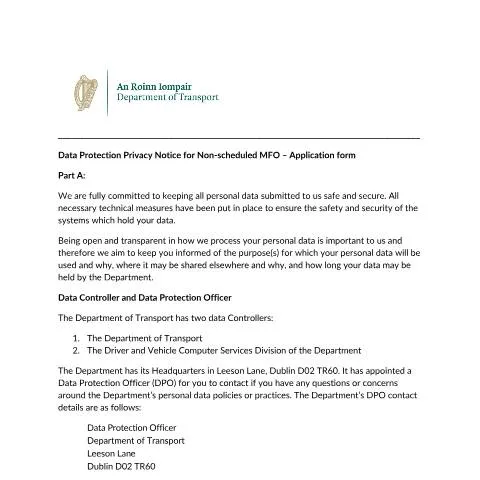
Navigating the Data Protection Privacy Notice for Non-Scheduled MFO Applications
When engaging with the Department of Transport regarding non-scheduled flights, understanding the accompanying Data Protection Privacy Notice is crucial. This document provides essential insights into how personal information is processed, ensuring that individuals remain informed about their data rights and the handling of their personal data.
Understanding the Document's Scope and Purpose
The privacy notice specifically pertains to the application process for non-scheduled MFO (Multi-Flight Operations) and is vital for all stakeholders involved, including third country air operators. It outlines the legal framework within which personal data will be collected and processed, ensuring transparency and accountability on behalf of the Department.
This document serves to clarify:
- What personal data is collected
- The legal basis for data collection
- How long data will be retained
- Who may access this data
Key Information on Data Collection
The notice specifies that personal data collected includes:
- Name of the data subject
- Job title
- Direct business contact number
- Business email address
- Business address
This data is essential for processing applications and generating the necessary documentation for the air operator representatives.
The Role of the Data Protection Officer
Every organization is required to have a Data Protection Officer (DPO) to oversee data processing activities. In this context, the Department of Transport has designated a DPO to address any inquiries or concerns related to personal data management. This DPO plays a crucial role in safeguarding personal data and ensuring compliance with the relevant data protection legislation.
Contact details for the DPO are as follows:
Data Protection Officer Department of Transport Leeson Lane, Dublin, D02 TR60 00353 (85) 879 7044 [email protected]
Understanding Your Rights as a Data Subject
As per the notice, individuals whose data is collected have specific rights under the prevailing data protection laws. These rights include:
- The right to be informed: Clarity on how your data is being used.
- The right of access: Ability to request your personal data held by the Department.
- The right to rectification: Right to correct inaccurate or incomplete data.
- The right to erasure: Right to request deletion of your personal data under certain circumstances.
- The right to restrict processing: Ability to limit how your data is used.
- The right to data portability: Right to transfer your data to another organization.
- The right to object: Ability to refuse processing of your personal data.
- Rights in relation to automated decision-making: Safeguards against decisions based solely on automated processes.
Exercising these rights involves direct communication with the DPO, ensuring that queries and requests are handled promptly and effectively.
Legal Framework Governing Data Processing
The collection and processing of personal data as outlined in the privacy notice is governed by the Air Navigation and Transport Act, 1965 and associated statutory instruments. This legal framework establishes the mandate for the Department to collect necessary data to fulfil its regulatory responsibilities.
Understanding this legal basis is important for stakeholders, as it delineates the authority under which personal data is managed, ensuring compliance with national and EU regulations.
Retention of Personal Data
Data retention policies are significant components of data management practices. The privacy notice specifies that personal data collected will be retained in accordance with the National Archives Act, 1986. Ultimately, such data may be transferred to the National Archives, where it becomes publicly accessible. This process is essential for maintaining transparency and accountability while ensuring historical data integrity.
Understanding the retention period helps applicants gauge how long their data will remain within the operational scope of the Department and informs them about the potential for public access in the future.
Data Sharing and Disclosure
While the Department retains internal control over personal data, situations may arise where information may be shared with other governmental bodies and agencies under its remit. This practice aligns with the principles of public service transparency and efficiency.
It is pertinent to highlight that all such sharing is governed by data protection regulations, and personal data will only be disclosed in accordance with established laws, ensuring that individuals’ rights remain protected. Notably, data may also be subject to freedom of information requests, which necessitates careful consideration during data management.
Guidelines for Data Subjects Regarding Information Requests
Should individuals wish to understand how their data may be used or wish to restrict its disclosure, they are encouraged to engage directly with the DPO. Such interactions are critical, especially in light of the shared responsibilities between various governmental organizations.
Automated Decision-Making: An Absence of Risk
It is essential to note that the processing of personal data in the context of the MFO application does not involve automated decision-making. This assurance alleviates concerns related to biases or errors that can stem from automated algorithms. Stakeholders can thus approach the application process with confidence, knowing that human oversight remains a pivotal component in the decision-making process.
Technical Considerations Regarding Data Protection
In today’s digital landscape, understanding technical measures related to data protection is essential. The Department implements necessary technical safeguards to protect personal data within its systems. This commitment ensures the security and integrity of data against unauthorized access or breaches.
For individuals interested in the technical details regarding the cookies used on the Department's website, a dedicated page provides comprehensive information. Familiarizing oneself with this technical aspect can enhance overall trust in how effectively personal data is safeguarded.
Final Important Notes for Applicants
Engaging with the Department of Transport regarding non-scheduled MFO applications entails a responsibility for applicants to be mindful of the significance of their personal data. Understanding the implications of providing this data is crucial, as the right to access and manage personal data empowers individuals within the application process.
Should there be any concerns or dissatisfaction regarding the handling of data, individuals possess the right to lodge a complaint with the Data Protection Commission, Ireland’s supervisory authority tasked with overseeing data protection matters. This step fortifies the overarching framework that ensures individual rights are upheld and respected.
In summary, the Data Protection Privacy Notice for Non-Scheduled MFO Applications serves as a comprehensive guide, elucidating critical aspects of how personal data is handled during the MFO application process. All stakeholders are encouraged to engage proactively with this notice, ensuring a smooth and transparent interaction with the Department of Transport.
Understanding the Data Protection Framework in Ireland
Data protection in Ireland is largely governed by the General Data Protection Regulation (GDPR) and the Data Protection Acts 1988 to 2018. These regulations establish the rights of individuals regarding their personal data and outline the obligations of organizations that process such data.
Fill in your form directly online
No printing: type your details into the boxes of the official form, tick, then download the PDF ready to send.
- 1Type into the form boxes
- 2Tick in one click
- 3Save and download the PDF
Under GDPR, individuals have several rights, ranging from the right to access their data, the right to rectification, to the right to erasure, also known as the "right to be forgotten." This regulation emphasizes transparency, requiring organizations to provide clear and detailed privacy notices, such as the one associated with the non-scheduled flights MFO application form.
The privacy notice must inform applicants about how their personal data will be used, the legal basis for processing, the retention period for the data, and the rights of the data subjects. It is essential for organizations to ensure that their privacy notices are user-friendly, avoiding legal jargon to enhance understanding.
Moreover, organizations must implement necessary technical and organizational measures to protect personal data from unauthorized access, processing, or disclosure. The Data Protection Commission (DPC) serves as the national authority to uphold these regulations, ensuring compliance, investigating complaints, and providing guidance to both individuals and organizations.
Individual Rights and Responsibilities Under Data Protection Law
The interplay between individual rights and organizational responsibilities is a cornerstone of data protection law in Ireland. When completing the non-scheduled flights MFO application form, it is crucial for applicants to be aware of their rights concerning the data they provide.
As an applicant, you have the right to:
- Access: Request access to your personal data held by the organization, including the purpose for processing, categories of data, and recipients of the data.
- Rectification: Correct any inaccuracies in your personal data held by the organization.
- Erasure: Request deletion of your personal data under certain conditions, such as if the data is no longer necessary for the purpose for which it was collected.
- Data Portability: Obtain your personal data in a structured, commonly used, and machine-readable format and transfer it to another organization if needed.
- Object: Object to the processing of your personal data, particularly in cases of direct marketing.
Organizations, on their part, have the responsibility to facilitate these rights, ensuring that requests are handled promptly and transparently. Failure to comply can lead to significant penalties, including fines imposed by the DPC. It is also important for organizations to maintain accurate records of data processing activities, which further supports compliance and accountability.
Implications of Non-Compliance with Data Protection Regulations
Non-compliance with data protection regulations can have severe implications for organizations operating in Ireland. In the context of the non-scheduled flights MFO application form, any misuse or mishandling of personal data could result in significant consequences.
Firstly, organizations may face substantial fines from the Data Protection Commission. Under GDPR, the maximum penalty can reach up to €20 million or 4% of the total worldwide annual turnover of the preceding financial year, whichever is higher. This serves as a strong deterrent and emphasizes the need for compliance.
In addition to financial penalties, organizations risk damage to their reputation, which can lead to loss of customer trust and business opportunities. When individuals feel their personal information is handled carelessly, it can result in public backlash and a decline in customer loyalty.
Furthermore, organizations may also face legal actions from individuals whose data rights have been violated. This can include claims for compensation, which can be costly to resolve and further damage the organization's reputation. Such legal challenges underscore the importance of developing robust data protection policies and training employees about data protection principles.
To mitigate these risks, organizations must conduct regular data protection impact assessments (DPIAs) to evaluate the potential risks associated with processing personal data. This proactive approach can help identify vulnerabilities and implement adequate safeguards.