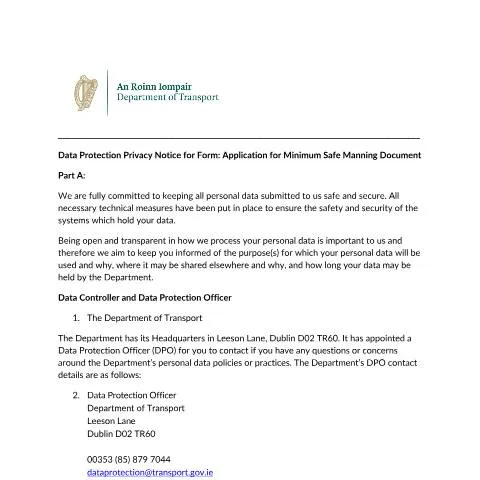
Navigating the Data Protection Privacy Notice for Minimum Safe Manning Document Applications
In the ever-evolving landscape of data privacy, it is crucial for individuals and organizations alike to understand how their personal information is managed, especially when engaging with official procedures like the application for a Minimum Safe Manning Document. This document serves as a pivotal resource, detailing the Department of Transport’s approach to data protection, ensuring that applicants are not only compliant but also informed about their rights and responsibilities. By delving into the nuances of this privacy notice, stakeholders can effectively safeguard their data while navigating the application process.
The Core Commitment to Data Security
The Department of Transport emphasizes its commitment to safeguarding all personal data submitted by applicants. This trust is built on the solid foundation of security measures implemented to protect sensitive information from unauthorized access. The privacy notice articulates the processes in place to ensure that data remains secure throughout its lifecycle.
Understanding the Role of the Data Protection Officer
Central to the Department's data protection strategy is the appointment of a Data Protection Officer (DPO). The DPO plays a vital role in overseeing compliance with data protection laws and is the primary point of contact for inquiries regarding personal data policies. Applicants are encouraged to reach out to the DPO located at:
- Department of Transport
- Leeson Lane
- Dublin D02 TR60
- Phone: 00353 (85) 879 7044
- Email: [email protected]
Engaging with the DPO not only clarifies any uncertainties around data handling practices but also reinforces the transparency that the Department pledges to its citizens.
Personal Data Rights: Empowering the Individual
Within the parameters of the Data Protection privacy notice, individuals are afforded a suite of rights concerning their personal data. Understanding these rights is essential for applicants, as they provide the means to control how their information is used.
A Closer Look at Your Rights
Under data protection legislation, applicants have the following rights:
- The Right to be Informed: Individuals should be clearly informed about how their data will be used.
- The Right of Access: Applicants can request access to their personal data held by the Department.
- The Right to Rectification: Individuals can request corrections to inaccurate personal data.
- The Right to Erasure: Under specific conditions, individuals can ask for their data to be deleted.
- The Right to Restrict Processing: Individuals have the right to limit how their data is used.
- The Right to Data Portability: Applicants can request their data in a format that allows transfer to another service.
- The Right to Object: Individuals can challenge the processing of their data in certain contexts.
- Rights in Relation to Automated Decision Making: Individuals have protections against decisions made solely by automated processes.
If any concerns arise regarding data privacy, individuals may file a complaint with the Data Protection Commission, Ireland’s supervisory authority concerning data protection matters.
Specific Data Collection for Manning Document Applications
The privacy notice outlines the specific data collected during the application process for a Minimum Safe Manning Document. This information is crucial for ensuring compliance with international and national regulations governing maritime safety.
Defining the Purpose of Data Collection
When applicants submit their personal information, it is specifically for processing applications aligned with:
- International Convention on Standards of Training, Certification and Watchkeeping for Seafarers (STCW)
- Regulation V/14 of the International Convention for the Safety of Life at Sea, 1974, as amended
- National Statutory Instrument No. 551 of 1998, as amended
This clear delineation of purpose not only ensures compliance but also sets the applicant’s expectations regarding data use.
Legal Foundations Underpinning Data Processing
The privacy notice details the legal basis under which personal data is collected and processed as part of the application for a Minimum Safe Manning Document. Understanding these legal underpinnings is pivotal for legal compliance.
Comprehending the Legal Basis
The processing of personal data is anchored in the legal frameworks established by:
- International maritime conventions
- National statutory instruments
These legal standards not only guide the department's practices but also assure applicants that their data is handled in accordance with established laws.
Retention Policies: Understanding Data Lifespan
An essential aspect of data management is the retention policy, which outlines how long personal data is held by the Department of Transport. This transparency provides reassurance to applicants regarding the management of their information.
Retention Period and Data Destruction Protocols
The department retains personal data only for as long as necessary to fulfill the purposes for which it was collected. After the conclusion of this period, the data is marked for destruction in accordance with:
- Internal guidelines
- National Archives guidelines
- Other statutory requirements
This structured approach ensures that personal information is not stored longer than necessary, thereby enhancing privacy protection.
Understanding the Implications of Data Provision
It is important to comprehend the implications of providing personal data when applying for the Minimum Safe Manning Document. The application process is governed by legal obligations that dictate how data is handled.
Statutory Obligations Related to Data Provision
Providing personal data is a statutory requirement necessary to process the application. Failure to submit complete information may halt the application process, emphasizing the importance of compliance with data requests.
Clarifying Misconceptions: Automated Decision Making
In the context of data processing for the Minimum Safe Manning Document, it is critical to address the role of automated decision-making. This aspect can often lead to concerns about the fairness and transparency of the process.
Automation and Its Absence in This Process
The privacy notice explicitly states that automated decision making is not utilized in processing personal data for the application. This reassurance mitigates concerns over decision-making processes that lack human oversight, ensuring that applicants are treated fairly and transparently.
Cookies and Technical Information
As part of the digital landscape, the privacy notice also references the use of cookies on the Department's website. Understanding how technical information impacts user experience and privacy is vital for applicants.
The Role of Cookies in Data Management
Cookies are critical for enhancing user experience on digital platforms. The Department provides a link to technical information regarding cookie usage, ensuring that applicants are informed about how their data might be tracked online.
For more technical details, applicants can access
https://www.gov.ie/en/publication/fdde77-data-protection/
Understanding cookies is essential for anyone engaging with online services, as they can influence data privacy perceptions and practices.
Conclusion: A Transparent Path Forward
Engaging with the Data Protection Privacy Notice for the Application for Minimum Safe Manning Document is essential for any applicant. By understanding the commitments made by the Department of Transport, the rights afforded to individuals, and the legal frameworks guiding data processing, applicants can navigate the application process with confidence.
This comprehensive approach not only enhances data security but also fosters trust between the Department and the public it serves. As the landscape of data privacy continues to evolve, remaining informed about these processes remains paramount for all stakeholders involved.
Understanding Data Protection Compliance in the Context of Minimum Safe Manning Documents
In Ireland, data protection is governed primarily by the General Data Protection Regulation (GDPR) and the Data Protection Act 2018. When it comes to the issuance of Minimum Safe Manning Documents (MSMDs), organizations must ensure that they adhere to strict data protection principles. The MSMD outlines the essential crew requirements for vessels, and often includes personal data of crew members. Therefore, understanding how to manage this data responsibly is paramount.
To begin with, organizations must identify the legal basis for processing any personal data included in the MSMD. This could relate to consent, contractual necessity, or compliance with legal obligations. Each scenario requires careful evaluation, as the GDPR stipulates that personal data should only be collected for specified, legitimate purposes and not further processed in a manner incompatible with those purposes.
The data minimization principle is another critical aspect to consider. Only data that is directly relevant and necessary for the creation of the MSMD should be collected. For instance, while it may be tempting to include extensive personal information, organizations should focus solely on the data that substantiates the minimum safe manning levels. Implementing this principle not only aids compliance but also builds trust with employees, reinforcing a culture of respect for personal privacy.
Moreover, transparency is a vital component of data protection. Organizations must ensure that crew members are informed about how their data will be used, stored, and protected. This is usually achieved through a privacy notice, which should clearly outline the types of personal data being processed, the purpose of processing, and the rights of individuals under GDPR. Such transparency helps to create a clear understanding of data handling practices, thus reinforcing the relationship between employers and employees.
Fill in your form directly online
No printing: type your details into the boxes of the official form, tick, then download the PDF ready to send.
- 1Type into the form boxes
- 2Tick in one click
- 3Save and download the PDF
Additionally, organizations should implement adequate security measures to protect personal data contained within the MSMD. This could involve securing electronic records with encryption, limiting access to authorized personnel only, and regularly reviewing security protocols. In the event of a data breach involving personal data related to the MSMD, organizations are required under GDPR to notify the Data Protection Commission (DPC) and, in some cases, the affected individuals.
Lastly, organizations must be mindful of the data retention policies for personal data included in the MSMD. Personal data should not be kept for longer than necessary, and a clear policy should be established regarding the deletion or anonymization of such data once it is no longer needed.
Best Practices for Drafting a Privacy Notice for Minimum Safe Manning Documents
When preparing a privacy notice as part of the compliance for Minimum Safe Manning Documents, it is crucial to follow best practices that ensure clarity, comprehensiveness, and compliance with applicable regulations. A well-structured privacy notice not only provides necessary information to data subjects but also serves to demonstrate the organization’s commitment to privacy and transparency.
1. Clear and Accessible Language: The language used in the privacy notice should be straightforward and accessible, avoiding legal jargon. It should be easy for the average crew member to understand what personal data is being collected, why it is necessary, and how it will be used.
2. Detailed Information: The privacy notice should comprehensively detail the types of personal data being collected (e.g., names, identification numbers, qualifications) and explain how this data is related to the safe manning of a vessel. It is also essential to specify the purposes for data collection, such as compliance with maritime safety regulations or crew scheduling.
3. Rights of Data Subjects: Include information on the rights of individuals under GDPR, such as the right to access their data, the right to rectification, the right to erasure, and the right to restrict processing. It is vital to explain how crew members can exercise these rights and whom to contact within the organization for assistance.
4. Data Sharing and Transfers: The notice must specify whether personal data will be shared with third parties, including regulatory bodies or other organizations. If data is transferred internationally, especially outside the European Economic Area (EEA), the notice should outline the safeguards in place to protect the data.
5. Contact Information: Clearly provide contact details for the data protection officer or another responsible person within the organization who can address any queries or concerns related to personal data processing.
6. Review and Update: Finally, it is important for organizations to regularly review and update their privacy notices to reflect any changes in data processing practices or regulations. This ensures ongoing compliance and reinforces the seriousness with which the organization handles data protection.
The Role of the Data Protection Commission in Regulating Minimum Safe Manning Documents
The Data Protection Commission (DPC) plays a crucial role in ensuring compliance with data protection laws in Ireland, particularly concerning Minimum Safe Manning Documents. The DPC is responsible for monitoring how personal data is processed and ensuring that individuals’ rights are protected under the GDPR.
Organizations applying for or issuing Minimum Safe Manning Documents must be prepared to demonstrate their compliance with data protection principles to the DPC. This means maintaining accurate records of data processing activities, conducting regular audits, and being prepared to respond effectively to any inquiries or investigations initiated by the DPC.
In cases of non-compliance, the DPC has the authority to impose substantial fines and sanctions, which can have significant financial and reputational implications for an organization. Therefore, understanding the DPC's role and the potential consequences of non-compliance is essential for organizations involved in the issuance of MSMDs.
Furthermore, the DPC provides guidelines and resources that can assist organizations in aligning their practices with GDPR requirements. These resources can be invaluable when drafting privacy notices or conducting data protection impact assessments related to Minimum Safe Manning Documents. Organizations are encouraged to actively engage with the DPC, attend workshops and training sessions, and utilize the available resources to enhance their understanding of data protection compliance.
In conclusion, the DPC serves not only as a regulatory body but also as a valuable partner in fostering a culture of data protection and privacy among organizations involved in maritime operations. By taking proactive measures to comply with data protection laws, organizations can protect themselves and reinforce the trust of their employees and stakeholders.