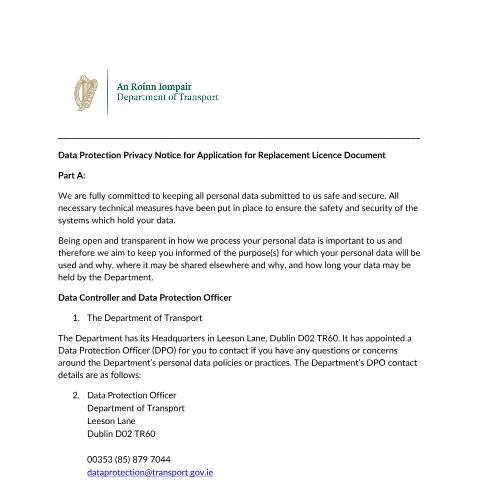
Understanding the Importance of the Data Protection Privacy Notice
The privacy notice laid out by the Department of Transport is a crucial document for applicants looking to secure a replacement for their license documents, specifically for Road Haulage Operator Licences and Road Passenger Transport Operator Licences. This notice not only informs applicants about how their personal data will be processed, but it also outlines their rights under the current data protection legislation in Ireland.
Navigating the Document: Key Sections You Need to Know
This privacy notice is structured into essential parts that detail important aspects of data handling. Key sections include:
- Part A: General Data Protection Principles - This section emphasizes the department's commitment to protecting personal data.
- Part B: Specific Information Related to Replacement Licence Document - Here, the specific types of data collected for replacement document requests are outlined.
- Data Subject Rights - This segment describes the rights individuals have over their personal data.
Each part contains specific that may impact how an applicant proceeds with their application. Understanding these sections can help applicants be more informed and prepared.
Who Should Pay Attention to This Notice?
This notice is indispensable for any individual or business holding a Road Haulage Operator Licence or a Road Passenger Transport Operator Licence. If you find yourself needing a replacement for a license document that has been lost or misplaced, this notice will guide you through the data protection considerations surrounding your application.
Moreover, if you are a data subject who interacts with the Department of Transport, understanding this notice is vital to exercise your rights effectively.
Data Processing: What Happens with Your Information?
By submitting an application for a replacement licence document, you are providing the department with specific personal data that will be processed solely for the purposes outlined in the privacy notice.
Types of Data Collected
The data processed for replacement licence document applications may include:
- Full name
- Contact information
- Details relating to the original licence document
Legal Basis for Data Processing
The processing of personal data is grounded in the Road Transport Act 2011, which sets clear legal requirements for maintaining proper documentation for transport operators. Understanding these legal bases reinforces the importance of the data being processed appropriately and securely.
Your Rights as a Data Subject
As a data subject, there are numerous rights that allow you to control how your personal data is managed:
- The right to be informed - You must be made aware of how your data is used.
- The right of access - You can request copies of your data held by the department.
- The right to rectification - You can ask for inaccuracies in your data to be corrected.
- The right to erasure - In certain circumstances, you may request your data be deleted.
- The right to restrict processing - You can limit how your data is used.
- The right to data portability - You may request your data in a structured format to transfer to another service.
- The right to object - You can object to how your data is processed under specific conditions.
If you feel your rights are not being upheld, you have the option to lodge a complaint with the Data Protection Commission, Ireland's supervisory authority on data protection matters.
Retention of Data: How Long Will Your Information Be Kept?
The department will retain your personal data only for as long as it is necessary to fulfill the purposes for which the data was collected. Once your data is no longer needed, it will be marked for destruction following strict guidelines.
| Data Purpose | Retention Period | Destruction Guidance |
|---|---|---|
| Application for Replacement Licence Document | As long as necessary for processing | Following internal guidelines or National Archives Office guidelines |
This ensures that once your case is closed and the replacement has been issued, your data is no longer at risk of being misused or accessed without permission.
Understanding Data Sharing: Who Has Access to Your Information?
Information regarding replacement licence documents is not shared outside the Department of Transport. This is crucial for maintaining the confidentiality of your personal data.
Moreover, no data collected will be transferred outside of the European Union (EU) or European Economic Area (EEA), ensuring compliance with international data protection standards.
Steps to Apply for a Replacement Licence Document
While the privacy notice does not serve as an application form, it is critical to understand the procedural steps that follow reading this document:
- Prepare your personal details and information regarding your original licence document.
- Submit the Application for Replacement Licence Document to the Road Transport Operator Licensing Unit
- Await processing, which will be governed by the principles outlined in the privacy notice.
Following these steps while considering the implications of the privacy notice ensures that applicants can navigate the process smoothly and have their rights protected throughout.
Technical Considerations: Cookies and Online Privacy
For those applying online, it’s important to be aware of how cookies may impact your experience on the Department of Transport website. Cookies may be used to enhance user experience, but data collected via cookies will also adhere to the same data protection laws.
For a detailed understanding of the cookies used, refer to the department's official page on data protection.
Final Thoughts: Empowering Yourself Through Knowledge
By familiarizing yourself with the Data Protection Privacy Notice for Replacement Licence Document applications, you empower yourself with the knowledge needed to navigate the process effectively. Understanding your rights and the department's responsibilities ensures that your personal data remains secure while you seek the necessary documentation.
This proactive approach not only protects your data but also contributes to a transparent relationship between you and the Department of Transport, fostering trust and accountability.
Understanding the Data Protection Framework in Ireland
Data protection in Ireland is primarily governed by the General Data Protection Regulation (GDPR) and the Data Protection Act 2018. The GDPR sets the standard for data protection across the European Union, establishing rights for individuals and obligations for organizations that process personal data. In Ireland, the Data Protection Commission (DPC) is the supervisory authority responsible for upholding these rights and ensuring compliance with the regulations.
It's essential for organizations handling personal data to have a clear understanding of the legal framework, including the definitions of personal data, processing, data subjects, and data controllers/processors as defined in GDPR. Understanding these terms is crucial for drafting an effective Privacy Notice, which is a requirement under Article 13 and 14 of the GDPR when collecting personal data.
Fill in your form directly online
No printing: type your details into the boxes of the official form, tick, then download the PDF ready to send.
- 1Type into the form boxes
- 2Tick in one click
- 3Save and download the PDF
Organizations must ensure that their privacy notices are transparent, intelligible, and easily accessible. This includes outlining the purpose of data collection, the legal basis for processing, the retention period of personal data, and individuals' rights regarding their data. The necessity of having a robust data protection framework cannot be overstated, particularly in an era where data breaches and misuse of personal information are prevalent.
Steps to Obtain a Privacy Notice Replacement License Document
When an organization finds it necessary to replace its Privacy Notice or obtain a new license document, the process typically involves several clear steps. Firstly, it’s essential to review the existing Privacy Notice to identify areas that may need updating, such as changes in processing activities or new legal obligations. This review should be done by a qualified individual or team familiar with data protection laws.
Next, organizations must draft a new Privacy Notice that complies with GDPR stipulations. This involves being clear about what personal data is being collected, why it is being collected, how it will be used, and how long it will be retained. Additionally, organizations should ensure that they include contact details for their Data Protection Officer (DPO) if applicable.
Once the new Privacy Notice is drafted, organizations must formally notify the DPC of the changes. This notification is critical, especially if there are significant changes that might affect data subjects’ rights. Following this, an internal review process may be necessary, where the new Privacy Notice is circulated among relevant stakeholders for feedback before final approval.
After obtaining all necessary approvals, the finalized Privacy Notice must be published and made accessible to all data subjects. This includes updating the organization’s website, app, or any other platform where personal data is collected. It is also advisable to engage in a communication plan to inform existing customers or clients about the changes, particularly if the updates materially affect how their personal information is handled.
Common Challenges and Solutions in Data Protection Compliance
Organizations often face various challenges in maintaining compliance with data protection laws. One of the most common issues is a lack of understanding of data subject rights under GDPR. Data subjects have several rights, including the right to access, rectify, and erase their personal data, as well as the right to restrict processing and data portability. Organizations must have procedures in place to respond to data subject requests promptly, typically within one month.
Another challenge is maintaining accurate records of processing activities, which is a requirement for many organizations under GDPR. This involves documenting the types of personal data being processed, the purposes of processing, retention periods, and the security measures in place. Organizations can address this challenge by implementing a data inventory and management system that allows them to keep track of their data processing activities easily.
Data breaches can also pose a significant challenge, and organizations must have a robust incident response plan to address potential breaches effectively. This plan should include procedures for identifying and assessing breaches, notifying the DPC, and informing affected data subjects where necessary. It is advisable for organizations to conduct regular training for staff on data protection and the importance of safeguarding personal data.
Finally, organizations may struggle with keeping their Privacy Notices up to date. An effective strategy is to review and revise Privacy Notices regularly, especially when there are changes in processing activities or legal requirements. This proactive approach ensures that organizations remain compliant and continue to build trust with their customers and clients.