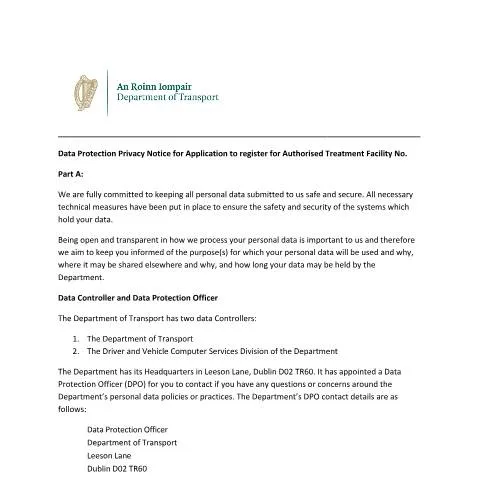
Navigating the Data Protection Privacy Notice for Application to Register for Authorised Treatment Facility
When engaging with the Department of Transport in Ireland, particularly in the context of registering an Authorised Treatment Facility (ATF), understanding the Data Protection Privacy Notice is crucial. This notice elucidates how personal data is managed, the rights of the data subjects, and the purposes for which the information is collected. This guide aims to distill the essential components of the privacy notice to empower individuals and organizations to navigate the registration process effectively.
Key Concepts of Data Protection in the Context of Authorised Treatment Facilities
Before delving into the specificities of the notice, it is vital to grasp some fundamental concepts relevant to data protection. This understanding not only helps in comprehension of the notice but also ensures compliance with legal obligations.
Personal Data and Data Subjects
Personal data, as defined under the relevant data protection legislation, refers to any information that relates to an identified or identifiable individual. This includes names, contact details, and other identifiers linked to the individual. Data subjects are the individuals whose data is being processed.
Data Controllers and Their Responsibilities
The document identifies two key data controllers:
- The Department of Transport
- The Driver and Vehicle Computer Services Division of the Department
Both controllers are responsible for ensuring that personal data is handled in compliance with data protection laws, and they must appoint a Data Protection Officer (DPO) to oversee data management practices.
The Purpose Behind Data Collection
Understanding why the data is collected is crucial for both data subjects and ATFs. The Data Protection Privacy Notice outlines the specific purposes for which personal data is processed. Engaging with the ATF registration process necessitates notifying the Department about vehicles that have reached the end of their operational life.
The Role of the National Vehicle & Driver File (NVDF)
Central to this process is the National Vehicle & Driver File (NVDF), which serves as the official register for vehicles and licensed drivers in Ireland. The registration of end-of-life vehicles is recorded on the NVDF, which plays a vital role in:
- Collecting motor tax
- Maintaining accurate records of vehicle ownership
- Facilitating statistical analyses for various stakeholders
This document is a part of a broader regulatory framework aimed at ensuring safety and accountability within the vehicle management system.
Legal Basis for Data Processing
Data processing under this framework has a solid legal foundation. The Waste Management (End-of-Life Vehicles) Regulations 2006 outlines the obligations imposed on ATFs, which include notifying the Department of the disposal of vehicles. The legal basis for these regulations stems from Section 60 of the Finance Act 1993.
Understanding Compliance Requirements
The regulations set forth compliance requirements that an ATF must adhere to when handling end-of-life vehicles. These details are critical for maintaining transparency and accountability in the processing of personal data.
Entitlements and Rights of Data Subjects
The privacy notice delineates several rights available to data subjects under data protection law. Being aware of these rights allows individuals to assert their control over their personal data effectively.
The Eight Fundamental Rights
Data subjects can exercise the following rights:
- The right to be informed: Subjects must be made aware of how their data is being used.
- The right of access: Individuals have the right to request access to their personal data.
- The right to rectification: Data subjects can request corrections to inaccurate data.
- The right to erasure: Under certain circumstances, individuals can request their data be deleted.
- The right to restrict processing: Individuals have rights to limit how their data is processed.
- The right to data portability: Data subjects can request their data to be transferred to another service.
- The right to object: Individuals can object to their data being processed in specific situations.
- Rights concerning automated decision-making: Data subjects have protections against automated decisions that significantly affect them.
Exercising these rights typically involves contacting the Data Protection Officer, whose details are outlined in the notice.
Retention Period for Collecting Data
Data retention policies are critical for compliance with legal obligations. The notice specifies that personal data will only be retained as long as necessary to fulfill the purpose for which it was collected. Once this period has elapsed, the data will be marked for destruction in accordance with internal guidelines or statutory requirements.
Guidelines on Destruction
The destruction of personal data must comply with regulations from the National Archives Office or other statutory directives. This ensures that data is not held longer than necessary, thereby minimizing risks associated with data breaches.
Potential Recipients of Collected Data
It's crucial to understand who could potentially receive or have access to the data collected through the application process. The privacy notice outlines various entities that may have access:
- Government Departments/Bodies using the NVDF data for internal purposes
- Government Agencies requiring the data for regulatory enforcement and business purposes
- Persons involved in providing commercial services deemed in the public interest
This section emphasizes the importance of safeguarding data while allowing necessary operational access for compliance and regulatory functions.
International Data Transfers: A Key Consideration
An essential aspect of data protection is understanding where data may be transferred. The privacy notice confirms that personal information collected will not be transferred outside the EU/EEA and countries lacking an adequacy agreement. This measure is crucial in ensuring that the data remains protected under the EU’s stringent data protection laws.
Implications of Data Transfers
This provision reflects the Department's commitment to uphold high standards of data protection, safeguarding personal information from varying international regulations that may not offer equivalent protections.
Practical Steps for Engaging with the Notice
Understanding this privacy notice is imperative for both ATFs and data subjects looking to navigate the registration process. Here’s a step-by-step approach to making the most of the information within the privacy notice:
- Read Thoroughly: Familiarize yourself with the entire notice. Understanding the nuances will aid in compliance and exercising your rights effectively.
- Engage the DPO: Should there be any uncertainties or concerns regarding data processing, reach out to the Data Protection Officer using the contact information provided.
- Document Your Interactions: Keep records of communications regarding personal data to maintain transparency and accountability in all transactions.
- Stay Informed: Regular updates and modifications to data protection legislation may occur. Stay abreast of these changes to remain compliant.
- Exercise Your Rights: If you believe your data protection rights have been violated, do not hesitate to assert your rights as outlined in the notice.
Conclusion: Navigating Data Protection with Confidence
The Data Protection Privacy Notice for the Application to Register for Authorised Treatment Facility is more than just a document—it is a comprehensive guide that elucidates how personal data is handled and provides essential rights to data subjects. It empowers individuals and organizations to understand their role within the regulatory framework, fostering a culture of transparency and accountability in data management processes.
By fully engaging with this privacy notice, stakeholders can ensure that they are compliant with the legal obligations while also respecting the rights of individuals. This proactive approach not only enhances organizational integrity but also instills public trust in the handling of data.
Understanding the CA428E54 Data Protection Privacy Notice
The CA428E54 Data Protection Privacy Notice is crucial for individuals and organizations applying to register for an Authorised Tax Relief (TRE) in Ireland. This notice outlines how your personal data is collected, used, stored, and shared in accordance with the General Data Protection Regulation (GDPR) and national legislation. As you navigate this process, it is important to understand your rights and the responsibilities of the authorities involved.
When you submit your application, you provide various types of personal data, including your name, address, and Tax Identification Number. The Revenue Commissioners (Revenue) collect this information to process your application and ensure compliance with tax laws. The privacy notice explicitly states the legal basis for processing your data, which is typically grounded in the performance of a public task or compliance with a legal obligation.
One of the key components of the CA428E54 notice is your right to access your data. You can request copies of personal information held about you and understand how it is being used. Furthermore, if you believe your data is inaccurate, you have the right to request corrections.
Data retention policies are also outlined in the notice. Revenue typically retains your data only for as long as necessary to fulfill the purposes outlined in the privacy notice, which may include audits, compliance checks, or other regulatory requirements. After this period, your information should be securely deleted or anonymized, ensuring that your privacy is protected.
How to Ensure Compliance with Data Protection Regulations
Ensuring compliance with data protection regulations when applying for Authorised Tax Relief (TRE) is essential for both individuals and businesses. The following steps can guide you through the process:
Familiarize Yourself with GDPR: Understanding the General Data Protection Regulation (GDPR) is key. This regulation provides comprehensive guidelines on data protection and privacy for all individuals within the European Union. Familiarize yourself with concepts such as data minimization, purpose limitation, and the importance of obtaining consent.
Conduct a Data Audit: Before submitting your application, conduct a data audit to determine what personal data you are providing. Identify the types of data required and consider whether any additional information may be included that is not necessary for processing your application. This aligns with the principle of data minimization, which is a core tenet of GDPR.
Fill in your form directly online
No printing: type your details into the boxes of the official form, tick, then download the PDF ready to send.
- 1Type into the form boxes
- 2Tick in one click
- 3Save and download the PDF
Review Your Privacy Notices: Ensure that any privacy notices provided by the Revenue or any third parties associated with your application are clear and comprehensive. Pay attention to how they describe your rights regarding your data and how long it will be retained. If there are any discrepancies, seek clarification.
Securely Store Your Information: While your application is being processed, ensure that any copies of personal data you have are stored securely. Use encryption if necessary and limit access to sensitive data to authorized individuals only.
Understand Your Rights: Be aware of your rights regarding your personal data under GDPR, such as the right to access, rectify, erase, restrict processing, and data portability. If you have concerns about how your data is handled, do not hesitate to reach out to the relevant authorities.
Stay Informed: Regularly check for updates on data protection regulations and practices from the Office of the Data Protection Commissioner (ODPC) and the Revenue. Changes to legislation or guidance can affect how you handle your data and your rights.
By taking these proactive steps, you can ensure compliance with data protection regulations while applying for Authorised Tax Relief (TRE) and safeguarding your personal information.
Implications of Non-Compliance with Data Protection Legislation
Non-compliance with data protection legislation, particularly in the context of applications for Authorised Tax Relief (TRE), can lead to significant repercussions for applicants. Understanding the implications of failing to comply with the CA428E54 privacy notice and broader GDPR requirements is crucial.
Financial Penalties: The Data Protection Commissioner has the authority to impose fines for breaches of GDPR. Non-compliance may result in hefty fines, which can range from €10 million to 4% of annual global turnover, whichever is higher. Such financial repercussions can have serious implications for both individuals and businesses, potentially jeopardizing their financial stability.
Legal Consequences: In addition to financial penalties, individuals or entities can face legal action if they mishandle personal data. This can include claims from affected individuals if their data rights are violated. Legal proceedings can be costly and time-consuming, diverting resources away from core activities.
Reputational Damage: Non-compliance can severely harm your reputation. In today's digital landscape, trust is paramount, and any data breach or mishandling of personal data can result in loss of business, client relationships, and credibility. For businesses, maintaining a positive reputation is essential for long-term success, and damage to this reputation can have lasting effects.
Loss of Authorisation: Failing to comply with data protection rules could also result in the loss of your eligibility for Authorised Tax Relief (TRE). If Revenue determines that you've mishandled personal data in your application or failed to adhere to privacy guidelines, your application may be rejected, and you could be prohibited from applying again in the future.
Impact on Future Applications: A record of non-compliance can affect your ability to apply for any future tax reliefs or incentives. Regulatory bodies may flag your account, complicating future interactions with Revenue and potentially placing additional burdens on your financial activities.
Increased Scrutiny: Non-compliance can lead to increased scrutiny from regulatory authorities going forward. This can involve more frequent audits, additional requirements for transparency, or closer monitoring of your data handling practices, leading to a more rigorous compliance environment.
Given these implications, it is crucial to approach the application process for Authorised Tax Relief (TRE) with a clear understanding of data protection obligations and a commitment to compliance. Taking the necessary steps to safeguard personal data and adhere to established regulations will not only protect your interests but also contribute to the integrity of the data protection framework in Ireland.