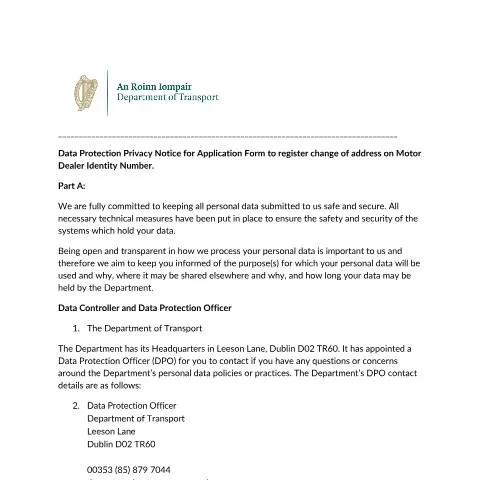
Navigating the Data Protection Landscape: A Guide to the Data Protection Privacy Notice
Understanding the nuances of data protection is critical, especially in administrative contexts like the registration of changes associated with your Motor Dealer Identity Number. The Data Protection Privacy Notice from the Department of Transport serves as a guiding document to ensure that users are aware of how their personal data will be handled when they apply for a change of address. This guide breaks down the essential components of this notice, providing you with a clear understanding of your rights and responsibilities.
What You Need to Know About Your Personal Data
The protection of your personal data is paramount for the Department of Transport. This notice outlines their commitment to safeguarding the information you submit. It is vital to recognize that all data collected will be processed transparently and securely, adhering to the stipulations of current data protection legislation.
Technical Measures for Data Security
The Department has established robust technical measures to protect the personal data contained in their systems. You can be assured that your information is safeguarded against unauthorized access, alteration, or loss. This includes measures such as encryption and secure databases to ensure your data remains confidential.
Understanding Your Data Controller
When submitting your application, it is crucial to know who is managing your personal data. The Data Controller in this context is the Department of Transport, headquartered in Dublin. They have also appointed a Data Protection Officer (DPO) to handle any inquiries or concerns about data protection practices. Should you have questions, here are the contact details:
- Data Protection Officer
- Department of Transport
- Leeson Lane, Dublin D02 TR60
- Phone: 00353 (85) 879 7044
- Email: [email protected]
Your Rights Under Data Protection Law
As an individual whose data is processed, you have specific rights which you can exercise in relation to your personal data. Understanding these rights is crucial for protecting your information effectively.
Exploring Your Data Rights
- The right to be informed: You have the right to know how your data is used.
- The right of access: You can request access to the personal data held about you.
- The right to rectification: You can ask for corrections to your data if it is inaccurate.
- The right to erasure: Under certain conditions, you can request the deletion of your data.
- The right to restrict processing: You can limit how your data is used.
- The right to data portability: You can request your data to be transferred to another service.
- The right to object: You can contest the processing of your data under specific circumstances.
- Rights related to automated decision-making: You have rights concerning automated decision processes that affect your data.
If you feel that your rights have been infringed upon, you have the option to lodge a complaint with the Data Protection Commission, the authority overseeing data protection issues in Ireland.
The Purpose Behind the Data Collection
The Data Protection Privacy Notice explicitly details the purpose of collecting personal data when applying for a change of address related to the Motor Dealer Identity Number. This number is essential for motor dealers engaging in the buying and selling of vehicles.
Why is This Data Essential?
The data collected serves specific legal and operational functions:
- It enables the Department to maintain accurate records concerning vehicle ownership.
- It aids in the collection of motor taxes and ensures compliance with regulations.
- Data is also utilized to support statistical analyses that inform governmental policy and regulatory frameworks.
The Legal Framework: Basis for Data Processing
The processing of personal data under this application form is governed by several critical pieces of legislation:
- Section 60 of the Finance Act 1993: This act provides the legal foundation for the registration and management of vehicle owner data.
- Road Vehicles (Registration and Licensing) Regulations 1992: These regulations establish the requirements for notifying ownership changes.
It is important to understand that your personal data may only be used within the framework of these laws, ensuring its processing is legitimate and lawful.
Sharing Your Data: Who Has Access?
When you submit your application, it opens the door to a network of information sharing. While this might seem concerning, it is essential to understand who will access your data and why.
Authorized Recipients of Your Data
According to Section 60 of the Finance Act, various government departments, agencies, and bodies are authorized to access data from the National Vehicle and Driver File (NVDF) as needed for business delivery and regulatory purposes. This may include:
- Government departments conducting investigations related to vehicle ownership.
- Agencies that leverage NVDF data to fulfill public service obligations or commercial services deemed to be in the public interest.
Your data will not be shared indiscriminately, as there are strict provisions governing who can access it and under what circumstances.
Retention Period: How Long is Your Data Kept?
An essential aspect of data protection is understanding how long your information will be stored. The Department’s policy is to retain your data only as long as necessary for the purposes for which it was collected.
Destruction of Data
After the required retention period, your data will be marked for destruction and securely disposed of in accordance with internal guidelines or legal requirements from the National Archives Office. This ensures that your data does not linger longer than necessary and minimizes risks associated with data breaches.
Obligations Under Statutory Requirements
Compliance with statutory obligations is a cornerstone of the data collection process. The requirement for data provision is not merely a bureaucratic necessity; it serves to uphold the integrity of the vehicle registration process.
The Role of Sellers and Buyers in Data Provision
Both the seller and buyer of a vehicle must complete the application form to effectively register changes in vehicle ownership. This collaborative approach is designed to prevent sellers from remaining the registered owners on the National Vehicle and Driver File, thereby shielding them from any liabilities concerning penalties associated with the vehicle.
Automated Decision-Making: Clarity on Processing Methods
It is important to clarify what automated decision-making entails in this context, as it can often cause confusion among users.
Understanding the Absence of Automated Decisions
For your peace of mind, it is confirmed that automated decision-making does not play a role in the processing of the personal data submitted through this form. All applications are handled manually, ensuring a human touch in the decision-making process.
Fill in your form directly online
No printing: type your details into the boxes of the official form, tick, then download the PDF ready to send.
- 1Type into the form boxes
- 2Tick in one click
- 3Save and download the PDF
Conclusion: Making the Most of Your Privacy Notice
Understanding the Data Protection Privacy Notice is crucial for anyone submitting an application to change the address associated with their Motor Dealer Identity Number. This notice is more than just a bureaucratic requirement; it’s a vital document that protects your rights and clarifies how your data will be processed. By familiarizing yourself with the contents of this notice, you empower yourself to engage with the Department of Transport confidently and knowledgeably.
Always remember that the Department of Transport prioritizes your data security and transparency in processing your information. If you have questions or concerns, do not hesitate to reach out to the Data Protection Officer for clarification. With the right information, you can ensure that your data protection rights are upheld throughout the process.
Understanding Your Rights Under Data Protection Legislation
In Ireland, data protection is primarily governed by the General Data Protection Regulation (GDPR) alongside the Data Protection Act 2018. Understanding your rights in relation to your personal data is crucial for anyone completing a form such as the dbb270e1 application form for changing an address. Under GDPR, you have the right to:
- Access your data: You can request confirmation of whether your personal data is being processed and access to that data.
- Rectification: If your personal data is inaccurate or incomplete, you have the right to request its correction.
- Erasure: Known as the "right to be forgotten," this allows you to request the deletion of your personal data under certain conditions.
- Data portability: You have the right to obtain and reuse your personal data across different services.
- Restriction of processing: You can request a restriction on the processing of your data under specific circumstances.
When filling out the dbb270e1 form, it is advisable to be aware of these rights. The privacy notice associated with the application will inform you how your data will be used, stored, and processed. If you feel any of your rights have been violated, you can lodge a complaint with the Data Protection Commission, which is the supervisory authority in Ireland.
How to Ensure Compliance with Data Protection While Handling Personal Data
For organizations and individuals handling personal data, compliance with data protection laws is essential. When registering a change of address using the dbb270e1 form, there are specific steps to ensure compliance:
- Review Privacy Notices: Always begin by reviewing the privacy notice associated with the application form. This document outlines how your data will be processed and for what purposes.
- Minimise Data Collection: Only collect the data that is necessary for processing the change of address. Avoid gathering excessive or irrelevant information.
- Secure Data Storage: Ensure that any personal data you collect is securely stored and protected against unauthorized access.
- Training and Awareness: If you’re part of an organization, ensure that staff are trained on data protection practices and understand the importance of safeguarding personal data.
- Regular Audits: Conduct regular audits of your data processing activities to ensure compliance and identify any potential areas of risk.
By following these steps, you can help ensure that your handling of personal data is compliant with the relevant data protection legislation, thus safeguarding the rights and privacy of individuals.
Consequences of Non-Compliance with Data Protection Regulations
Non-compliance with data protection regulations can have serious repercussions for individuals and organizations alike. When applying for a change of address through the dbb270e1 form, both applicants and organizations must be aware of these potential consequences:
- Fines and Penalties: The Data Protection Commission can impose significant fines for breaches of data protection laws, which can reach up to 4% of an organization’s annual global turnover or €20 million, whichever is higher.
- Legal Action: Individuals may take legal action against organizations for breaches of their data protection rights, leading to potential compensation claims.
- Reputational Damage: Non-compliance can result in damage to an organization's reputation, eroding trust with customers and clients.
- Operational Disruption: Investigations by the Data Protection Commission can lead to operational disruptions, as organizations may need to adapt their practices or implement corrective measures.
Given these risks, it is imperative that all parties involved in processing personal data, including those submitting the dbb270e1 form, understand the importance of compliance with data protection laws.