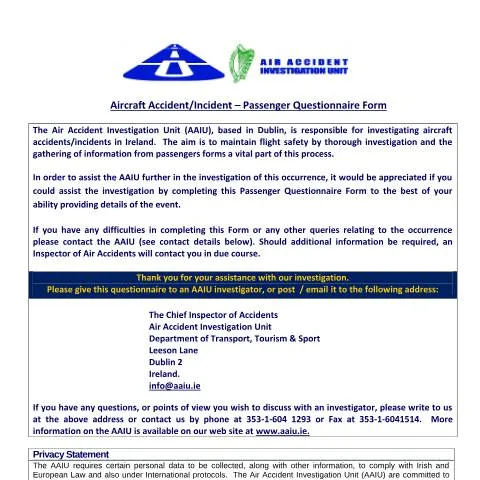
Navigating the Passenger Questionnaire Form for Aircraft Accidents and Incidents
In the unfortunate event of an aircraft accident or incident, the role of passengers in ensuring thorough investigations cannot be overstated. The Passenger Questionnaire Form, issued by the Air Accident Investigation Unit (AAIU) under the Department of Transport, serves as a crucial tool for gathering firsthand accounts that aid in maintaining aviation safety. This article delves into the nuances of this document, guiding passengers through every step of the process, from understanding its importance to the submission of their insights.
Understanding Who Needs to Complete the Form
Passengers who have experienced or witnessed an incident during their flight are invited to participate in the investigation process by filling out this form. This includes a wide range of individuals such as:
- Adults: Individuals aged 18 and above, capable of providing detailed accounts.
- Minors: If the passenger is under 18, a parent or guardian should complete the form on their behalf.
- Foreign Nationals: Non-Irish citizens who were on board an aircraft registered in Ireland or operated by an Irish airline.
- Witnesses: Individuals who were not passengers but may have vital information about the incident.
Each of these profiles may have unique considerations when filling out the form, especially regarding language barriers, consent in the case of minors, and how witnesses can provide their accounts without direct involvement.
Minors and their Guardians
For minors, it is vital that the questionnaire is filled out by a responsible adult. The adult must ensure that the child's perspective is accurately represented while also being mindful of their comfort and understanding of the situation. The parent or guardian will need to provide their details along with the child’s.
Foreign National Considerations
Foreign nationals may face additional hurdles such as language barriers; thus, they can seek assistance from airline staff or interpreters if needed. It is also essential for them to provide accurate personal details as per their official documentation to avoid discrepancies.
Form Completion: Step-by-Step Guidance
Completing the Passenger Questionnaire Form requires careful attention to detail to ensure that all relevant information is captured. Below is a structured approach to filling out the form:
1. Personal Information Section
This section captures essential details that identify the passenger:
- Full Name: Enter your name as it appears on your identification documents.
- Contact Details: Include your telephone numbers and address. This is crucial for follow-up inquiries.
- Occupation and Age: This information helps investigators understand the diversity of perspectives among passengers.
2. Flight Details
You will need to provide information about your flight, including:
- Seat Position: Indicate your exact seat, whether it was assigned or not.
- Other Passengers: List names of individuals traveling with you, if applicable. This can assist investigators in gathering more testimonies.
3. Incident Description
This is arguably the most critical part of the form, where you recount:
- When you noticed something was wrong.
- Your observations: What did you see and hear during the event?
- Actions Taken: Did you follow crew instructions? Were announcements clear?
4. Exit and Evacuation Details
It is important to specify how you exited the aircraft during the incident:
- Indicate whether you used an emergency exit or another route.
- Share any difficulties you encountered, such as crowded aisles or unclear instructions.
5. Injury Reporting
If you sustained any injuries, describe them succinctly, including how they occurred. This information is vital for safety assessments and potential future safety improvements.
Submission of the Form: Channels and Processes
Once the questionnaire is completed, the next step is submission. This can be done through various channels:
1. Direct Submission to AAIU Investigators
Passengers may hand the completed form directly to an investigator from the AAIU present at the site of the incident.
2. Postal Submission
If physical submission is not feasible, the form can be mailed to:
The Chief Inspector of Accidents Air Accident Investigation Unit Department of Transport, Tourism & Sport Leeson Lane, Dublin 2 Ireland3. Email Submission
For those who prefer electronic communication, the form can also be sent via email to [email protected]. Ensure that all scanned copies are legible and that the email includes a subject line indicating its importance.
The Importance of Timeliness in Submission
Submitting the Passenger Questionnaire Form promptly is crucial for several reasons:
- Memory Freshness: The sooner you provide your account, the more accurate and detailed it will be.
- Investigation Timelines: Every delay can hinder the investigation process, potentially impacting safety protocols in the future.
Understanding Data Protection and Privacy Concerns
Passengers filling out the form may have concerns about how their personal data will be handled. The AAIU emphasizes its commitment to data protection under Irish and European laws:
- Data Security: Measures are in place to protect all personal data from unauthorized access or misuse.
- Confidentiality: Information collected is strictly for safety investigations and cannot be shared outside this context without legal obligation.
Transparency in Data Use
All passengers are entitled to know how their data will be used, how long it will be stored, and who will have access. For more detailed information, the Department of Transport provides a Data Protection Policy available upon request.
Special Cases: Complex Situations in Reporting
Certain situations may complicate the process of filling out and submitting the questionnaire. These include:
1. Severe Incidents with Many Involved
In the case of significant accidents involving numerous passengers, ensure that your account is as distinct and detailed from others as possible. It may help to document specific observations that only you would have noted.
2. Emotional and Psychological Impact
Incidents can have lasting psychological effects. If you feel uncomfortable or overwhelmed while completing the questionnaire, consider seeking professional support before submitting your account. It’s essential that your testimony reflects your true perspective and experience.
Continuous Support and Follow-Up
After submitting the form, you may wonder about next steps:
- Follow-ups: An AAIU investigator may reach out for further clarification or additional information.
- Support Resources: The AAIU may also provide information on mental health resources for passengers affected by the incident.
Contacting the AAIU
For any queries regarding the form or the investigation, passengers can reach out to the AAIU via:
- Phone: +353 1 604 1293
- Fax: +353 1 604 1514
Final Thoughts on the Questionnaire Process
Filling out the Passenger Questionnaire Form serves not just as a commitment to the investigation but as a contribution to enhancing aviation safety for everyone. By accurately recording and submitting your experiences, you play an essential role in the broader aviation community. Remember, your input is invaluable in shaping future safety measures and protocols.
Fill in your form directly online
No printing: type your details into the boxes of the official form, tick, then download the PDF ready to send.
- 1Type into the form boxes
- 2Tick in one click
- 3Save and download the PDF
Understanding Your Rights Under Data Protection Law
In Ireland, data protection is governed by the Data Protection Act 2018 and the General Data Protection Regulation (GDPR). If you are completing the Aircraft Accident/Incident Passenger Questionnaire Form, it is crucial to understand how your personal information will be handled by the relevant authorities. The questionnaire collects sensitive data that may include personal identifiers, contact details, and health-related information.
Under the GDPR, you have specific rights concerning your data. These rights include:
- Right to Access: You can request access to your personal information held by the relevant authority. This means you can ask for copies of your data and know how it is being used.
- Right to Rectification: If you believe that any of your information is inaccurate or incomplete, you have the right to request corrections.
- Right to Erasure: You can request the deletion of your personal data when it is no longer necessary for the purpose it was collected.
- Right to Restrict Processing: You can request that your data be restricted from further processing in specific circumstances.
- Right to Data Portability: You can request that your data be provided in a machine-readable format and transferred to another data controller, should you choose.
To exercise these rights, you would typically need to submit a request to the data controller responsible for handling the questionnaire, which may be the relevant aviation authority or investigation body in Ireland. This ensures that your personal data is respected and protected throughout the process of any accident investigation.
The Role of the Irish Aviation Authority in Data Protection
The Irish Aviation Authority (IAA) plays a critical role in regulating civil aviation in Ireland, including the oversight of safety investigations related to aircraft accidents and incidents. When you fill out the Aircraft Accident/Incident Passenger Questionnaire Form, your data is not only crucial for investigation purposes but is also subject to strict data protection regulations enforced by the IAA.
The IAA is required to comply with GDPR principles, ensuring that your personal data is processed lawfully, transparently, and fairly. This includes:
- Purpose Limitation: Your data can only be collected for specified, legitimate purposes and cannot be further processed in a manner incompatible with those purposes.
- Data Minimisation: The IAA will ensure that only the necessary amount of personal data is collected from you, reducing potential risks to your privacy.
- Storage Limitation: Your data will not be kept longer than necessary for the investigation's purposes, following the principles of data retention.
Furthermore, the IAA has implemented various technical and organisational measures to protect your personal data from unauthorized access, loss, or destruction. This may include secure storage solutions and regular audits of data handling practices. Understanding the IAA’s role can help you feel more secure about the data you provide when completing the questionnaire.
The Impact of Data Breaches on Accident Investigation Procedures
Data breaches can have significant implications for the integrity of accident investigations conducted in Ireland. When you submit the Aircraft Accident/Incident Passenger Questionnaire Form, the expectation is that your data will be handled with the utmost confidentiality and security. However, if a data breach occurs, it can compromise not only your personal information but also the investigation's outcome.
In the event of a data breach, the IAA is obligated to notify the Data Protection Commission (DPC) and potentially affected individuals. This notification must occur within 72 hours of becoming aware of the breach, provided that the breach poses a risk to the rights and freedoms of individuals. The IAA will also aim to mitigate the effects of the breach and implement measures to prevent future occurrences.
Additionally, data breaches can lead to a lack of trust in the data collection processes associated with aircraft incident investigations. Passengers may become apprehensive about providing necessary information, which could hinder thorough investigations and the implementation of safety improvements. Therefore, the IAA needs to maintain robust security measures and transparent communication with the public regarding data protection practices.
In summary, while filling out the Aircraft Accident/Incident Passenger Questionnaire Form is essential for ensuring safety and accountability in aviation, it is equally important to be aware of the data protection implications surrounding the process. Understanding your rights, the role of the IAA, and the potential impacts of data breaches can empower you as a passenger to engage more confidently with the investigation process.