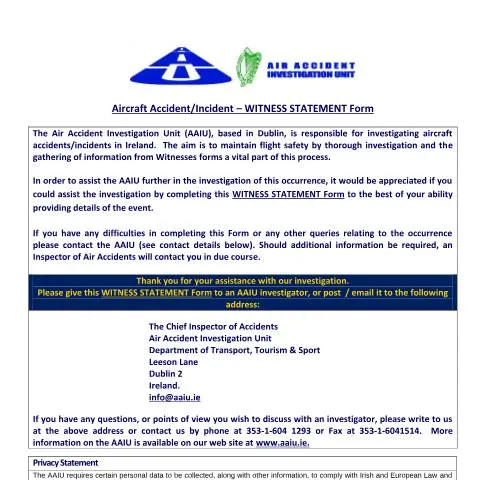
Understanding the Witness Statement Form in Aircraft Accidents and Incidents
In the realm of aviation, safety is paramount, and the rigorous process of investigating aircraft accidents and incidents is a crucial component of maintaining that safety. One key element within this process is the Witness Statement form administered by the Air Accident Investigation Unit (AAIU) under the Department of Transport. This form serves as a vital tool for collecting information from individuals who have observed events surrounding an aircraft accident or incident.
The significance of this form cannot be overstated, as firsthand accounts often provide critical insights that may not be available through other means. By understanding the nuances of this form, individuals can contribute meaningfully to aviation safety investigations.
Who Should Fill Out the Witness Statement Form?
Any individual who has witnessed an aircraft accident or incident is encouraged to complete the Witness Statement form. This includes a wide spectrum of observers, from passengers and crew members to ground personnel and nearby residents.
Additionally, certain scenarios may require special attention:
- Foreign Nationals: Individuals who are not Irish citizens but have witnessed an incident can also fill out this form. They should provide accurate contact details to facilitate follow-up by investigators.
- Minors: If the witness is under 18, parental consent is required. A parent or guardian may need to assist in completing the form.
- Unusual Circumstances: Witnesses with disabilities or those who experienced trauma during the incident may require assistance. The AAIU is equipped to accommodate such needs.
The AAIU seeks to gather comprehensive accounts from a diverse array of witnesses to ensure a well-rounded understanding of the circumstances surrounding the incident.
Navigating the Form: A Section-by-Section Breakdown
Completing the Witness Statement form requires careful attention to detail. Each section of the form is designed to elicit specific information that will aid the investigation. Below is a detailed look at the main components of the form and common pitfalls to avoid.
Personal Information
In the first part of the form, witnesses are required to provide their full name, address, date of birth, and gender. This information is crucial for identifying and contacting witnesses.
Common issues include:
- Incomplete Addresses: Failing to provide a complete Eircode can hinder follow-up efforts.
- Incorrect Phone Numbers: Providing incorrect or outdated contact information may lead to missed opportunities for clarification.
Details of the Event
This section is arguably the most critical part of the form. Witnesses should thoroughly describe what they saw or heard during the incident.
Key points to consider include:
- Specific Observations: Ensure to include details like the sequence of events, sounds, and any unusual occurrences.
- Location: Describe your position relative to the event, as this can greatly influence the reliability of your account.
- Timing: Clearly note when you first realized something was wrong, as timing can play a significant role in understanding the incident.
Witnesses should take their time to fill out this section, as the information gathered here is vital to the investigation.
Timeframe for Submission: When and How
The submission of the Witness Statement form should occur as soon as possible after the incident. Timely submissions help ensure that the information provided is accurate and fresh in the witness's mind.
Witnesses should be mindful of the following:
- Immediate Action: It is advisable to complete and submit the form within 24 to 48 hours of the incident.
- Submission Channels: The form can be submitted in several ways, which we will explore in the next section.
After submission, the witness can expect to be contacted by an AAIU investigator if additional information is required.
Channels of Submission: Navigating Your Options
Understanding the various ways to submit the Witness Statement form can help ensure that your submission is processed efficiently. The AAIU provides several options for submitting the form:
- In-Person: Witnesses can hand their completed forms directly to AAIU investigators at the scene or during follow-up meetings.
- Postal Submission: The completed form can be mailed to the AAIU at the following address:
The Chief Inspector of Accidents Air Accident Investigation Unit Department of Transport, Tourism & Sport Leeson Lane Dublin 2 Ireland.
- Email Submission: Alternatively, completed forms can be emailed to [email protected]. Ensure that scanned copies are clear and legible.
Witnesses should choose the submission method that is most convenient for them, but must ensure it is completed and submitted promptly.
Understanding the Role of the Witness Statement in the Investigation Process
The Witness Statement form is not merely a formality; it plays a critical role in the overall investigation process of the AAIU.
Here’s how this document integrates into the broader investigative framework:
- Collecting Evidence: Each witness statement contributes to a comprehensive understanding of the event, helping investigators piece together the sequence of events leading to the accident.
- Enhancing Safety Protocols: Insights gathered from witness accounts often lead to improvements in aviation safety regulations and procedures.
- Legal and Regulatory Compliance: The data collected through these forms supports compliance with Irish and international aviation laws, ensuring that all necessary protocols are followed.
The AAIU aims to maintain transparency throughout the investigation, and witness statements are critical to achieving that goal.
Protecting Your Privacy: Understanding Data Protection
Given the personal nature of the information collected, data protection is a significant concern for the AAIU. Witnesses should be assured that their data will be handled with the utmost care and in compliance with relevant data protection laws.
Key points related to privacy include:
- Data Collection Purpose: Personal information collected is solely for the purpose of enhancing aviation safety and is handled in accordance with Irish and EU laws.
- Confidentiality Measures: The AAIU implements stringent security measures to protect the data from unauthorized access and misuse.
- Limited Sharing: Personal data will not be shared outside the context of the investigation unless mandated by the High Court of Ireland.
Witnesses are encouraged to familiarize themselves with the AAIU's privacy policies to understand how their data will be used and protected.
Consequences and Responsibilities: What You Should Keep in Mind
Filling out the Witness Statement form is more than just a civic duty; it carries certain responsibilities and potential consequences.
Consider the following aspects:
- Accuracy is Vital: Providing false information or omitting key details can have serious implications, including potential legal consequences.
- Obligation to Follow Up: Witnesses are encouraged to remain available for any follow-up questions or clarifications from investigators.
- Non-Compliance: Failing to submit the form on time may result in a lack of representation in the investigation, which could impact safety improvements.
Witnesses should approach the completion of the form with a sense of responsibility, recognizing their role in enhancing aviation safety.
The Bigger Picture: Your Role in Aviation Safety
Ultimately, completing the Witness Statement form is a vital contribution to aviation safety. Each form submitted helps to build a clearer picture of incidents, leading to essential improvements in safety protocols and regulations.
By participating in this process, witnesses play a crucial role in protecting future passengers and crew members. The collective effort of witnesses and investigators fosters a safer aviation environment for everyone.
Witnesses are encouraged to view themselves as integral members of the aviation safety community. Your account could very well be the key to preventing future incidents and enhancing the overall safety framework within the industry.
Fill in your form directly online
No printing: type your details into the boxes of the official form, tick, then download the PDF ready to send.
- 1Type into the form boxes
- 2Tick in one click
- 3Save and download the PDF
Understanding the Data Protection Framework in Ireland
In the context of aviation incidents, the handling of witness statements is tightly bound by the principles laid out in the General Data Protection Regulation (GDPR) and the Data Protection Act 2018. These legal frameworks ensure that personal data is processed lawfully, fairly, and transparently.
When you are asked to provide a witness statement regarding an aircraft accident or incident, it is crucial to understand what personal data you are sharing, how it will be used, and who will have access to it. The data collected will typically include your name, contact information, and details regarding your observations during the incident.
Under GDPR, individuals have specific rights concerning their data. You have the right to access your information, request corrections if necessary, and in certain situations, the right to erasure. As such, if you believe your witness statement has been mishandled or you no longer wish for your data to be processed, you can contact the entity that collected your data—often the Irish Aviation Authority (IAA) or the relevant investigating authority—and exercise these rights.
Additionally, any organization collecting your data must have a clear legal basis for doing so, which in the context of an investigation into an aircraft incident typically falls under 'public task'—the processing of data necessary for the performance of a task carried out in the public interest. This means that while your personal data may be processed, it is done so under stringent regulations to protect your privacy.
The Role of the Irish Aviation Authority in Data Protection
The Irish Aviation Authority (IAA) plays a pivotal role not only in the regulation of civil aviation and safety but also in ensuring compliance with data protection laws during investigations of aircraft incidents. The IAA is responsible for collecting evidence, which may include witness statements, to ascertain the facts surrounding an aviation occurrence.
As a witness, you may be approached by investigators from the IAA to provide a statement. It is essential to understand how the IAA safeguards your data throughout this process. The authority is mandated to follow GDPR principles, ensuring that your data is only used for the purposes of the investigation and is not retained longer than necessary.
Moreover, the IAA must implement technical and organizational measures to protect your personal data from unauthorized access, loss, or destruction. For example, electronic data might be stored in secure databases with limited access, while physical documents may be kept in locked filing cabinets.
If you have concerns about data protection practices employed during the investigation, you can reach out to the IAA’s Data Protection Officer, who is tasked with overseeing compliance with data protection legislation and addressing any queries or complaints you might have regarding your personal data.
Reporting and Documenting Data Breaches in Aviation Incidents
In the unfortunate event of a data breach involving witness statements or other personal data linked to an aircraft incident, both the data controller (the entity collecting the data, such as the IAA) and the data subjects (you as a witness) have specific responsibilities and rights.
The IAA, as a data controller, is obliged to report any data breach to the Data Protection Commission (DPC) within 72 hours of establishing that a breach has occurred, provided that the breach is likely to result in a risk to the rights and freedoms of individuals. They must also notify affected individuals without undue delay if the breach is likely to result in a high risk to their rights and freedoms.
As a witness whose data may have been compromised, you have the right to be informed about the nature of the breach, the potential consequences, and the measures taken to address it. Additionally, if you believe your data has been mishandled or your rights have been violated, you can lodge a complaint with the DPC, which oversees data protection compliance in Ireland.
In summary, the combination of IAA's obligations under GDPR and your rights as a witness creates a framework designed to protect personal information while ensuring that investigations into aviation incidents are thorough and effective.