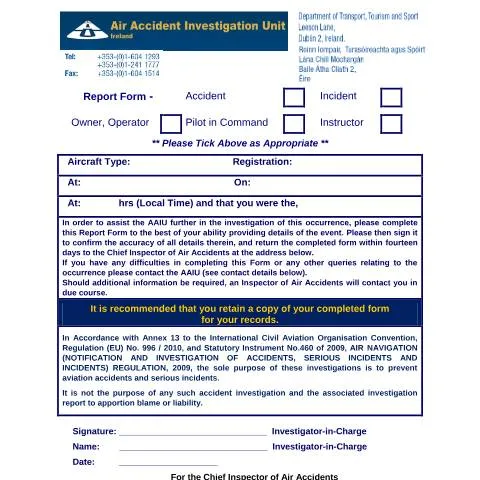
Understanding the Air Accident Investigation Unit Report Form
The Air Accident Investigation Unit (AAIU) report form is a critical document in the aviation field in Ireland. When an aviation incident or accident occurs, this official form serves as the first step towards understanding what happened, ensuring safety, and preventing future occurrences. The process begins with this form but extends far beyond, impacting a wide range of stakeholders in the aviation sector.
Defining the Context: Why This Form Matters
The AAIU operates under the aegis of the Department of Transport, adhering to both Irish and international regulations. The need for this specific report form stems from the necessity to comply with Annex 13 of the International Civil Aviation Organisation Convention. This annex outlines the procedures for investigating civil aviation accidents and incidents, focusing on safety rather than assigning blame or liability.
By collecting detailed information about the event through this report form, the AAIU can conduct thorough investigations aimed at enhancing the safety standards in air travel.
Who Needs to Fill Out the Report?
The range of individuals responsible for submitting this form includes:
- Owners: Individuals or entities that own the aircraft involved in the incident.
- Operators: Companies or entities responsible for the operation of the aircraft.
- Pilots: Commanding officers of the aircraft during the time of the incident.
Each of these parties may have different responsibilities when it comes to reporting the event. For example:
- Owner: May need to provide details about maintenance records and aircraft history.
- Operator: Should document flight operations, including schedules and crew assignments.
- Pilot: Will give a narrative of the incident based on firsthand experience during the flight.
Diving Deeper: Sub-cases and Exceptions
Not all incidents fit neatly into one category, and the regulations surrounding who must complete the form can vary. Consider the following scenarios:
- Commercial Flights: For commercial airline incidents, both the operator and the pilot must contribute to the report due to the complexities and regulatory requirements involved.
- Private Flights: In private aviation scenarios, the owner may have more responsibility, particularly if they also serve as the pilot.
- Training Flights: In the case of training incidents, instructors and student pilots might also be required to fill out the report to provide a comprehensive account of what transpired.
Navigating the Form: A Step-by-Step Guide
Completing the AAIU report form requires careful attention to detail. Here’s a breakdown of the primary sections and what information is typically required:
- Aircraft Details: This section mandates specifics such as:
- Aircraft registration number
- Make and model
- Engine specifications
| Field | Description |
|---|---|
| Aircraft Registration No | Unique identifier for the aircraft. |
| Year of Manufacture | The year the aircraft was built. |
| Total Airframe Hours | The cumulative flying hours of the aircraft. |
Flight Details: Key elements here include:
- Departure and arrival airfields
- Flight category and number of crew members
- Planned destination and actual flight path
Weather Conditions: Weather can significantly affect aviation safety. Reporting on forecasted and actual conditions during the flight helps investigators understand potential contributing factors.
Personal Information of Flight Crew: Capturing the background of the flight crew is vital. This includes licenses, medical certifications, and total flying experience.
Additional Information: This section allows for supplementary details that could aid in the investigation, such as communication logs or specific circumstances related to the event.
Ensuring Accuracy and Completeness
It is crucial for individuals filling out the form to ensure that all information provided is accurate and thorough. Inaccuracies can lead to misinterpretations during the investigation process, potentially undermining safety improvements.
Tip: Retaining a copy of the completed form for personal records is highly recommended. This provides a reference in the event of follow-up inquiries or additional information requests from the AAIU.
The Submission Process: Timelines and Protocols
After completing the form, it must be returned to the Chief Inspector of Air Accidents within 14 days of the incident. Adhering to this timeline is not merely a bureaucratic formality; it is a vital component of maintaining aviation safety.
Here’s a quick checklist for submitting the form:
- Double-check all entries for accuracy.
- Ensure the form is signed by the appropriate personnel.
- Submit via the prescribed method outlined by the AAIU.
What Happens Next? Understanding the Investigation Process
Once submitted, the report undergoes evaluation by AAIU investigators. They will examine the details provided, potentially reaching out for clarification or additional information.
- Investigation Stages: Generally, an investigation will have several phases, including initial analysis, detailed investigation, and preparation of a final report.
- Follow-Up: If investigators require further details, they will contact the person who submitted the report, ensuring all aspects of the incident are thoroughly examined.
Compliance with Data Protection Regulations
Given the sensitive nature of aviation incidents, data protection is of utmost concern. The AAIU is governed by the Data Protection Policy of the Department of Transport. Personal information collected during the reporting process is safeguarded against misuse and unauthorized access.
As per the policy:
- Data may be shared with international investigative authorities when required.
- Personal data not related to safety investigations is collected under strict privacy regulations.
Individuals filling out the form retain rights regarding their personal data, including the right to access and request corrections to their information.
Privacy Statement: What You Need to Know
The AAIU provides assurances regarding the handling of personal data. Key points include:
- Personal data collected for investigation purposes cannot be disclosed outside the investigation unless mandated by the High Court of Ireland.
- Security measures are in place to protect the information collected, in compliance with best practices in data protection.
Understanding the Broader Implications of the Report Form
The AAIU report form is not an isolated document; it resonates throughout the aviation community. It serves as a foundational piece in the ongoing effort to improve safety standards and safeguard the public. Here’s how it fits into the larger framework:
- Safety Improvements: Findings from investigations lead to recommendations that can improve safety regulations and operational protocols.
- Training: Information gathered can inform the training processes for new pilots and crew, emphasizing areas where awareness is crucial.
- Policy Development: Data from these reports can influence policy changes or the introduction of new regulations within the aviation sector.
Real-Life Case Studies: Learning from Past Incidents
Even a single report can lead to significant changes. For instance, in cases where multiple accidents share similar causes, the AAIU can identify critical issues and recommend changes in procedures or regulations.
Case Study Example:
- Incident A: Resulted in increased training requirements for low-visibility operations.
- Incident B: Led to enhanced protocols for maintenance checks on aging aircraft models.
Final Thoughts on the AAIU Report Form
The importance of the AAIU report form in aviation safety cannot be overstated. It is a crucial tool for gathering information that leads to enhanced safety measures, better training, and more informed policy-making.
Fill in your form directly online
No printing: type your details into the boxes of the official form, tick, then download the PDF ready to send.
- 1Type into the form boxes
- 2Tick in one click
- 3Save and download the PDF
Filling out this form accurately and promptly is not just a regulatory requirement; it is an essential step in contributing to a safer aviation environment for everyone. As such, those involved in aviation incidents should be mindful of their responsibilities in completing this report and understand the wider implications their input can have on future aviation safety standards.
Understanding Data Protection in the Context of Air Accident Investigations
In Ireland, the protection of personal data, especially within the framework of sensitive investigations such as those conducted by the Air Accident Investigation Unit (AAIU), is governed by the Data Protection Act 2018 and the General Data Protection Regulation (GDPR). These regulations ensure that any personal information collected during an investigation is handled with the utmost care and respect for individual privacy rights.
When individuals or entities provide information to the AAIU, they must be aware of their rights and the obligations of the AAIU under the law. For instance, all personal data must be processed lawfully, fairly, and transparently. This means that individuals have the right to know why their data is being collected, how it will be used, and the duration for which it will be retained. Furthermore, as part of the investigation process, any reports generated will typically anonymize personal data to safeguard privacy while still providing valuable insights into the incident being investigated.
It is essential for stakeholders, including witnesses, crew members, or passengers involved in an air accident, to understand that their personal data may be included in the AAIU investigation reports. However, the AAIU takes steps to minimize the identification of individuals unless it is necessary for the investigation’s integrity. For those who may have concerns regarding the processing of their data, the AAIU has a dedicated data protection officer who can be contacted for further clarification.
Filing a Report: The Role of the AAIU and Public Participation
The AAIU encourages public participation in air accident investigations as it can significantly contribute to the safety and improvement of aviation standards. Reporting an air accident or serious incident is not only a legal requirement but also a civic duty aimed at preventing future occurrences. Anyone who witnesses an aviation incident is urged to fill out the relevant report form, which is available on the AAIU's official website.
When completing the report form, individuals must provide as much detail as possible regarding the incident. This includes the date, time, location, and nature of the accident, as well as any identifiable particulars regarding the aircraft involved. The AAIU emphasizes the importance of accuracy and completeness in these reports to facilitate a thorough investigation process. It is worth noting that while personal information is required for follow-up, the AAIU will manage and protect this data in compliance with GDPR guidelines.
Once a report is filed, the AAIU will assess the situation and determine if an investigation is warranted. Individuals who submit a report can expect to receive acknowledgment of their submission, although detailed feedback may not always be possible due to the nature of investigations and confidentiality considerations. Maintaining open lines of communication is crucial; therefore, those involved should ensure that they provide correct contact details.
Confidentiality and Transparency: Navigating the Balance
One of the critical challenges faced by the AAIU is balancing confidentiality with transparency in air accident investigations. While the need for comprehensive and open reporting is paramount in fostering safety improvements, certain information must remain confidential to protect the integrity of the investigation and the privacy of individuals involved.
According to the regulations, the AAIU must maintain strict confidentiality regarding sensitive information related to investigations. This includes personal data of victims, witnesses, and any individuals who provided information. However, the AAIU is also required to publish reports of its findings, which can potentially lead to discussions about the limits of what can be shared publicly versus what must remain confidential.
To ensure that this balance is maintained, the AAIU has implemented several protocols. These involve a thorough review process where data related to personal identification is carefully considered before being included in any public reports. This means that insights drawn from the investigation can be shared with the public, thereby enhancing safety practices within the aviation sector, without compromising the privacy rights of those involved. Furthermore, the AAIU encourages stakeholders to engage in discussions about the effectiveness of these measures and any potential improvements that could be made to enhance transparency while protecting individual rights.