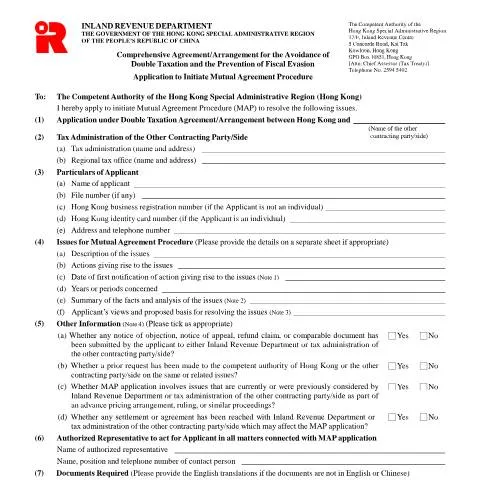
Navigating the IR 1454: A Practical Guide to the Application to Initiate Mutual Agreement Procedure
As global commerce expands and intertwines, understanding the nuances of international taxation becomes vital for individuals and corporations alike. Among the essential tools at your disposal is the Application to Initiate Mutual Agreement Procedure, formally known as IR 1454. This document serves as an entry point to resolving taxation disputes under double taxation agreements, ensuring that taxpayers are not hampered by conflicting tax regulations across jurisdictions.
The Significance of the Mutual Agreement Procedure (MAP)
Taxation is a critical concern for businesses operating in multiple countries. The mutual agreement procedure allows taxpayers to address disputes arising from the interpretation or application of double taxation agreements (DTAs). These agreements are designed to prevent double taxation and fiscal evasion. By filing the IR 1454, you initiate a process that can lead to a resolution, minimizing the risk of paying taxes in multiple jurisdictions.
Understanding the Document: Breakdown of Sections
The IR 1454 form is composed of several sections, each aimed at collecting specific information crucial for processing your application. Below is a detailed exploration of the form’s components, including common pitfalls to avoid during completion:
Section (1): Applicant Information
- Name of Applicant: This should reflect the legal entity or individual filing the application. Ensure accuracy to avoid processing delays.
- File Number: If applicable, include your tax file number; this helps the Inland Revenue Department (IRD) streamline your case.
- Contact Details: Providing a clear address and telephone number is essential for correspondence regarding your application.
Section (2): Tax Administration Details
Here, you must specify the tax administration responsible for the other contracting party. Often overlooked, this information is crucial, as discrepancies can lead to further complications.
Section (4): Issues for Mutual Agreement Procedure
This section is the heart of your application. It requires you to detail the issues giving rise to the taxation dispute. Notably, this is where many applicants stumble:
- Actions Giving Rise to Issues: Be as specific as possible. A vague description may result in a denial of your application.
- Summary of Facts: Clearly outline the facts surrounding your case, including any relevant dates and previous communications with tax authorities.
The Legal Framework Behind the IR 1454
Understanding the context within which the IR 1454 operates is essential. Under the Basic Law of the Hong Kong Special Administrative Region, provisions regarding taxation are designed to promote fairness and transparency. The MAP process aligns with this legal framework, ensuring that taxpayers have a channel through which they can seek resolutions to disputes arising from double taxation agreements.
Preparation of Supporting Documents
Supporting documentation is crucial for a successful application. You’ll need to compile various documents depending on your situation:
- Notice of Action: Include a copy of the notice leading to the dispute, such as an assessment or notification from the other contracting party.
- Relevant Agreements: Any existing agreements related to the taxation matter must be included for context.
- Transfer Pricing Documentation: If applicable, ensure that you adhere to the guidelines set forth in Departmental Interpretation and Practice Notes No. 58.
Specific Cases: Tailoring Your Application
Not all cases are straightforward. Here are a few examples of specific situations that might require a more nuanced approach when filling out the IR 1454:
Foreign Taxpayers
For non-Hong Kong residents, filling out the IR 1454 can be complex. It’s crucial to ensure that all information related to foreign tax identification numbers and relevant jurisdictions is accurately provided.
Minors and Guardianship
If the applicant is a minor, the form must be completed by a legal guardian. This adds another layer of responsibility, as all provided information must align with the minor's legal identity.
Complex Corporate Structures
For businesses with intricate ownership structures, it’s essential to outline the relationships between various entities clearly. This transparency will facilitate a smoother review process.
The Application Process: A Step-by-Step Journey
| Step | Description |
|---|---|
| 1. Gather Information | Collect all necessary documentation and information outlined in the form. |
| 2. Complete the Form | Fill out the IR 1454 accurately, ensuring no details are overlooked. |
| 3. Submit the Application | Choose your submission channel and file the application along with supporting documents. |
| 4. Await Response | The competent authority will review your application and may reach out for additional information. |
| 5. Agreement | If successful, an agreement will be proposed; review it carefully before acceptance. |
Submission Channels: Online and Offline Options
Hong Kong’s Inland Revenue Department emphasizes e-services, making the online submission of the IR 1454 both efficient and preferred. However, traditional paper submissions are still accepted. Here’s a breakdown of the options:
Online Submission
- Accessibility: Users can easily fill and submit the form through the official IRD website, ensuring a streamlined process.
- Tracking: An online submission allows for real-time tracking of your application status.
Paper Submission
- Location: Applications can be sent to the GPO Box 10851, Kowloon, Hong Kong. Ensure that all documentation is included to avoid delays.
- Processing Time: Expect longer processing times with paper submissions, as they require manual handling.
After the Submission: Anticipating Outcomes
Upon submission, it’s natural to wonder what comes next. The competent authority will assess your application based on the completeness and accuracy of the provided documents. They may reach out for further clarification or additional information, so prompt responses are vital.
Once an agreement is reached, the parties involved will be notified. If the terms of the agreement are acceptable, you will need to acknowledge this in writing for it to take effect. If not, you may choose to dispute the findings, which could lead to further negotiations or alternative resolutions.
Conclusion: Empowering Yourself in Taxation Matters
Engaging with the Mutual Agreement Procedure through the IR 1454 can seem daunting, but understanding each component of the process demystifies it significantly. By preparing thoroughly and ensuring accuracy in your submission, you position yourself for a favorable resolution to potential tax disputes. Always remember, the complexities of international taxation require vigilance, but with the right resources and knowledge, you can navigate them successfully.
Understanding the Mutual Agreement Procedure (MAP) in Hong Kong
The Mutual Agreement Procedure (MAP) is a key mechanism that allows taxpayers to resolve disputes related to double taxation. Under the double taxation agreements (DTAs) that Hong Kong has established with various jurisdictions, taxpayers can utilize the MAP to seek relief from double taxation on the same income. This procedure is especially beneficial for individuals or entities engaged in cross-border transactions. Understanding the MAP is crucial, as it offers a framework to ensure that double taxation does not impede international business operations.
In essence, the MAP provides an avenue for taxpayers to negotiate with tax authorities from both countries involved in the dispute. The process typically requires the taxpayer to submit a request to the Inland Revenue Department (IRD) in Hong Kong, which will then interact with the respective foreign tax authority. Taxpayers should be aware of the timelines and requirements set forth in the relevant DTA, as these can vary significantly depending on the partner jurisdiction.
For successful engagement with the MAP, the following steps should be meticulously observed:
- Preparation of Documentation: Gather all pertinent information, including tax returns, relevant correspondence with tax authorities, and any other documents that substantiate the claim of double taxation.
- Submission of Application: Fill out the necessary forms as specified by the IRD. It is critical to submit these within the timeframes outlined in the DTA—often within three years from the end of the tax year in which the income was taxed.
- Awaiting Response: After submission, there may be a formal acknowledgment from the IRD, followed by discussions with the foreign tax authority. Be prepared for potential requests for additional information.
Ultimately, the effectiveness of the MAP is contingent upon clear communication and thorough documentation. Each DTA may provide specific guidelines on procedural aspects, making it imperative for taxpayers to familiarize themselves with these nuances.
Key Considerations for Taxpayers Initiating MAP in Hong Kong
Initiating the Mutual Agreement Procedure (MAP) is a significant step for any taxpayer facing issues of double taxation. While the framework is established to assist taxpayers, there are several critical considerations that must be addressed to navigate the process successfully.
Eligibility Criteria: Not all taxpayers will qualify for the MAP. Eligibility usually requires that the taxpayer has been a resident of Hong Kong for tax purposes and has a valid double taxation agreement with the other jurisdiction. If the taxpayer has not paid the tax in question, the application may be deemed ineligible. Moreover, taxpayers should have already made efforts to resolve the issue with the foreign tax authority directly before invoking the MAP.
Timing and Deadlines: As previously mentioned, time is of the essence when it comes to MAP applications. The specific deadlines outlined in the DTA are non-negotiable, and failure to adhere to these timelines could result in the forfeiture of the taxpayer’s right to relief. Familiarity with the timeline ensures that all necessary documentation and requests are submitted promptly.
Documentation Requirements: Accurate and comprehensive documentation is paramount. This includes not only tax returns but also any correspondence that can substantiate the taxpayer’s position. Failure to provide sufficient evidence can result in delays or rejection of the MAP application. Taxpayers should also be prepared to provide translations for documents that are not in English or Traditional Chinese, ensuring compliance with the IRD’s requirements.
Legal Assistance: While it is possible for taxpayers to navigate the MAP process on their own, seeking legal advice can significantly enhance the likelihood of a favorable outcome. Tax laws, treaties, and procedures can be intricate, and expert guidance can help in understanding the nuances of the case and in formulating a strategy for the MAP.
The Role of E-Services in MAP Applications
In Hong Kong, the Inland Revenue Department has increasingly emphasized the use of e-services to streamline administrative operations, including the Mutual Agreement Procedure (MAP). Utilizing e-services not only expedites the submission process but also enhances the overall efficiency of communication between taxpayers and the IRD.
Online Application Submission: Taxpayers are encouraged to make use of the e-Tax platform provided by the IRD. Through this system, applications for the MAP can be submitted electronically, ensuring quicker processing times and immediate acknowledgment of receipt. This system also allows taxpayers to upload supporting documents in a secure environment, reducing the need for physical submissions.
Tracking Application Status: One of the key advantages of using e-services is the ability to track the status of your MAP application. Taxpayers can log into their e-Tax accounts to view updates, respond to requests for additional information, and communicate directly with IRD officials. This transparency can provide peace of mind and help taxpayers stay informed throughout the process.
Access to Resources and Guidance: The IRD’s website offers a wealth of resources, including guidance on the MAP process, FAQs, and contact information for relevant departments. By leveraging these online resources, taxpayers can better prepare their applications and understand the intricacies of the process, ensuring a higher likelihood of successful resolution.
Ongoing Communication: E-services facilitate ongoing communication between the taxpayer and the IRD. This is crucial in a process where timely exchanges of information can significantly impact the outcome. Regular updates through the e-Tax platform allow taxpayers to remain proactive and responsive to any queries raised by the IRD or the foreign tax authority.