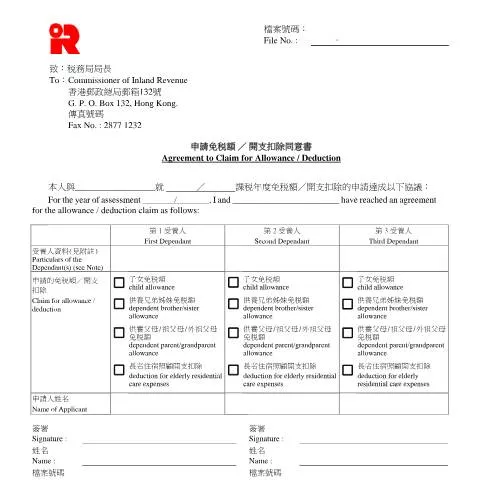
Understanding the Importance of the IR 6074A Form in Salaries Tax Assessment
The IR 6074A form, officially titled "Agreement to Claim for Allowance / Deduction," plays a pivotal role in the Salaries Tax and Personal Assessment framework in Hong Kong. This document serves as an agreement among parties to facilitate the claiming of various allowances and deductions under the Salaries Tax regime. Individuals seeking to maximize their tax benefits must be aware of what this form entails and how to navigate its submission.
A Deep Dive into the Components of IR 6074A
The IR 6074A comprises several sections designed to collect essential information from the applicants. Understanding each component is crucial for accurate completion. The form is structured into the following segments:
- Particulars of the Dependants: This section requires the names and HKID numbers of the dependants for whom allowances are being claimed.
- Claims for Allowance / Deduction: Here, applicants indicate which specific allowances or deductions they wish to claim, such as child allowances or deductions for elderly care expenses.
- Signatures and Contact Information: The document concludes with sections for signatures from all parties involved and their contact information, reinforcing the agreement's legitimacy.
Navigating the Submission Process Effectively
Once completed, the next step involves submitting the IR 6074A form. Applicants have multiple channels available for submission, each with its own nuances:
- Online Submission: Leveraging e-services enhances convenience. Users must log into the Inland Revenue Department (IRD) portal to upload their forms securely.
- Postal Submission: For those preferring traditional methods, forms can be mailed to the IRD, ensuring they are sent well ahead of deadlines to avoid delays.
- In-Person Submission: Visits to the IRD offices for face-to-face submission are also an option, allowing for immediate clarifications or inquiries.
Regardless of the method chosen, it is essential to confirm that the form is submitted within the stipulated deadlines to avoid penalties.
Essential Documentation and Justification Preparation
Preparation is crucial when it comes to the documentation needed to support claims made on the IR 6074A. Depending on the allowances being claimed, applicants should gather relevant documents:
| Allowance Type | Required Documentation |
|---|---|
| Child Allowance | Birth certificates or HKID numbers of the children |
| Dependent Brother/Sister Allowance | Proof of relationship and HKID numbers |
| Dependent Parent/Grandparent Allowance | Documentation proving dependent status and HKID numbers |
| Elderly Residential Care Expenses | Invoices or receipts related to care expenses |
Collecting the right documentation not only supports the claims but also expedites the review process by the IRD.
What Happens After Submission? Understanding the Processing Timeline
After the IR 6074A form is submitted, the processing kicks in. The IRD typically undertakes the following steps:
- Review of Submitted Claims: The department will assess the claims based on the provided documentation.
- Notification of Additional Information Requests: If further details or documents are needed, the IRD will reach out to the applicant.
- Issuance of Assessment Notice: Upon successful review, an assessment notice will be issued detailing the approved allowances and deductions.
Staying proactive during this stage is advisable; applicants can monitor their submission status via the IRD online platform or through direct contact.
Consequences of Incomplete or Incorrect Submissions
Submitting the IR 6074A without thorough checks can lead to several implications. Here are potential consequences:
- Delayed Processing: Incomplete forms may cause significant delays in processing times, impacting your tax situation.
- Denial of Claims: If claims are made without proper justification, the IRD may reject them entirely.
- Possible Penalties: Failing to submit on time or submitting incorrect information can lead to financial penalties, further complicating one’s tax situation.
It is therefore critical to double-check the form before submission and consult with tax professionals if uncertainties arise.
Understanding the Legal Framework Behind the IR 6074A
The IR 6074A form operates within the broader context of the Basic Law of the Hong Kong Special Administrative Region. The legal framework emphasizes transparency and fairness in taxation, outlining the rights and responsibilities of taxpayers. It is essential to understand:
- The Basic Law: This serves as the foundation for the legislative framework governing taxation and the rights of residents.
- Taxpayer Rights: Residents have the right to claim deductions and allowances as per the law, provided they meet stipulated criteria.
- Obligations of the IRD: The Inland Revenue Department is mandated to handle claims fairly and efficiently, ensuring taxpayers receive the benefits they are entitled to.
Being informed about the legal backdrop not only empowers taxpayers but also aids in navigating the claims process with confidence.
Final Steps: Confirming Receipt and Tracking Your Application
Once you have submitted the IR 6074A form, the next phase involves confirming the receipt and tracking your application. Here’s how you can effectively manage this:
- Receipt Confirmation: Ensure you receive an acknowledgment from the IRD indicating that your submission has been received. This can be an email confirmation for online submissions or a postal acknowledgment for mailed forms.
- Tracking Your Application: Utilize the IRD's online tracking services to monitor the status of your claims. Regularly checking can help identify any issues early in the process.
- Follow-Up: If there’s a delay in processing beyond the expected timeline, don’t hesitate to reach out to the IRD for updates or clarification.
Proactively managing your submission and ensuring open lines of communication with the IRD can alleviate stress and enhance your ability to successfully claim the allowances and deductions you are entitled to.
Understanding Allowances and Deductions in Hong Kong
In Hong Kong, the tax system is underpinned by various allowances and deductions aimed at tax relief for residents. The fundamental principle of the Salaries Tax and Personal Assessment is to tax individuals based on their income while allowing certain deductions to reduce their taxable income. Notably, the Agreement to Claim for Allowance/Deduction is an essential form that various taxpayers must complete to claim their eligible allowances and deductions effectively.
Taxpayers should familiarize themselves with the categories of allowances available, such as the basic allowance, married person's allowance, and child allowances. Each category has specific eligibility requirements, and the amounts are subject to annual review. For instance, the basic allowance is available to all taxpayers, while the married person's allowance can only be claimed by those who are legally married and living together.
In addition to personal allowances, taxpayers may also claim deductions for expenses incurred during employment, which include but are not limited to: self-education expenses, charitable donations, and contributions to mandatory provident funds (MPF). It's critical to retain all necessary documentation and receipts as proof, as they may be required for verification during the tax assessment.
Filling Out the Agreement to Claim for Allowance/Deduction: A Step-by-Step Guide
The completion of the Agreement to Claim for Allowance/Deduction can be daunting for some, but it is a straightforward process if approached systematically. Below is a step-by-step guide to assist taxpayers in filling out the relevant forms accurately:
- Gather Necessary Information: Before starting the form, compile all necessary documents, including your HKID number, income statements, proof of marriage (if applicable), and receipts for any deductible expenses.
- Download the Form: Visit the official website of the Inland Revenue Department (IRD) to download the latest version of the Agreement to Claim for Allowance/Deduction (Form IR56B or applicable specified forms).
- Personal Details Section: Input your personal details, including your name, HKID number, and contact information. Ensure that all entries are accurate to avoid processing delays.
- Claiming Allowances: Indicate which allowances you are claiming by checking the appropriate boxes. Be meticulous in reviewing the eligibility criteria for each allowance to avoid misrepresentations.
- Detailing Deductions: When filling in deductions, specify the amounts you are claiming. If you have multiple deductions, be sure to provide a breakdown, and ensure all claims are supported by receipts.
- Review and Submit: After completing the form, review all entries for accuracy. Once confirmed, submit the form electronically via eTax services or through physical mail to the appropriate address as indicated on the IRD website.
Common Pitfalls When Claiming Allowances and Deductions
While the process of claiming allowances and deductions in Hong Kong appears straightforward, taxpayers often encounter common pitfalls that can hinder their claims. Being aware of these issues can help mitigate potential challenges:
- Incomplete Information: One of the most frequent errors is providing incomplete or inaccurate information in the Agreement to Claim for Allowance/Deduction. Double-checking all entries and ensuring that they correspond with your supporting documents is crucial.
- Missing Deadlines: Hong Kong follows strict deadlines for tax submissions, and missing these deadlines can result in penalties or the inability to claim certain deductions. Mark important dates on your calendar and set reminders as necessary.
- Lack of Documentation: Failing to keep proper documentation can severely impact your claims. It is essential to retain all receipts, acknowledgments, and documentation for your deductions. The IRD may request these documents for verification.
- Not Understanding Eligibility Requirements: Each allowance and deduction has specific eligibility criteria that must be met. A lack of understanding can lead taxpayers to claim allowances they are not eligible for, which could result in penalties.
- Not Seeking Professional Advice: Given the complexity of tax regulations, many taxpayers miss out on potential deductions simply because they do not seek professional advice. Engaging with a tax consultant familiar with Hong Kong tax law can provide insights that are invaluable for maximizing your tax relief.
By being prepared and informed, taxpayers can enhance their ability to navigate the claiming process smoothly and fully benefit from the allowances and deductions available in Hong Kong.