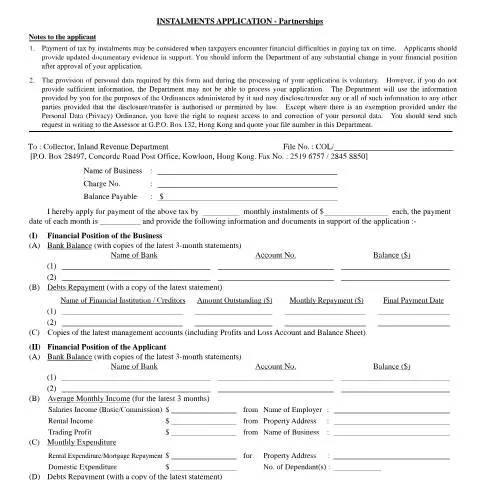
Understanding the Instalments Application - Partnerships (IR 1360A)
The Instalments Application - Partnerships form, designated as IR 1360A, plays a crucial role in the financial landscape for partnerships facing challenges in managing their tax obligations in Hong Kong. This document serves as a lifeline for businesses encountering financial strain, allowing them to request the Inland Revenue Department to accept tax payments in manageable instalments instead of a lump sum. This feature is particularly beneficial for partnerships that might experience cash flow difficulties, enabling them to maintain financial stability while fulfilling their tax responsibilities.
Navigating the Application Process
Filing the IR 1360A form requires a precise understanding of its structure and the specific details required. Below, we outline the essential components and steps to ensure a smooth application process:
- Business Information: Clearly state the name of the business and charge number. This information identifies the application and links it to the business's tax records.
- Financial Position: Provide detailed financial data, including bank balances and any outstanding debts. Attach the latest statements to substantiate your claims.
- Monthly Instalment Proposal: Specify the amount you wish to pay each month and indicate the payment date for each instalment. This proposal should align with your financial capabilities.
- Signature and Declaration: Ensure that the application is signed, affirming the accuracy of the provided information. This section holds legal significance, as it signifies your commitment to the application.
Documentation Requirements
As you prepare to submit the IR 1360A, several supporting documents are essential to bolster your application:
- Bank Statements: Include copies of the last three months' bank statements to provide evidence of your financial status.
- Debt Repayment Statements: Attach the latest statements from creditors to showcase any existing financial commitments.
- Management Accounts: Recent management accounts, including profit and loss statements, help to present a comprehensive view of your partnership's financial health.
The Importance of Accurate Financial Representation
When completing the IR 1360A form, accuracy cannot be overstated. Misrepresenting your financial position can lead to significant repercussions, including the rejection of your application or potential legal issues. It is crucial to:
- Verify Financial Data: Double-check all figures related to income, expenses, and debts.
- Document All Claims: Use official documents to support any claims made in your application, ensuring transparency and credibility.
What Happens After Submission?
Once you have submitted the IR 1360A, it is critical to understand the subsequent steps and how to stay informed about your application’s progress:
- Application Review: The Inland Revenue Department will review your application, which may take several weeks. During this time, they may contact you for further information.
- Acceptance or Rejection: You will receive a notification detailing the outcome of your application. If approved, it will outline the terms of your instalment plan.
- Monitoring Payments: Keep a record of your payments; failure to comply with the agreed terms may lead to additional penalties.
Dealing with Potential Issues
While navigating the IR 1360A application process, unforeseen issues may arise. Understanding how to address these challenges is vital:
- Refusal of Application: If your application is rejected, review the reasons provided and consider resubmitting with additional documentation or clarification.
- Missing Information: Incomplete applications can lead to delays. Always ensure that all required sections are filled out and that supporting documents are attached.
- Errors in Submission: If you notice an error after submission, promptly notify the Inland Revenue Department to amend the application to avoid complications.
Understanding Your Obligations as an Applicant
Submitting the IR 1360A form comes with a set of responsibilities that must be adhered to for the application to be processed efficiently:
- Timely Submission: Ensure that the application is submitted before the tax payment due date to avoid complications.
- Payment Compliance: Once accepted, adhere strictly to the payment schedule outlined in the approval.
- Honest Reporting: Always provide truthful and accurate information to maintain trust and transparency with the tax authorities.
Key Differences Between the Instalments Application and Other Forms
Understanding how the IR 1360A form differs from other related forms can clarify its unique purpose and application:
| Form | Purpose | Applicable Users |
|---|---|---|
| IR 1360A | Application for tax payments by instalments | Partnerships experiencing financial difficulties |
| IR 56A | Employer's Return of Remuneration and Pensions | Employers reporting employee income |
| IR 1001 | Property Tax Return | Property owners declaring rental income |
Preparing for the Future: Lessons from the Instalments Application
Filing the IR 1360A form is not merely a transaction; it provides invaluable insights into the financial management of partnerships. Here, we highlight essential lessons to consider moving forward:
- Financial Planning: Use this experience to refine your partnership's financial planning strategies. Regularly assess cash flow to prevent future tax payment difficulties.
- Documentation Practices: Establish robust documentation practices to ensure that financial data can be readily accessed and verified during future tax applications.
- Engagement with Tax Authorities: Foster a proactive relationship with the Inland Revenue Department, staying informed about any changes to tax regulations or support available for businesses.
Conclusion: The Path to Financial Stability
The Instalments Application - Partnerships (IR 1360A) serves as a critical tool for partnerships striving to manage their tax obligations amidst financial challenges. By thoroughly understanding the application process, ensuring accurate representation of financial status, and adhering to obligations, partnerships can navigate this critical aspect of taxation effectively. This proactive approach not only aids in compliance but also contributes to the overall financial health of the partnership, ultimately fostering a sustainable business environment in Hong Kong.
Understanding the Instalments Application Process for Partnerships in Hong Kong
When navigating the intricacies of the Instalments Application process in Hong Kong, particularly for partnerships, it’s essential to grasp the specific requirements and nuances that apply to this type of business structure. Partnerships in Hong Kong are primarily governed by the Partnership Ordinance (Cap. 38), and as such, they must comply with certain legal and administrative protocols when applying for instalment payments for tax obligations.
The instalment scheme allows taxpayers to spread out their tax payments over several months, easing financial burdens and encouraging compliance with tax obligations. In the context of partnerships, it’s important to understand who qualifies, the necessary documentation, and the specifics of the application process.
Eligibility Criteria for Instalments Applications in Partnerships
To be eligible for the Instalments Application, a partnership must demonstrate that it meets certain criteria. This includes:
Assessment of Taxable Income: The partnership should have a stable income stream and be able to demonstrate cash flow capability to meet the proposed instalment payments. An income projection may be a requisite part of the application process.
Good Compliance History: The Hong Kong Inland Revenue Department (IRD) looks favorably upon partnerships with a clean compliance record, meaning no past due taxes or penalties. A history of timely payments can significantly enhance the likelihood of approval for the instalment plan.
Nature of Business Activities: Certain industries may face greater scrutiny based on economic conditions. The IRD may take into consideration external factors affecting the partnership's business, especially if a partnership operates in a volatile sector.
Submission of Financial Statements: Partnerships must provide detailed financial statements, including profit and loss statements and balance sheets, for the past year or how the current fiscal year has been progressing. This documentation attests to the partnership's financial status.
Documents Required for Application Submission
An Instalments Application for partnerships necessitates the assembly of various documents to support the submission effectively. Below is a comprehensive list of the documents you may need to prepare:
Form IRD 156: This form is the standard application for the proposal of an instalment payment plan. It must be filled out accurately, providing all relevant details about the partnership.
Financial Statements: As mentioned earlier, ensure that these statements are up-to-date, ideally audited, and prepared in accordance with the Hong Kong Financial Reporting Standards (HKFRS).
Projected Cash Flow Statement: This should illustrate anticipated income, expenses, and any other financial commitments, providing evidence that the partnership can meet the proposed payment schedule.
Partnership Agreement: A copy of the partnership agreement may be required to clarify the roles and responsibilities of each partner. This document can also highlight how profits are shared, which can influence tax obligations.
Proof of ID for All Partners: Hong Kong Identity Cards (HKID) of all partners must be submitted to verify identity and business registration.
Submission and Processing Timelines
Once all documents are collated, the application can be submitted to the IRD. It is advisable to allow ample processing time, as the IRD typically takes several weeks to review applications. A timeline for the application process generally includes:
Initial Submission: The partnership submits the application and accompanying documents to the IRD.
Review Period: The IRD will examine the provided information and may request additional documentation or clarification. This review process can take anywhere from 4 to 8 weeks.
Notification of Outcome: After the review, the IRD will issue a notification regarding the approval or rejection of the instalment application.
Commencement of Payments: If approved, the IRD will specify the payment schedule, detailing the amount due and the deadlines for each instalment.
Partnerships should remain proactive during this phase and follow up with the IRD if they have not received a response within the expected timeframe.
Common Challenges and Solutions in the Instalments Application Process for Partnerships
While applying for an Instalments Application can streamline tax payments, partnerships often face specific challenges during the process. Understanding these hurdles and potential solutions can facilitate smoother navigation through the application.
Common Challenges
Lack of Clear Financial Records: A frequent issue arises from inadequate bookkeeping. Partnerships that do not maintain precise financial records risk rejection of their application due to insufficient evidence of their financial status.
Inadequate Financial Projections: Submitting overly optimistic or unrealistic financial projections can hinder the application process. The IRD is experienced in assessing business viability and cash flow, and unrealistic data can lead to skepticism regarding the ability to honor the instalment agreement.
Failure to Meet Submission Deadlines: Timeliness is critical in the application process. Partnerships that miss deadlines may not only face delays but could also incur penalties or interest on outstanding tax amounts.
Inconsistent Partner Information: Any discrepancies among partners’ information can create confusion in the application process. This includes inconsistent names, terms in the partnership agreement, or differing identification documents.
Solutions to Overcome Challenges
Maintain Accurate Records: Implementing robust accounting practices will help ensure that all financial transactions are recorded systematically. Regular financial reviews can catch discrepancies early and ensure compliance.
Realistic Financial Forecasting: When preparing cash flow projections, it is essential to use conservative estimates based on historical data and realistic expectations for the upcoming tax year.
Calendar Management: Use digital calendars or reminders to track important deadlines related to tax filings and applications. Setting internal deadlines earlier than official ones can also provide a buffer for unexpected issues.
Consistent Communication Among Partners: Establish clear communication channels among partners to ensure that all information is consistent and accurate. Regular meetings can help address any discrepancies before submission.
By anticipating and addressing these challenges, partnerships can improve their chances of successfully navigating the Instalments Application process, ultimately leading to more effective tax management.
Post-Application: Managing Instalment Payments and Compliance
Once a partnership's Instalments Application is approved, managing ongoing payments and compliance becomes critical for maintaining good standing with the IRD. Here are essential considerations and effective strategies for post-application management.
Ongoing Payment Management
Setting Up Payment Reminders: It is beneficial for partnerships to set up payment reminders well in advance of due dates. This can help in avoiding any late payments, which could result in penalties.
Budgeting for Instalment Payments: Partnerships should incorporate instalment payments into their overall budgetary framework. This ensures that funds are available when payments are due, reducing financial strain.
Monitoring Cash Flow: Regular monitoring of cash flow is essential to ensure that the partnership can meet its instalment obligations without jeopardizing operational funds. Considerations should include seasonal fluctuations in income and unexpected expenses.
Compliance with IRD Regulations
Regular Review of Tax Obligations: Partnerships should routinely review their tax obligations, especially if there are changes in business operations or income levels. Staying informed about tax law changes can also safeguard against compliance issues.
Documentation of Payments: Keep an organized record of all payment transactions related to tax instalments. This documentation can be vital in case of any queries from the IRD or if discrepancies arise.
Consultation with Tax Professionals: Engaging with tax consultants or accountants can provide partnerships with insights into compliance and best practices for managing their tax obligations effectively. This can also assist in navigating any unforeseen circumstances that may impact financial standing.
Review of Partnership Agreement: With an approved instalment plan in place, it might also be prudent to review the partnership agreement to ensure it accommodates any changes in financial responsibilities resulting from the instalment payments, especially if any new partners are added or partners leave.
By implementing these strategies, partnerships can effectively manage their instalment payments while ensuring they remain compliant with the IRD’s regulations, thereby fostering a healthy financial environment.