The Role of the Certificate of Resident Status in Hong Kong's Tax Landscape
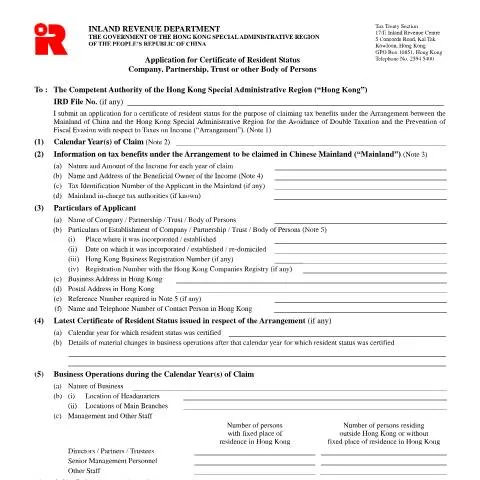
In the dynamic world of international business, understanding tax obligations is crucial for companies, partnerships, and trusts operating across jurisdictions. The Application for Certificate of Resident Status (IR 1313A) serves as a vital document for entities seeking to benefit from agreements that eliminate double taxation. This certificate not only provides validation of an entity's residency status but also facilitates smoother interactions with tax authorities in other jurisdictions.
Eligibility Criteria for Application: Who Can Apply?
Determining eligibility for the Certificate of Resident Status is essential for companies, partnerships, and trusts. The following conditions generally apply:
- Entity Type: Applicants must be a registered company, partnership, trust, or other body of persons established in Hong Kong or outside with local operations.
- Purpose of Application: The certificate must be sought to claim tax benefits under the Double Taxation Agreements (DTAs) Hong Kong has with other jurisdictions.
- Business Operations: The applicant should have conducted business operations in Hong Kong during the calendar year of claim.
- Documentation: Applicants must provide supporting documentation, including proof of registration and details of business operations.
The Legal Significance of the Certificate
The Certificate of Resident Status possesses substantial legal weight. It functions as a formal acknowledgment from the Hong Kong Inland Revenue Department of an entity's residency status. This document attests to:
- Tax Residency: Confirmation that the entity is a resident for tax purposes in Hong Kong.
- Eligibility for Tax Benefits: Access to claim benefits under the relevant Double Taxation Agreements.
- Legal Assurance: Reduced risk of double taxation in the jurisdictions with which Hong Kong has treaties.
Navigating the Application Process: A Step-by-Step Guide
The application process for the Certificate of Resident Status can appear daunting, yet it can be effectively navigated by following these structured steps:
- Prepare Documentation: Gather all necessary documents, including the certificate of incorporation, business registration, and any relevant financial statements.
- Complete the Application Form (IR 1313A): Fill out the form accurately, ensuring all sections are completed with precise information about your entity's operations.
- Submit Supporting Documents: Include copies of additional documents that substantiate your application, such as business operation details and prior certificates of resident status.
- Submit Application: Send the completed application form along with supporting documents to the appropriate authority in Hong Kong.
- Await Review: The Inland Revenue Department will review the application and may request further information if needed.
- Receive Certificate: If approved, the certificate will be issued, confirming your entity's resident status.
Renewal and Validity: Understanding Timeframes
The duration of validity for the Certificate of Resident Status varies based on specific circumstances:
- Annual Renewal: The certificate is typically valid for the calendar year specified in the application. Entities must reapply annually if they continue to seek tax benefits.
- Material Changes: If there are significant changes in business operations or structure, a new certificate may be required.
- Expiry of Benefits: Entities should be aware that even with a certificate, the eligibility for tax benefits depends on meeting continuous residency criteria in Hong Kong.
Impact of the Certificate: Practical Applications in Global Business
The Certificate of Resident Status empowers companies to navigate tax obligations effectively while expanding their global footprint. Here’s how:
- Access to Double Taxation Relief: Entities can claim relief from tax on foreign-sourced income, significantly enhancing their profitability.
- Facilitating Cross-Border Transactions: With the certificate, businesses can efficiently manage tax implications when entering new markets.
- Enhancing Credibility: Holding an official document from the Hong Kong Inland Revenue Department enhances the credibility of a business in international dealings.
Specific Cases: When to Seek Expert Guidance
While the process is clear-cut for many, there are instances where seeking expert guidance is advisable:
- Complex Business Structures: Entities with intricate international setups may require professional assistance to ensure compliance.
- Previous Denials: If an application has been previously denied, understanding the reasons and addressing them may require expert input.
- Tax Planning Strategies: Engaging a professional can optimize tax strategies that leverage the advantages of the certificate.
The Importance of Compliance: Consequences of Non-Disclosure
Honesty in the application is paramount. The Inland Revenue Department emphasizes that:
- Accuracy is Key: Any misinformation may lead to severe penalties under section 80(2D) of the Inland Revenue Ordinance.
- Disclosure Requirements: Applicants must disclose all relevant information that could impact their eligibility for tax benefits.
- Long-Term Implications: Non-compliance may result in ongoing scrutiny from tax authorities, impacting future applications.
Conclusion: The Certificate's Role in Hong Kong’s Economic Framework
The Certificate of Resident Status (IR 1313A) is more than just a document; it represents a strategic asset for entities looking to operate efficiently in the global marketplace. Understanding its importance, navigating the application process, and maintaining compliance are essential for any business aiming for sustainable growth in Hong Kong and beyond.
Understanding the Implications of Resident Status in Hong Kong
When applying for a Certificate of Resident Status, it is crucial to understand the broader implications this status holds for your entity. The Certificate is not merely a formality; it serves as a pivotal document that establishes your entity's operational legitimacy in Hong Kong. It can impact various aspects of your entity's operations, including tax obligations, eligibility for certain reliefs, and compliance with local regulations.
The distinction of being classified as a resident entity implies that your company, partnership, or trust is primarily managed and controlled within Hong Kong. This status is vital for tax purposes; as a resident, your entity will be subject to the profits tax on income sourced from Hong Kong, and you may benefit from the Double Taxation Relief agreements that Hong Kong has established with numerous jurisdictions. It is essential to keep accurate records and documentation that demonstrate your operational base and management in Hong Kong to substantiate your application for resident status.
Furthermore, understanding this status also helps in navigating the local regulatory landscape. For instance, certain licenses or permits may only be granted to resident entities. This could affect your ability to conduct business, especially in regulated sectors such as finance or healthcare. Therefore, it is advisable to consult with legal or tax professionals who are well-versed in Hong Kong regulations and can provide tailored advice based on your entity's unique circumstances.
Common Challenges and Solutions in the Application Process
The application for a Certificate of Resident Status can present several challenges, particularly for foreign entities looking to establish their presence in Hong Kong. One common hurdle is the requirement for comprehensive documentation that verifies the entity's management and control within Hong Kong. Often, applicants may struggle to provide sufficient evidence, leading to delays or even rejection of the application.
To overcome these challenges, it is advisable to engage in meticulous preparation before submitting your application. Identify all necessary documents early in the process, including board meeting minutes, financial records, and local payroll evidence, that clearly demonstrate the entity's activities and decision-making processes within Hong Kong. Working with local professionals who understand the intricacies of the application requirements can also significantly enhance your chances of a successful application.
Another potential challenge arises from the interpretation of "control" and "management," which can sometimes be subjective. The Hong Kong Inland Revenue Department (IRD) closely scrutinizes these factors. Therefore, it is crucial to ensure that your entity's governing bodies—such as boards of directors or trustees—are composed of individuals who are physically present in Hong Kong and actively involved in day-to-day operations. This not only solidifies your application but also enhances the operational efficiency of your entity in the long run.
Post-Application Considerations for Maintaining Resident Status
Securing a Certificate of Resident Status is just the beginning of a more extensive journey in maintaining that status. Several ongoing obligations and considerations come into play once your application is approved. One of the most significant aspects to consider is the continuous compliance with local laws and regulations. The IRD expects resident entities to uphold their operational presence in Hong Kong consistently. Any significant changes in the management structure or operational strategies must be reported to the IRD to avoid complications regarding your resident status.
Additionally, regular audits and compliance checks may be conducted by the IRD to validate your claims of resident status. Thus, maintaining thorough and accurate records becomes imperative. This includes keeping track of financial transactions, governance meetings, and any strategic business decisions made within Hong Kong. Failure to maintain proper documentation can lead to challenges if the IRD questions your residency status during an audit.
Moreover, it is also wise to stay informed about changes in Hong Kong’s tax laws and international agreements, such as updates to the Double Taxation Relief arrangements. Such changes can significantly impact your entity’s tax obligations and eligibility for various tax reliefs. Regular consultations with tax advisors can help your entity navigate these complexities and ensure compliance with the legal landscape.