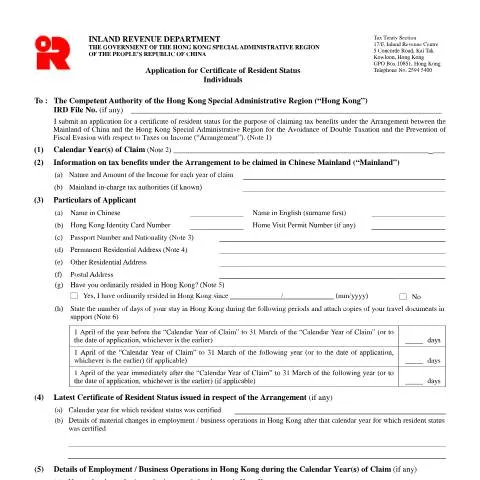
Navigating the Application for Certificate of Resident Status: A Detailed Guide
In the rapidly evolving landscape of international finance and taxation, understanding the Application for Certificate of Resident Status (Individuals) is crucial for those residing in Hong Kong. This document, referenced as IR 1314A, is essential for individuals seeking to benefit from double taxation agreements between Hong Kong and other jurisdictions. The process of application, its implications, and practical considerations can significantly impact your financial obligations and rights. Here, we delve into the intricacies of this application.
Understanding the Importance of the Certificate of Resident Status
The Certificate of Resident Status serves as a vital instrument for individuals wishing to claim relief from double taxation—essentially preventing the same income from being taxed in both Hong Kong and another jurisdiction. This status not only provides financial benefits but also facilitates smoother business operations for expatriates and local residents alike.
Real-life Implications
Consider an expatriate who has relocated to Hong Kong for employment. Without this certificate, the individual could face a significantly higher tax burden, as they may be subject to taxation in both their home country and Hong Kong. By obtaining the certificate, the individual can claim applicable tax benefits, ensuring that they pay taxes only in one jurisdiction, thereby alleviating financial strain.
Eligibility and Conditions for Application
Eligibility for the Certificate of Resident Status is primarily predicated on a few key criteria. Understanding these conditions is essential for prospective applicants.
Who Can Apply?
- Individuals who ordinarily reside in Hong Kong.
- Individuals with a permanent residence status in Hong Kong.
- Tax residents who have a Hong Kong Identity Card (HKID).
Conditions to Fulfill
Each applicant must meet specific conditions to ensure a successful application:
- The applicant must have resided in Hong Kong for a substantial portion of the tax year.
- Documentation supporting the claim of residence must be provided, including proof of employment or business operations in Hong Kong.
- Previous certificates of resident status, if applicable, must be disclosed.
Step-by-Step Application Process
Completing the application correctly is paramount for receiving the Certificate of Resident Status without delay. The steps are as follows:
Gather Required Information
Before diving into the application form, ensure that you have the following information ready:
- Your full name (in Chinese and English).
- Your HKID number and passport information.
- Your permanent and postal addresses.
- Details regarding your employment or business operations in Hong Kong.
Filling Out the Application Form (IR 1314A)
The form requires detailed information across several sections, including:
- Calendar Year(s) of Claim: Specify the relevant calendar years for which you are applying.
- Tax Benefits: Outline the tax benefits you wish to claim under the double taxation arrangement.
- Particulars of the Applicant: Provide personal details, including your residence history.
Submitting the Application
Once completed, submit your application to the Inland Revenue Department (IRD) via the specified channels. Ensure all documents are attached to avoid any processing delays.
Duration and Validity of the Certificate
The Certificate of Resident Status is not indefinite; understanding its duration and renewal process is essential for ongoing compliance.
Validity Period
The certificate typically covers a specific calendar year and is valid for that year plus the subsequent two years. For example, if you apply for the 2023 calendar year, the certificate will be valid until the end of 2025.
Renewal Process
Renewing your certificate involves reapplying for resident status, ensuring that all supporting documentation is up to date. If your residency situation does not change significantly, the renewal process can often be streamlined.
Challenges and Solutions: What If Issues Arise?
Despite careful preparation, applicants may encounter challenges. Understanding the potential hurdles can help applicants navigate them effectively.
Loss or Misplacement of the Certificate
If your certificate is lost or misplaced, prompt action is required:
- Contact the IRD immediately to report the loss.
- Request a reissue, supplying necessary identification and a formal declaration.
Errors in the Application
In the event of an error in the application:
- Contact the IRD to discuss the issue.
- Submit any amendments or additional documents as instructed by the department.
Usage Scenarios: Where the Certificate is Required
Understanding where and how the Certificate of Resident Status is utilized can provide clarity on its practical applications.
International Tax Claims
For individuals planning to claim tax benefits in both Hong Kong and other jurisdictions, presenting this certificate is often a prerequisite. Authorities in various jurisdictions may require verification of your resident status to grant applicable tax relief.
Financial Institutions
When engaging with banks or financial institutions, the certificate may be necessary to facilitate the opening of accounts or obtaining loans. It serves as proof of your tax residence status, significantly influencing financial dealings.
Potential Future Changes: Staying Informed
The landscape of international taxation is continuously evolving. Keeping abreast of any changes in regulations around the Certificate of Resident Status can ensure compliance and optimize tax benefits.
Legislative Updates
Regularly check updates from the IRD regarding changes to double taxation agreements and the implications for residency status. Engaging with tax professionals for advice based on the latest information can also be beneficial.
Adapting to Changing Circumstances
Individuals may find their residency situations shifting due to employment changes or personal circumstances. It's crucial to reassess your residency status regularly and apply for a new certificate if necessary.
Final Thoughts on the Application Process
The pursuit of the Certificate of Resident Status is a vital step for anyone looking to navigate the complexities of taxation effectively in Hong Kong and beyond. Understanding the application process, its implications, and where to seek assistance ensures that individuals can leverage their status effectively.
For those looking to apply, a proactive approach combined with thorough preparation can facilitate a smooth experience. Engage with the Inland Revenue Department for clarity on specifics, and ensure that you are fully informed about your rights and responsibilities as a taxpayer in this unique regulatory landscape.
Understanding the Criteria for Residency Status Application
In order to successfully apply for a Certificate of Resident Status in Hong Kong, it is essential for individuals to understand the specific criteria set forth by the Hong Kong authorities. The application process is not merely a formality; it requires a thorough examination of residency status under the prevailing legal framework.
Fill in your form directly online
No printing: type your details into the boxes of the official form, tick, then download the PDF ready to send.
- 1Type into the form boxes
- 2Tick in one click
- 3Save and download the PDF
The primary consideration for residency is the duration of physical presence in Hong Kong. An individual must demonstrate a continuous stay of at least 180 days during the financial year to qualify for the certificate. Additionally, applicants must provide evidence of their ties to Hong Kong, such as employment or business operations, as well as any family connections, which can significantly impact the decision.
Furthermore, individuals who have been physically present in Hong Kong for more than seven years may qualify for permanent resident status, which further simplifies the application process for the certificate. A thorough understanding of these criteria will not only assist in the correct completion of the application, but also expedite the review process conducted by the Hong Kong Inland Revenue Department (IRD).
Documenting Your Residency: Essential Paperwork
One of the most critical aspects of applying for a Certificate of Resident Status is the documentation required. An applicant must be prepared to present a comprehensive set of documents that validate their claims of residency in Hong Kong.
Firstly, the application requires a completed NNC2 form, which is the primary document for the application. This must be accompanied by the applicant's HKID card copy, proof of residence (such as a utility bill or rental agreement), and any employment contracts that may substantiate claims of presence in Hong Kong. Moreover, for those who own businesses, providing business registration certificates and tax documentation further strengthens the application.
It's also imperative to include any relevant personal documents, such as marriage certificates or birth certificates for dependents, as these establish family ties within the region. The more comprehensive the documentation, the higher the chances of a smooth approval process.
Lastly, ensure that all documents submitted are in English or Traditional Chinese, as bilingual submissions are mandatory. This adherence to language requirements not only facilitates processing but also aligns with the regulations outlined in the Basic Law of the Hong Kong Special Administrative Region.
Maximizing Your Application Success: Common Pitfalls to Avoid
While applying for a Certificate of Resident Status, applicants should be aware of common pitfalls that could lead to delays or even rejections of their applications. Understanding these potential issues is crucial for ensuring a successful application.
One common mistake involves submitting incomplete documentation. Applicants must ensure that all required forms are not only filled out completely but also submitted alongside all necessary supporting documents. Missing documents, such as proof of residence or employment, will likely lead to requests for additional information, which can prolong the application process.
Another issue arises from insufficient proof of physical presence. Many applicants fail to adequately document their time spent in Hong Kong. It is not enough to simply state that one resides in the area; comprehensive records of entry and exit dates, as well as travel itineraries, can provide concrete evidence of residency. Maintaining a clear and organized record of these dates is essential.
Additionally, applicants should be cautious of deadlines. The tax year in Hong Kong runs from April 1 to March 31, and applications should be submitted promptly within the relevant timeframe. Delays could result in missed deadlines, thus complicating the approval process.
In summary, being methodical in gathering documentation, providing thorough evidence, and adhering to timelines can significantly enhance the likelihood of a successful application for the Certificate of Resident Status.