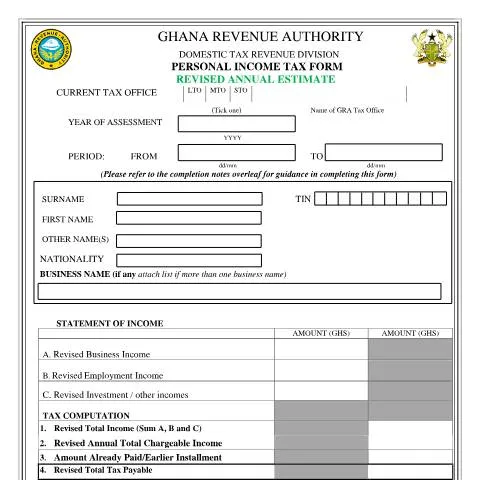
Navigating the Revised Personal Income Tax Self Assessment Estimate Form (DT-0104A)
Understanding the intricacies of tax documentation is a crucial part of financial responsibility in Ghana. The Revised Personal Income Tax Self Assessment Estimate Form, referenced as DT-0104A, plays a pivotal role in ensuring that individual taxpayers accurately assess and report their income and tax obligations. For those who may be unfamiliar with the procedure, filling out this form is not merely a bureaucratic exercise; it is an essential component of compliance with tax regulations set forth by the Ghana Revenue Authority (GRA).
A Historical Overview: The Framework Behind DT-0104A
To fully grasp the significance of the DT-0104A form, one must look at the historical and legal context that has shaped its existence. Under the 1992 Constitution of Ghana, tax collection and administration are fundamental responsibilities allocated to the GRA. This authority is tasked with enforcing tax laws, ensuring compliance, and collecting revenue necessary for national development. The introduction of the Revised Personal Income Tax Self Assessment Estimate Form is a direct response to the need for a more streamlined process in the self-assessment of tax obligations.
The self-assessment regime allows taxpayers to determine their tax obligations based on their income, thereby promoting transparency and accountability. The form was revised to reflect current economic conditions and to simplify the process for taxpayers, aligning it with the GRA's ongoing modernization efforts. The current iteration of the form takes into account various income sources, allowing the taxpayer to provide a comprehensive overview of their financial situation.
Understanding Your Responsibilities: Who Should File DT-0104A?
The DT-0104A form is primarily intended for individuals who earn income through various channels, including business activities, salaried employment, and investment returns. Any Ghanaian citizen or resident who meets the income requirements stipulated by the GRA is obligated to file this form. It is particularly critical for:
- Self-employed individuals who derive income from business activities.
- Employees whose income has fluctuated during the fiscal year.
- Individuals with diversified investment portfolios generating returns.
Moreover, understanding the demographic nuances is crucial. For instance, expatriates and foreign nationals earning income within Ghana must also comply with the tax regulations and may need to use this form to declare their income specifically related to Ghanaian sources.
Deciphering the Sections: A Closer Look at Form DT-0104A
Filling out the DT-0104A form requires careful attention to detail. Each section corresponds to specific information that the GRA needs to assess an individual’s tax liabilities adequately. Below, we break down the key sections of the form and highlight potential pitfalls to avoid during the completion process.
Identification Details
The first section of the DT-0104A form requests personal identification details:
- Surname: Your last name as it appears on official identification.
- First Name: Your first name.
- Other Names: Any additional names by which you are known.
- Nationality: Your country of citizenship.
- TIN: The Taxpayer Identification Number, crucial for all tax-related matters.
- Business Name: If applicable, provide the registered name of your business.
Each of these fields must be filled out accurately, as discrepancies can lead to delays or complications in processing. For instance, entering an incorrect TIN can result in rejection of the form and potential penalties.
Statement of Income
The Statement of Income is possibly the most critical part of the form, as it provides the GRA with a clear picture of your financial situation:
- Revised Business Income: Total income derived from business operations. Ensure that this figure reflects your latest financial records to avoid overestimations.
- Revised Employment Income: Total income from employment. Notify the GRA about any changes in employment status to adjust your estimates appropriately.
- Revised Investment/Other Income: Any income generated from investments or other sources must be reported here.
For many taxpayers, the challenge lies in accurately calculating the revised figures. It is advisable to maintain organized records throughout the year to facilitate this process. Taxpayers should ensure that they categorize their income sources correctly, as misclassifications can lead to wrongful tax assessments.
Tax Computation Section
In this section, users calculate their total tax obligations based on the income reported. The calculations include:
- Revised Total Income: The sum of all income sources (A + B + C).
- Revised Annual Total Chargeable Income: This is calculated by deducting any allowable deductions from the total income.
- Amount Already Paid/Earlier Installment: Include any payments made before the submission of this form.
- Revised Total Tax Payable: The final amount owed to the GRA after accounting for previous payments.
- Number of Quarters Outstanding: How many quarters remain in the financial year.
- Amount to be Paid Each Remaining Quarter: Calculate the payable amount for each quarter based on the total tax payable and any previous installments made.
This section often confuses taxpayers. A detailed understanding of tax rates and allowable deductions is essential. Utilizing the GRA's resources or consulting with a tax professional can help clarify any uncertainties.
Filing the DT-0104A: Steps and Considerations
Completing the DT-0104A form is only one part of the process; timely filing is equally important. Here's a step-by-step guide to streamline your submission:
Step 1: Gather Documentation
Before you fill out the form, ensure you have all relevant documents at hand:
- Financial statements (income statements, profit and loss accounts).
- Previous tax returns to reference income and deductions.
- Any correspondence with the GRA regarding tax matters.
Step 2: Complete the Form
Take your time to fill out every section of the DT-0104A. Use the completion notes provided with the form as guidance. Ensure that all fields are complete:
- Where a response is not applicable, indicate 'N/A' or '0' for numeric values.
- Avoid leaving any sections blank, as this could delay processing.
Step 3: Submit the Completed Form
After ensuring that your form is accurate and complete, submit it to your designated GRA tax office. It's essential to keep a copy for your records.
Step 4: Await Confirmation
Following submission, the GRA will process your form and provide confirmation. If there are any issues, such as errors or missing information, you will be contacted for clarification.
Dealing with Complications: What If Issues Arise?
Filing taxes can be fraught with challenges, and it's crucial to know how to handle potential issues that may arise during the process. Here are some common scenarios and how to navigate them:
Refusal or Rejection of the Form
If your DT-0104A form is rejected, the GRA will typically communicate the reasons for the refusal. Common issues include:
- Incomplete information provided.
- Discrepancies in income calculations.
- Incorrect TIN or personal identification details.
Upon receiving notification of rejection, rectify the stated issues promptly and resubmit the form. Be sure to communicate with the GRA for guidance to avoid future mistakes.
Missing Documentation
In the event that documentation is missing, such as proof of income or identity verification, the GRA may suspend the processing of your form. Always ensure that you have duplicates of any necessary documents to expedite the process. If you realize you’ve overlooked a requirement after submission, contact the GRA immediately to submit the missing pieces.
Special Considerations: Unique Taxpayer Situations
Not everyone fits neatly into standard categories, and specific situations require tailored approaches when completing the DT-0104A form:
Foreign Nationals and Expatriates
Expatriates earning income in Ghana must adhere to local tax obligations, including completing the DT-0104A. However, specific tax treaties may affect their tax liability. Consulting with a tax advisor familiar with international tax law is prudent.
Minors and Guardians
For minors earning income, a guardian or parent must complete the form on their behalf, ensuring all sections are filled out accurately. Guardians should be aware that minors may be subject to different tax rates or exemptions.
Simplifying Complex Situations
Taxpayers in complex situations—such as those with multiple income sources, investments, or significant changes in employment—may benefit from professional assistance. Enlisting the help of tax professionals can mitigate errors and ensure compliance with local tax laws.
Resources Available for Assistance
Taxpayers are not alone on this journey. The GRA provides several resources to aid individuals in completing their tax obligations:
- GRA Website: Access digital forms, guides, and updates on tax regulations at ghana.gov.gh.
- Local Tax Offices: Visit the nearest GRA office for personalized assistance and clarification on complex tax matters.
- Community Workshops: The GRA occasionally hosts workshops to educate taxpayers on the self-assessment process.
By utilizing available resources and understanding the implications of the DT-0104A form, taxpayers can make informed decisions and ensure compliance with Ghanaian tax laws.
Understanding the Revised Personal Income Tax Self-Assessment Estimate Form
The Revised Personal Income Tax Self-Assessment Estimate Form is an essential document for individuals in Ghana who wish to accurately report their income and estimate their personal income tax liabilities. The form is part of the Ghana Revenue Authority's (GRA) efforts to streamline tax administration and encourage voluntary compliance among taxpayers. It is vital to understand its components, how to fill it out, and its relevance to both residents and non-residents.
The form, often referred to as Form PERS 1 (or specific GRA codes), requires taxpayers to provide detailed information regarding their income sources, anticipated earnings for the financial year, and any applicable deductions or exemptions. Taxpayers must ensure that the information recorded is truthful and precise to avoid penalties, which could arise from underreporting income.
To commence filling out the form, individuals must provide their Tax Identification Number (TIN), which is crucial for processing tax information within the GRA's systems. This unique identifier allows the GRA to track and manage tax obligations more effectively. Furthermore, it is advisable for taxpayers to consult the current income tax rates, as these can vary annually. The GRA publishes these rates on their official website and in relevant circulars.
Moreover, the Revised Personal Income Tax Self-Assessment Estimate Form includes sections dedicated to detailing any allowable deductions, such as contributions to pension schemes, donations to approved charities, and other relevant reliefs. Proper documentation supporting these claims should be retained, as the GRA may request such information during audits or reviews.
Challenges and Solutions in Completing the Self-Assessment Estimate
Completing the Revised Personal Income Tax Self-Assessment Estimate Form can present several challenges for taxpayers. Common issues include a lack of awareness about allowable deductions, misunderstanding tax obligations, and the complexities involved in calculating estimated tax liabilities. Here are some challenges and their corresponding solutions:
Lack of Knowledge on Tax Regulations
Many individuals are not fully aware of the tax regulations that apply to them, leading to confusion when estimating tax obligations. To overcome this challenge, taxpayers should invest time in educating themselves about the tax laws in Ghana. The GRA provides a wealth of resources on their official website, including guides and FAQs, which can help clarify common misconceptions.
Complex Income Scenarios
People with multiple streams of income, such as self-employment income, rental income, and salary from employment, may find it difficult to calculate their total income accurately. In these cases, seeking assistance from tax professionals who can offer personalized guidance is recommended. Engaging with certified tax advisors can ensure accurate reporting and compliance with tax regulations.
Deadline Confusion
Another prevalent challenge is the confusion surrounding the deadlines for submitting the Revised Personal Income Tax Self-Assessment Estimate Form. The GRA typically sets specific deadlines for submission, often at the end of the financial year. Keeping track of these dates can be daunting, especially for individuals who manage their finances independently. To mitigate this issue, taxpayers are encouraged to set reminders well in advance of the due date and to utilize digital calendars or planning apps that can alert them of approaching deadlines.
The Importance of Accurate Self-Assessment for Future Tax Planning
Accurate completion of the Revised Personal Income Tax Self-Assessment Estimate Form not only ensures compliance with current tax obligations but also plays a crucial role in future tax planning. By carefully estimating income and understanding tax deductions, taxpayers can gain insights into their financial situation, enabling them to make informed decisions for the upcoming fiscal year.
One of the primary benefits of accurate self-assessment is that it helps individuals budget for future tax payments. Knowing the expected tax liability allows for better financial planning, including setting aside funds for tax payments, which can prevent financial strain when taxes are due. This proactive approach can also minimize the risk of incurring penalties for late payment or underpayment.
Furthermore, an accurate self-assessment can reveal opportunities for tax optimization. If individuals consistently report their income and deductions accurately, they may identify trends that could inform their financial strategies. This might include considering investments that yield tax benefits or adjusting income levels to fit into lower tax brackets, thus reducing overall tax obligations.
In addition, maintaining a record of accurate tax assessments over the years can build credibility with the GRA. Taxpayers who have a history of compliance are often viewed favorably during audits or inquiries. This can streamline future interactions with tax authorities, making tax affairs less stressful and time-consuming.