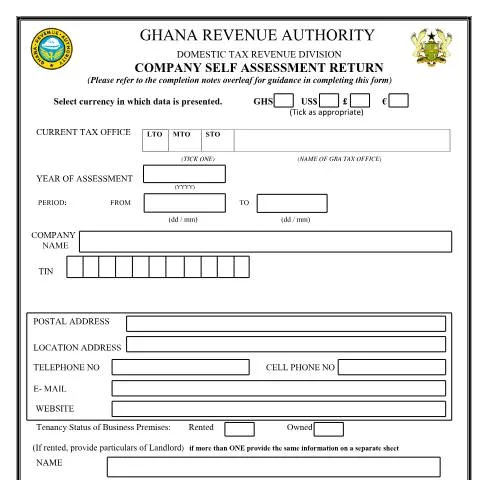
Navigating the Company Income Tax Self Assessment Return Form (DT-0101)
In Ghana's tax landscape, proper compliance is not just a legal requirement but a cornerstone for the sustainable growth of businesses. The Company Income Tax Self Assessment Return Form (DT-0101) stands as a crucial tool for assessing corporate income tax obligations. This document is essential for companies to report their income, expenses, and tax liabilities accurately to the Ghana Revenue Authority (GRA). The process of completing and submitting this form may seem daunting, but understanding its intricacies can lead to a seamless filing experience.
Understanding the Role of DT-0101 Within the Tax Framework
The Company Income Tax Self Assessment Return Form serves as a vital piece in the broader context of Ghana's taxation system. Under the 1992 Constitution of Ghana and subsequent parliamentary enactments, companies operating within the jurisdiction are required to compute their tax liabilities based on the income they generate annually.
When a company prepares the DT-0101, it triggers several important actions:
- Assessment Period: The form specifies the year and period under assessment, ensuring that the reported data aligns with the fiscal calendar.
- Self-Assessment: By completing the form, companies engage in self-assessment, which encourages transparency and accountability in reporting.
- Tax Compliance: Filing the DT-0101 is a prerequisite for tax compliance, leading to the avoidance of penalties associated with late filing or underreporting.
This document essentially acts as a bridge between the taxpayer and the tax authorities, fostering a relationship built on trust through accurate reporting.
Decoding Each Section of the DT-0101 Form
When approaching the DT-0101, it is essential to dissect each section and understand the requirements. Below is a breakdown of the key sections of the form, highlighting what needs to be filled in and common pitfalls to avoid.
Section 1: Company Information
This section requires foundational details about the company, including:
- Company Name: Ensure the name matches the registration documents.
- TIN (Tax Identification Number): This is critical for the GRA to identify your company.
- Date of Incorporation: Accurately reflecting this date confirms the company's operational history.
Common error: Failing to provide the correct TIN can lead to delays in processing the return.
Section 2: Financial Performance
Here, the template expects details on the company's financial standing over the relevant fiscal period. Important entries include:
- Total Business Income: Clearly delineate between local and export income.
- Operating Expenses: List operational expenditures meticulously, ensuring that no expense is overlooked.
- Net Company Profit/Loss: This figure determines the subsequent tax calculations.
Tip: Keep records of all invoices and receipts to substantiate the reported figures.
Section 3: Tax Computation
The computation section is where the tax liability is calculated, based on the net income after allowable deductions. Key components include:
- Non-Allowable Deductions: Be cautious when adding back non-taxable items; any mistakes can skew your tax liability.
- Chargeable Income: Identify portions of income subject to different tax rates as outlined in Schedule 1B.
Common mistake: Misclassification of expenses as allowable deductions can lead to audits and penalties.
Preparing Supporting Documents: What You Need
Completing the DT-0101 entails more than just filling out the form; it requires corroborating your entries with supporting documentation. Here’s a summary of essential documents to prepare:
- Financial Statements: Accurate balance sheets and income statements for the period in question.
- Invoices and Receipts: These documents underpin your income and expense claims.
- Tax Consultant Details: If you have engaged a consultant, their contact information should be included.
Organizing these documents prior to filling out the form can streamline the process and minimize errors.
Submission Channels: Where to File Your Return
The GRA offers various submission channels for the DT-0101, each with distinct advantages:
| Submission Method | Advantages | Considerations |
|---|---|---|
| Online Submission | Convenient, time-efficient, instant confirmation of receipt | Requires internet access and familiarity with the online portal |
| Paper Submission | Traditional method, suitable for those unfamiliar with online systems | Possible delays in processing; ensure to keep copies for records |
| In-Person Submission | Direct interaction with GRA officials for immediate clarification | Time-consuming; may require waiting in line |
Choosing the right submission method depends on your company’s resources and familiarity with technology.
Historical Context and Regulatory Framework of the DT-0101
The DT-0101 is not just a bureaucratic form; it is anchored in Ghana's evolving tax legislation. Understanding its background can provide valuable context:
- Taxation Legislation: Established under the Internal Revenue Act, 2000 (Act 592), which laid down the foundation for corporate taxation in Ghana.
- Amendments: The tax landscape has seen several amendments to adapt to economic changes, influencing the parameters of the DT-0101.
- GRA Initiatives: The GRA continually implements measures to streamline tax processes and encourage compliance.
This historical perspective reinforces the importance of the DT-0101 as a tool for both the government and taxpayers in fostering a transparent and accountable tax system.
The Importance of Accurate Reporting: Consequences of Non-Compliance
Accurate completion and timely submission of the DT-0101 are essential. Non-compliance can lead to several consequences:
- Penalties: Late filings attract penalties, which can significantly increase the tax burden.
- Audits: Inaccuracies may trigger audits from the GRA, leading to additional scrutiny and potential financial liabilities.
- Legal Repercussions: Persistent non-compliance can result in legal actions against the company, impacting reputation and operations.
The ramifications of neglecting proper tax reporting illustrate the critical nature of the DT-0101 in corporate governance and fiscal responsibility.
Final Thoughts on Filing the Company Income Tax Self Assessment Return
Filing the DT-0101 is an integral part of a company's annual obligations. By grasping its nuances and requirements, companies can navigate the taxation landscape more effectively, ensuring compliance while optimizing their tax liabilities. Engaging with tax consultants, maintaining thorough documentation, and adhering to deadlines can make a significant difference in the submission process. Ultimately, the Company Income Tax Self Assessment Return Form is more than just a document; it is a commitment to transparency and accountability in the corporate sector.
Understanding the Company Income Tax Self Assessment Process
The Company Income Tax Self Assessment Return Form, often referred to as the CIT Self Assessment Form, is a critical document used by corporate entities in Ghana to report their income and calculate their tax liabilities. As per the Ghana Revenue Authority (GRA) guidelines, every registered company must submit this form annually to ensure compliance with the tax regulations stipulated in the Income Tax Act, 2015 (Act 896).
Self-assessment allows companies to evaluate their own tax liabilities based on their financial records. This system promotes accountability as businesses must accurately report their incomes, expenses, and any applicable deductions. Companies are expected to use their financial statements to derive their taxable income, which forms the basis for calculating the tax payable.
Upon completion, companies must ensure that their CIT Self Assessment Form is submitted within the stipulated deadline, which is generally within four months after the end of their financial year. Extensions may not be commonly granted, so firms are advised to adhere strictly to this timeline to avoid penalties for late submission.
Key Components of the Company Income Tax Self Assessment Return Form
The CIT Self Assessment Form comprises several sections that require meticulous attention to detail. Understanding these components is crucial for ensuring accurate reporting and compliance with the GRA’s requirements. Below are the primary sections typically included in the form:
- Company Information: This section requires the company’s name, registration number, and Tax Identification Number (TIN), all of which should be consistent with information previously submitted to the GRA.
- Income Details: Companies must provide details of all sources of income generated during the financial year, including sales revenue, investment income, and any other business-related earnings.
- Allowable Deductions: This section allows companies to list all permissible deductions, such as operating expenses, depreciation, and other costs directly associated with revenue generation. It is imperative to keep proper records to substantiate these claims.
- Tax Computation: Companies will compute their taxable income by subtracting allowable deductions from total income. The applicable corporate tax rate, typically 25% for most companies, will then be applied to determine the total tax liability.
- Payment Information: Finally, companies must indicate how they intend to remit the tax due, including any prepayments made during the financial year.
Filling out the CIT Self Assessment Form accurately is crucial to avoid audits and penalties. Companies are encouraged to keep detailed records and consult with tax professionals if necessary to ensure compliance.
Common Challenges and Solutions in Completing the CIT Self Assessment Form
Many companies face challenges when completing their CIT Self Assessment Form, which can lead to inaccuracies and potential penalties. Understanding these hurdles and how to navigate them can greatly streamline the process. Below, we discuss some typical challenges and their corresponding solutions:
- Complex Income Sources: Companies with diverse revenue streams may find it challenging to categorize different sources of income accurately. Solution: Maintain detailed financial records and consider utilizing accounting software that can help streamline categorization and reporting.
- Understanding Deductions: The rules regarding allowable deductions can be complex and can vary significantly by industry. Solution: Consult with tax advisors who specialize in corporate taxation to ensure that all possible deductions are adequately identified and claimed.
- Compliance with Submission Deadlines: Companies may struggle to meet the submission deadlines due to internal processes or unforeseen circumstances. Solution: Establish a timeline well in advance of the due date and utilize reminder systems to ensure timely completion and submission of the form.
- Errors in Computation: Miscalculating tax liabilities is a common issue that can lead to penalties. Solution: Implement a thorough review process where multiple parties verify the calculations before submitting the form.
By proactively identifying these challenges and implementing the suggested solutions, companies can enhance their compliance and reduce the risk of incurring penalties associated with incorrect filings.