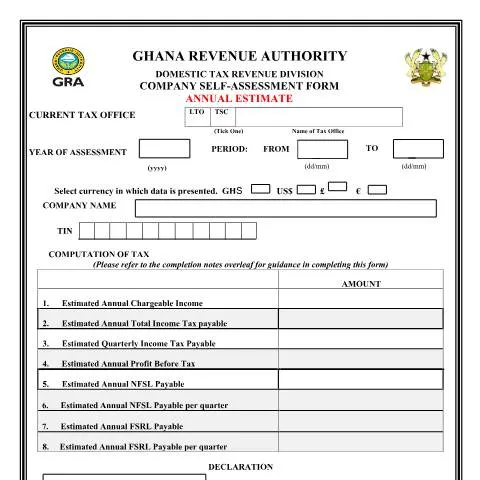
Understanding the Company Income Tax Self Assessment Estimate Form DT-102
The Company Income Tax Self Assessment Estimate Form DT-102 serves as a fundamental instrument for businesses operating within Ghana to project their tax obligations accurately. Businesses must realize that tax compliance is not merely a bureaucratic obligation but a critical aspect of corporate governance that can have significant implications for their financial health. This document encapsulates the estimation process that businesses must undertake to fulfil their tax duties to the Ghana Revenue Authority (GRA).
Who Needs to Submit the DT-102 Form?
The submission of the DT-102 form is primarily mandated for registered companies in Ghana that are liable to pay corporate income tax. This includes entities involved in various sectors—ranging from manufacturing and services to finance and real estate. Various categories of companies are obliged to submit this form:
- Domestic Companies: Businesses that operate within Ghana and generate taxable income.
- Foreign Companies: Non-Ghanaian entities with a registered presence in Ghana.
- Small and Medium Enterprises (SMEs): Businesses that fall under the Ghana Revenue Authority's definition of SMEs and are engaged in income-generating activities.
Completion of the Form: A Step-by-Step Guide
Filling out the DT-102 form accurately is paramount for compliance and avoiding penalties. Below are detailed instructions on how to navigate this form effectively:
- Select the Tax Office: Indicate the relevant tax office you are associated with, as assigned by the GRA.
- Specify the Year of Assessment: Clearly state the financial year for which this estimate pertains. This is crucial for aligning your estimates with GRA's financial calendar.
- Currency Selection: Choose the currency in which the amounts will be presented. Options include Ghanaian Cedi (GHS), United States Dollar (US$), British Pound (£), and Euro (€).
- Estimated Annual Chargeable Income: Provide your estimate of the income that will be subjected to tax. This figure should be realistic and based on historical performance and future projections.
- Annual Tax Computation: Calculate your Estimated Annual Total Income Tax Payable and provide the amount. This must reflect your anticipated tax liability based on the chargeable income.
- Quarterly Tax Payable: Divide the annual tax figure by four to arrive at the Estimated Quarterly Income Tax Payable, which must be remitted at the end of each quarter.
- Profit Before Tax: Estimate your Annual Profit Before Tax, which will affect various levies applicable to your business.
- Additional Levies: Identify any additional levies applicable to your business, such as the National Fiscal Stabilization Levy (NFSL) and Financial Sector Recovery Levy (FSRL). Include these in your annual estimates.
- Final Declaration: The responsible officer must sign, providing their full name, designation, and date, thereby affirming the accuracy of the information provided.
The Importance of Timely Submission and Consequences of Delay
Adhering to the submission timeline for the DT-102 form is essential. Failure to submit this form on time can result in significant financial ramifications:
- Penalties: The Ghana Revenue Authority imposes penalties for late submissions. These can escalate quickly, impacting cash flow.
- Interest Charges: Any unpaid taxes may accrue interest, increasing the total amount due to the GRA.
- Tax Audits: Delayed filings can trigger audits, resulting in administrative burdens and increased scrutiny of your financial records.
Therefore, businesses must strictly adhere to the following timeline:
| Quarter | Submission Deadline | Payment Due Date |
|---|---|---|
| Q1 (January - March) | 30th April | 30th April |
| Q2 (April - June) | 31st July | 31st July |
| Q3 (July - September) | 31st October | 31st October |
| Q4 (October - December) | 31st January | 31st January |
Channels for Submission: Navigating Your Options
Taxpayers have several options for submitting the DT-102 form, each presenting different conveniences and challenges:
- Online Submission: Taxpayers can submit their forms via the GRA’s online platform. This method is often faster and provides immediate confirmation of submission.
- Paper Submission: Companies preferring traditional methods can submit paper forms at their assigned tax offices. Ensure that all details are filled accurately to avoid delays.
- In-person Submission at Tax Offices: Businesses can also visit local tax offices for guidance and direct submission. This option is beneficial for those seeking clarification or assistance.
Specific Situations: When the DT-102 Form Might Shift
There are various scenarios where businesses might need to adjust their DT-102 submissions, including:
- Changes in Business Structure: If a business undergoes significant restructuring, such as mergers or acquisitions, it may require a reevaluation of its tax forecasts.
- Fluctuating Income Levels: Companies experiencing unexpected changes in revenue—whether due to market conditions or operational challenges—must revise their estimates to remain compliant.
- Start-up Companies: Newly established businesses may face unique challenges in estimating their tax obligations, requiring additional support from tax advisors.
Historical Context and Regulatory Framework
The DT-102 form is embedded within the larger framework of Ghana's tax legislation, rooted in the 1992 Constitution of Ghana and subsequent parliamentary enactments. The GRA administers this form under the authority granted by the Income Tax Act. Understanding the historical context is vital for appreciating the evolution of tax compliance in Ghana:
- Tax Reforms: Over the years, Ghana has implemented various reforms aimed at broadening the tax base and enhancing compliance.
- Modernization Efforts: The GRA continues to adopt digital tools to streamline tax processes, making submissions more accessible.
- Public Awareness Initiatives: The GRA conducts training sessions and workshops to educate taxpayers about their responsibilities and the importance of accurate reporting.
Conclusion: Emphasizing Accuracy and Compliance
The Company Income Tax Self Assessment Estimate Form DT-102 is not just a mere obligation; it is a crucial tool for corporate governance and fiscal responsibility. Businesses must engage with this form proactively, ensuring they provide accurate and timely estimates. By doing so, they not only comply with regulatory requirements but also pave the way for sustainable business practices that contribute to Ghana's economic growth.
Understanding the Company Income Tax Self-Assessment Process in Ghana
The Company Income Tax Self-Assessment process is crucial for businesses in Ghana, as it allows them to estimate their tax liabilities accurately and comply with local tax regulations outlined by the Ghana Revenue Authority (GRA). This process requires companies to assess their income and make a reasonable estimate of the tax payable, which is then reported to the GRA. Understanding the intricacies of this self-assessment is vital for business owners and financial officers alike.
To begin with, it is essential to recognize what constitutes taxable income. According to the Income Tax Act, 2015 (Act 896), all resident companies are required to pay tax on their worldwide income, while non-resident companies are taxed only on income sourced within Ghana. This necessitates a careful review of all revenue streams and expenses. Companies must maintain comprehensive financial records, as these will form the basis for the estimates made in their self-assessment submissions.
The GRA provides guidelines on how to calculate taxable income, including allowable deductions such as operating expenses, depreciation, and interest. It's important to note that companies must adhere to the regulations regarding the arm's length principle to ensure that transactions between related parties are performed at market value, thereby preventing profit shifting and tax evasion.
Upon completing the self-assessment, companies must submit the Company Income Tax Self-Assessment Estimate Form (GRA Form 4) to the GRA. This form captures details such as the estimated taxable income, the tax rate applicable, and any credits that may reduce the overall tax liability. Companies should also be aware of the deadlines for submissions—typically, the self-assessment must be submitted by the end of the tax year to avoid penalties.
Common Challenges and Best Practices in Completing the Self-Assessment Estimate Form
The completion of the Company Income Tax Self-Assessment Estimate Form can present several challenges for businesses. Many companies struggle with accurately estimating their taxable income, particularly when dealing with fluctuating revenue or unexpected expenses. Additionally, the requirement to adhere to tax laws and regulations can be daunting, especially for small and medium-sized enterprises (SMEs) that may lack dedicated financial experts.
One of the most common pitfalls is underestimating or overestimating income, which can lead to penalties or overpayment of taxes. To mitigate these risks, businesses are encouraged to implement robust accounting practices, including regular financial reviews and consultations with tax professionals. Maintaining accurate records throughout the fiscal year allows for more precise estimates and enhances the likelihood of compliance with GRA regulations.
Another best practice is to engage in tax planning throughout the year. By analyzing financial performance and making necessary adjustments before the end of the tax period, companies can arrive at a more accurate estimate of their tax liabilities. Furthermore, it is beneficial for businesses to familiarize themselves with tax incentives and exemptions that may apply to their operations, as these can significantly reduce tax burdens.
Lastly, businesses should prioritize timely submissions of their self-assessment forms. Late submissions can result in penalties and interest charges, which can adversely affect cash flow. To avoid such issues, companies should establish a timeline for preparing and submitting the GRA Form 4, allowing adequate time for reviews and adjustments.
Implications of Non-compliance with the Self-Assessment Requirements
Failure to comply with the self-assessment requirements can have serious ramifications for businesses operating in Ghana. The GRA employs a strict policy regarding tax compliance, and failure to accurately report estimated tax liabilities can lead to significant financial repercussions.
Firstly, companies that do not submit their self-assessment forms on time may face hefty penalties. The GRA has the authority to impose fines based on a percentage of the tax amount owed, which can compound rapidly and lead to substantial financial distress for the business. Moreover, the GRA may charge interest on any outstanding tax liabilities, further exacerbating the financial burden.
Additionally, non-compliance can result in increased scrutiny from tax authorities. Companies that are flagged for discrepancies may undergo audits, which can be time-consuming and costly. These audits can uncover not only unpaid taxes but also past compliance failures, leading to further penalties and potential legal issues.
Furthermore, non-compliance can damage a company's reputation. In an era where transparency and accountability are valued, businesses that fail to meet their tax obligations may find it challenging to maintain relationships with stakeholders, including clients, investors, and partners. This reputational damage can have long-term effects on business growth and market positioning.
To mitigate the risks associated with non-compliance, businesses should invest in training for their finance teams and consider utilizing accounting software that is compliant with Ghana's tax regulations. Regular consultations with tax professionals can also provide invaluable insights and help ensure that businesses remain compliant with all aspects of the self-assessment process.