Understanding Industrial Injuries Disablement Benefit Claims After Workplace Accidents
When a workplace accident fundamentally alters your capacity to work and live, the Industrial Injuries Disablement Benefit represents one of the UK's most significant safety nets for employees who suffer lasting disabilities from occupational injuries. Unlike standard sick pay or even Personal Independence Payment, this benefit specifically recognises that certain injuries stem directly from the inherent risks of employment, creating a distinct pathway for compensation that acknowledges employer responsibility within the broader social security framework.
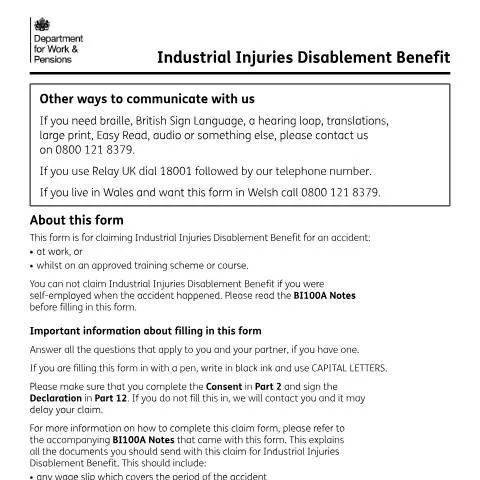
The BI100A claim form serves as the gateway to this specialised benefit system, designed exclusively for employees who have sustained workplace injuries or accidents during approved training schemes. This comprehensive document requires meticulous completion, as it establishes the foundational link between your accident, resulting disability, and entitlement to ongoing financial support that could continue for years or even decades.
Establishing Your Eligibility and Employment Status Requirements
The Department for Work and Pensions maintains strict boundaries around who can access Industrial Injuries Disablement Benefit, with employment status at the time of accident serving as the primary gateway criterion. The form explicitly excludes self-employed individuals, regardless of injury severity or long-term consequences, reflecting the benefit's foundation in employer-employee relationships and workplace safety obligations.
Your eligibility extends beyond traditional employment to encompass participants in approved training schemes or courses, recognising that government-sanctioned skills development carries similar protections to formal employment. This includes apprenticeships, work-based learning programmes, and vocational training initiatives where participants face workplace hazards despite their learner status.
| Employment Category | Eligibility Status | Key Considerations |
|---|---|---|
| Direct employees (PAYE) | Eligible | Standard workplace accident coverage |
| Apprentices and trainees | Eligible | Must be on approved government scheme |
| Agency workers | Potentially eligible | Depends on specific contractual arrangements |
| Self-employed contractors | Not eligible | Excluded regardless of injury severity |
| Volunteers | Generally not eligible | Unless receiving payments qualifying as wages |
The timing of your claim submission carries particular weight, as Industrial Injuries Disablement Benefit operates on the principle that disability assessment should occur after your condition has stabilised. Unlike immediate injury benefits, this scheme focuses on long-term disablement, typically assessed once medical professionals determine that your condition is unlikely to improve significantly.
Navigating the Multi-Part Structure of Form BI100A
The BI100A form spans 16 pages across 12 distinct parts, each addressing specific aspects of your circumstances, accident details, and ongoing disability impacts. This structured approach ensures the Department for Work and Pensions gathers comprehensive information necessary for accurate assessment while maintaining consistency across all claims.
Part 1 establishes your personal details and partner information, requiring your National Insurance number as the primary identifier linking your claim to employment records and previous benefit entitlements. If you cannot locate your National Insurance number, the form accommodates this common situation by asking whether you have ever possessed one, allowing DWP to conduct internal searches using alternative identifiers.
The inclusion of partner details reflects the benefit's interaction with means-tested elements and household income considerations. The form defines "partner" broadly, encompassing legal spouses, civil partners, and individuals living together as if married, ensuring comprehensive household assessment regardless of formal relationship status.
Part 2's consent section represents a critical decision point that significantly influences your claim's trajectory. By granting consent for medical information sharing, you enable DWP to directly contact your healthcare providers, potentially expediting the assessment process and ensuring decision-makers access complete medical records. However, the form explicitly states that refusing consent will not automatically disqualify your claim, though DWP will base decisions solely on information you personally provide.
Third-Party Representation and Posthumous Claims
Part 3 accommodates situations where claimants cannot complete forms themselves due to incapacity or death, establishing clear protocols for legitimate third-party representation. This section requires detailed justification for why the claimant cannot participate directly, along with comprehensive information about the representative's relationship and authority to act on the claimant's behalf.
For posthumous claims following workplace fatalities, representatives must provide death certificates and demonstrate their legal standing to pursue benefits on behalf of the deceased's estate or dependents. This process often involves complex interactions with coroner investigations, employer liability assessments, and potential criminal proceedings related to workplace safety violations.
Compiling Essential Documentation and Medical Evidence
Success in Industrial Injuries Disablement Benefit claims heavily depends on presenting compelling documentary evidence that establishes clear causal links between workplace exposure and resulting disability. The accompanying BI100A Notes specify three fundamental document categories that support virtually every successful claim.
Wage slips covering the accident period serve multiple functions beyond simple income verification. They confirm your employment status, demonstrate your presence at work during the relevant timeframe, and often contain employer details that help DWP verify workplace circumstances. If your accident occurred during the final days of a pay period, ensure you obtain slips from both the accident period and the subsequent period to show employment continuity.
The employer's accident report form represents perhaps the most crucial single document in your claim, as it provides contemporaneous, official acknowledgment of the incident from the party legally responsible for workplace safety. These reports typically contain detailed circumstances, witness statements, immediate medical responses, and preliminary assessments of fault or contributing factors.
- HSE RIDDOR reports for serious workplace injuries requiring official notification
- Internal accident books containing immediate incident recordings
- Risk assessment documents showing known hazards and mitigation measures
- Training records demonstrating safety instruction provision or absence
- Equipment maintenance logs for machinery-related accidents
- Witness statements from colleagues or supervisors present during the incident
Medical evidence requirements extend beyond simple injury confirmation to encompass ongoing disability assessment and prognosis. The form explicitly advises against commissioning new medical reports solely for the claim, recognising that existing documentation from treating physicians often provides more authentic insights into your condition's development and impact.
Preparing for Mandatory Medical Assessments
DWP commonly arranges medical assessments with approved healthcare professionals to evaluate disability levels and functional limitations. These assessments differ significantly from routine medical appointments, focusing specifically on how your workplace injury affects your capacity for employment and daily activities rather than treatment options or symptom management.
If mobility limitations or severe symptoms prevent attendance at assessment centres, the form allows requests for home visits accompanied by detailed medical justification. However, DWP maintains strict criteria for approving home assessments, typically requiring evidence of severe mobility restrictions or conditions that make travel genuinely impossible rather than merely inconvenient.
Understanding the Claims Processing Journey and Decision Timescales
Industrial Injuries Disablement Benefit claims follow a distinctly different processing pathway compared to standard DWP benefits, reflecting the specialised nature of workplace injury assessment and the need for detailed medical evaluation. Initial processing focuses on establishing causation – the direct link between your workplace activities and resulting injury – before progressing to disablement assessment that determines benefit levels.
The Department for Work and Pensions operates dedicated Industrial Injuries teams with specific expertise in occupational health, workplace safety regulations, and long-term disability assessment. These specialists work closely with approved medical practitioners who understand the unique challenges of evaluating workplace-related conditions and their impact on earning capacity.
Processing timescales vary significantly based on claim complexity, medical evidence availability, and the need for additional investigations. Straightforward claims with clear causation and comprehensive documentation may progress within several weeks, while complex cases involving disputed circumstances, multiple contributing factors, or rare occupational diseases can extend over many months.
Monitoring Your Claim's Progress
The form provides the dedicated helpline 0800 121 8379 for claim-related enquiries, offering direct access to Industrial Injuries specialists who can provide specific updates on your case's status. This service includes comprehensive accessibility options, from British Sign Language interpretation to document translation services for Welsh speakers and other language requirements.
DWP maintains internal tracking systems that monitor key milestone achievements throughout the claims process, enabling telephone advisers to provide detailed progress updates including outstanding evidence requirements, scheduled assessment appointments, and anticipated decision timescales.
Maximising Communication Accessibility and Support Options
The Department for Work and Pensions recognises that workplace injuries often create or exacerbate communication barriers, implementing comprehensive accessibility measures that extend far beyond standard reasonable adjustments. The form's opening section emphasises alternative format availability including braille, large print, Easy Read versions, and audio formats, ensuring that visual impairments or cognitive impacts from workplace injuries do not prevent successful claim submission.
Relay UK services provide telephone accessibility for deaf or hearing-impaired claimants, requiring the prefix 18001 before dialling standard DWP numbers. This service translates spoken conversations into text and vice versa, enabling full participation in telephone consultations and claim discussions without requiring third-party interpretation.
For Welsh speakers, dedicated language support acknowledges the statutory right to conduct official business in Welsh throughout Wales, with the form explicitly offering Welsh-language versions and bilingual support services. This extends to all claim-related correspondence, assessment arrangements, and ongoing benefit administration.
Professional Representation and Advocacy Support
While the form emphasises DWP's direct support availability, many claimants benefit from professional representation, particularly given the technical nature of Industrial Injuries legislation and the potential for significant long-term financial consequences. Trade unions often provide specialised support for workplace injury claims, drawing on extensive experience with similar cases and detailed knowledge of industry-specific hazards.
Citizens Advice bureaux maintain Industrial Injuries expertise, offering free guidance on evidence compilation, form completion, and ongoing claim management. Their services prove particularly valuable for claimants facing employer resistance to providing accident reports or medical evidence access difficulties.
Long-Term Implications and Ongoing Benefit Management
Industrial Injuries Disablement Benefit represents a lifetime entitlement for qualifying claimants, with payment levels determined by assessed disablement percentages rather than means-testing or contribution requirements. This fundamental difference from other DWP benefits creates unique administrative responsibilities and ongoing relationship management between claimants and the Department.
Successful claims typically result in percentage-based assessments ranging from 14% minimum disablement (the threshold for benefit entitlement) up to 100% for total incapacity. These percentages directly determine weekly payment amounts and remain subject to periodic review as medical conditions evolve or improve over time.
The benefit's interaction with other DWP payments requires careful consideration, as Industrial Injuries Disablement Benefit generally supplements rather than replaces other entitlements. However, specific rules govern interactions with Personal Independence Payment, Employment and Support Allowance, and State Pension, potentially affecting total household income in complex ways.
Award reviews typically occur at intervals determined by medical prognosis and condition stability, with DWP maintaining ongoing monitoring responsibilities to ensure continued entitlement accuracy. Claimants must report significant medical improvements or changes in circumstances that might affect their disablement assessment, maintaining the integrity of this specialised compensation system designed to support those whose working lives have been fundamentally altered by workplace accidents.
Understanding the Industrial Injuries Scheme Assessment Process
The assessment process for Industrial Injuries Disablement Benefit follows a structured pathway designed to evaluate both the causal link between your workplace incident and your condition, as well as the degree of disablement it has caused. Understanding this process can help you navigate what might seem like a complex system with greater confidence.
Once DWP receives your BI100A form, the initial review focuses on establishing whether your accident or disease meets the prescribed criteria. For accidents, this typically involves confirming the incident occurred during working hours, on work premises, or whilst undertaking work-related activities. Industrial diseases require more detailed scrutiny, as officials must verify both your exposure to the relevant hazard and that your employment involved sufficient risk.
The medical assessment stage involves independent healthcare professionals who specialise in occupational health. These assessments differ significantly from standard medical examinations, as they focus specifically on work-related causation and functional impact. The examining doctor will review your medical records, examine your condition, and may request additional specialist reports if your case involves complex medical issues.
Disablement assessment uses a percentage scale from 1% to 100%, though benefit is only payable from 14% upwards for most conditions. The assessment considers your condition at the point it's expected to remain stable, which may be months or years after your initial injury. This explains why some claimants experience delays – officials may defer assessment until your medical condition has reached what's termed 'maximum medical improvement'.
Certain conditions have prescribed degrees of disablement. For instance, loss of a thumb typically attracts a 30% assessment, while total deafness in both ears rates 100%. However, these are starting points rather than fixed outcomes – your individual circumstances, including age, occupation, and how the condition affects your daily activities, all influence the final assessment.
The decision notice you receive will detail not only whether your claim succeeds, but also explain the reasoning behind any disablement percentage awarded. If you're awarded benefit, it will specify the assessment period – this might be for life, or for a fixed period after which reassessment occurs. Provisional assessments are common where your condition might improve or deteriorate over time.
Navigating Complex Scenarios and Multiple Conditions
Industrial injuries cases often involve complications that standard guidance doesn't fully address. Understanding how the system handles these scenarios can prove crucial for ensuring your claim accurately reflects your circumstances.
Multiple injury claims require careful consideration of how different conditions interact. If you've sustained several injuries in the same workplace incident, each condition is assessed separately, but the combined effect may be greater than the sum of individual assessments. Conversely, where you have multiple unrelated workplace injuries from different incidents, each requires separate consideration under the scheme.
Pre-existing conditions create particular complexity. The scheme operates on a 'material contribution' basis – your workplace exposure must have materially contributed to your condition, but it doesn't need to be the sole cause. For instance, if you develop occupational asthma but already had some respiratory sensitivity, benefit may still be payable if workplace exposures significantly worsened your condition. However, proving this material contribution often requires detailed medical evidence and expert testimony.
Secondary conditions arising from industrial injuries can qualify for assessment in their own right. If your initial workplace injury leads to depression, mobility problems, or other health issues, these may warrant separate consideration. However, the causal chain must be clearly established – the secondary condition must be a reasonably foreseeable consequence of your industrial injury rather than an unrelated development.
Occupational disease claims involving long latency periods present unique challenges. Conditions like mesothelioma or industrial deafness may not manifest symptoms until decades after exposure ceased. The scheme recognises this through specific provisions for prescribed diseases, but establishing the necessary employment history and exposure details can prove difficult when employers have ceased trading or records are incomplete.
Where your condition results from cumulative exposure across multiple employers, the scheme still applies, but gathering evidence becomes more complex. You'll need to document all relevant employment periods and the nature of exposure in each role. Former colleagues, union records, or health surveillance data from previous employers can provide valuable supporting evidence in such cases.
Aggravation of existing conditions requires particularly careful handling. If workplace factors have worsened a pre-existing condition, benefit may be payable for the degree of aggravation attributable to work. This often involves complex medical assessment to distinguish between natural disease progression and work-related deterioration.
Post-Decision Procedures and Ongoing Entitlements
Receiving a decision on your Industrial Injuries Disablement Benefit claim marks the beginning rather than the end of your interaction with the system. Understanding your ongoing rights and responsibilities ensures you maintain appropriate benefit levels and can respond effectively to changing circumstances.
Successful claimants receive benefit based on their assessed degree of disablement, paid as a weekly allowance directly into their nominated bank account. Payment typically begins from the date of claim or the end of the qualifying period, whichever is later. The amount varies according to your disablement percentage, with rates reviewed annually each April in line with government policy on benefit uprating.
Review procedures may require you to attend further medical examinations, particularly where your condition was assessed as likely to change over time. DWP typically provides several weeks' notice of review appointments, and you should inform them immediately if you cannot attend the scheduled time. Failing to attend without good reason may result in benefit suspension until the examination takes place.
Your condition may qualify for additional support beyond basic disablement benefit. Constant Attendance Allowance becomes payable where your assessed disablement reaches 100% and you require substantial daily care and attention. This allowance has four rates depending on your care needs, with the highest rate available for those requiring constant care throughout both day and night.
Exceptionally Severe Disablement Allowance provides further support for claimants receiving Constant Attendance Allowance at one of the higher rates. This additional payment recognises the most serious cases where individuals face exceptional care needs resulting from their industrial injury.
Changes in your condition should be reported promptly to DWP. If your disability worsens significantly, you can request a review of your assessment, potentially leading to increased benefit. Conversely, if your condition improves substantially, this might result in reduced entitlement. However, the system includes safeguards – minor fluctuations in your condition typically don't trigger reassessment unless the change appears permanent and significant.
Hospital admission doesn't automatically affect your Industrial Injuries Disablement Benefit, unlike some other DWP benefits. However, if you're receiving Constant Attendance Allowance and enter hospital for an extended period, this additional payment may be suspended after a specified period, as the hospital provides the care and attention that the allowance is designed to cover.
Moving abroad while receiving Industrial Injuries Disablement Benefit requires careful consideration of ongoing entitlement. The basic disablement benefit typically continues regardless of your country of residence, but additional allowances like Constant Attendance Allowance may be affected by your new location. You must inform DWP before moving abroad to ensure continued payment and avoid potential overpayment recovery.
Estate claims provide a mechanism for pursuing benefit where someone dies before their claim is determined, or where death results from the industrial injury or disease. These claims follow specific procedures and time limits, requiring careful attention to detail from representatives acting on behalf of the deceased person's estate.