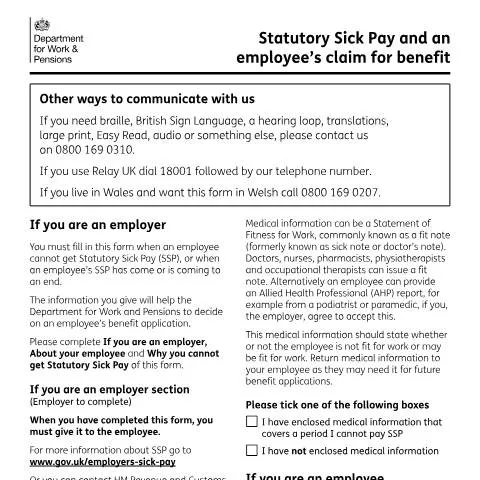
When Employment Protection Meets Healthcare: Understanding the SSP1 Bridge
Every year, millions of British workers face the challenging transition from employer-provided sick pay to state benefits when illness extends beyond their workplace entitlements. The SSP1 form serves as the crucial administrative bridge in this process, yet its significance often becomes apparent only when employees find themselves caught between ending Statutory Sick Pay (SSP) and beginning their claim for Employment and Support Allowance or other Department for Work and Pensions benefits.
This employer-generated document represents more than mere paperwork—it constitutes the formal handover of responsibility from private employer obligations to state welfare provision. When an employee's entitlement to SSP ceases, whether through exhaustion of the 28-week maximum, contract termination, or other qualifying circumstances, the SSP1 becomes their gateway to continued financial support during ongoing incapacity.
The form's dual nature reflects the collaborative approach required between employers and the benefits system. Whilst employers must complete the administrative sections, they simultaneously serve as custodians of medical evidence that employees will need for their subsequent benefit applications, creating a seamless transition that protects vulnerable workers during periods of extended illness.
The Legislative Framework Behind SSP Transitions
The SSP1 form exists within a carefully constructed legislative framework designed to prevent gaps in support for incapacitated workers. The Social Security Contributions and Benefits Act 1992 established the fundamental principle that employers bear initial responsibility for supporting sick employees, whilst the state provides longer-term assistance through the benefits system.
This division of responsibility serves multiple policy objectives. Employers, being closest to their workforce, can initially assess and manage short-term sickness absence more effectively than centralised government systems. However, when illness extends beyond the 28-week SSP period or other qualifying circumstances arise, the Department for Work and Pensions assumes responsibility through Employment and Support Allowance or Universal Credit.
The SSP1 mechanism ensures continuity by requiring employers to provide comprehensive information about the employee's circumstances, employment history, and the specific reasons why SSP entitlement has ended. This information enables DWP decision-makers to assess benefit eligibility without requiring employees to navigate complex administrative processes whilst managing serious health conditions.
Importantly, the form also protects employers by creating a clear audit trail of their SSP obligations. By documenting the precise reasons for SSP cessation, employers demonstrate compliance with their statutory duties and protect themselves against potential disputes or challenges.
Employer Obligations: Beyond Simple Form Completion
The employer's role in the SSP1 process extends far beyond completing administrative fields. Mandatory completion occurs in specific circumstances that employers must recognise and respond to promptly, as failure to provide the form can leave employees without crucial documentation for their benefit claims.
Employers must issue an SSP1 when an employee cannot qualify for SSP from the outset, such as when someone becomes ill after their employment contract has ended, or when they've received Employment and Support Allowance within the preceding 12 weeks. The form is equally essential when existing SSP payments are approaching or have reached their conclusion, whether through the 28-week maximum or other qualifying circumstances.
The medical information provisions place additional responsibilities on employers. When employees have been absent for more than seven consecutive days, employers can request medical evidence, typically in the form of a Statement of Fitness for Work (fit note). However, employers must return this medical information to the employee alongside the completed SSP1, as it may be required for benefit applications or future employment situations.
| Circumstance | Employer Action Required | Timeline |
|---|---|---|
| SSP reaching 28-week limit | Complete SSP1 before final payment | Before cessation date |
| Contract termination during sickness | Issue SSP1 with final employment documentation | With P45 and final pay |
| Employee ineligible from onset | Complete SSP1 immediately upon request | Within reasonable timeframe |
| Maternity/paternity conflicts | Coordinate with payroll for benefit transitions | Before statutory pay periods |
Crucially, employers must continue paying SSP up to and including the day before the date specified in the SSP1 form, ensuring no gap in the employee's financial support during the transition period.
Medical Evidence Management
The handling of medical information represents a particularly sensitive aspect of the SSP1 process. Employers can request fit notes or equivalent medical evidence from various healthcare professionals, including GPs, nurses, pharmacists, physiotherapists, and occupational therapists. Additionally, Allied Health Professional reports from specialists such as podiatrists or paramedics may be acceptable if employers agree to recognise them.
However, employers must balance their legitimate need for medical verification with employees' privacy rights under the Data Protection Act 2018 and UK GDPR. Medical information should be processed only for the specific purposes of SSP administration and benefit transition, with appropriate safeguards to protect sensitive health data.
Complex Eligibility Scenarios and Their Documentation
The SSP1 form addresses numerous complex scenarios where standard SSP provisions don't apply, each requiring careful documentation to ensure accurate benefit assessments. Understanding these scenarios helps both employers and employees navigate the transition process effectively.
Intermittent sickness patterns present particular challenges. When employees experience recurring health issues, the form must document whether separate periods of sickness fall within the eight-week linking rule. If an employee returns to work for fewer than eight weeks between periods of incapacity, these episodes combine for SSP calculation purposes, potentially accelerating the approach to the 28-week maximum.
The three-year rule adds another layer of complexity. Employees who have experienced recurring sickness over more than three years, without returning to work for more than eight weeks between episodes, may find their SSP entitlement affected. The SSP1 must clearly document these patterns to enable accurate benefit assessment.
Trade dispute exclusions require particularly careful handling. Employees absent due to strikes, walkouts, or lockouts that began before their illness may be excluded from SSP. However, exceptions exist for those already receiving SSP when disputes commence, or those who can demonstrate they had no direct involvement in the industrial action despite their illness timing.
International Employment Complications
Cross-border employment arrangements create additional complexity in SSP1 documentation. Employees working outside the UK when their illness begins may be excluded from SSP if their employer wasn't liable for Class 1 National Insurance contributions on their earnings at the onset of incapacity.
These situations require careful documentation of the employee's work location, the employer's National Insurance obligations, and the specific timing of illness onset. Such details become crucial for DWP decision-makers assessing subsequent benefit entitlement, particularly for Employment and Support Allowance claims.
The Employee Perspective: Navigating Benefit Transitions
From the employee's standpoint, receiving an SSP1 form often signals a critical juncture in their health and financial circumstances. The document serves multiple functions: it explains why SSP has ended, provides essential information for benefit applications, and includes medical evidence that may be required for ongoing claims.
Employees must understand that the SSP1 represents their employer's assessment of their SSP entitlement, not a final determination of their benefit eligibility. If they disagree with their employer's decision, they retain the right to seek explanations and, if necessary, pursue disputes through appropriate channels.
The form's medical information provisions require careful attention from employees. Any fit notes or medical reports provided by their employer must be retained, as these documents may be essential for Employment and Support Allowance applications, Universal Credit claims, or future employment situations where health-related adjustments might be necessary.
Timing considerations are crucial for employees. The transition from SSP to benefits should be seamless, but employees must typically initiate their benefit claims before SSP ends to avoid gaps in financial support. The SSP1 provides the necessary documentation to support these applications and demonstrate the continuity of their incapacity.
Dispute Resolution Pathways
When employees disagree with SSP1 determinations, several resolution pathways exist. Initial discussions with employers often resolve misunderstandings about eligibility criteria or calculation methods. However, persistent disputes may require formal challenge procedures through HMRC's employer helpline or, in complex cases, through employment tribunal processes.
The SSP1 form itself becomes crucial evidence in any dispute, as it documents the employer's reasoning and provides a baseline for assessing whether correct procedures were followed. Employees should retain copies of all SSP1 forms received, along with supporting medical evidence and correspondence.
Administrative Precision in Form Completion
The SSP1's effectiveness depends heavily on accurate and complete information in each section. Employers must provide comprehensive employee identification details, including National Insurance numbers, payroll references, and tax codes, ensuring seamless integration with DWP systems and preventing processing delays that could affect benefit payments.
The employment history section requires particular attention to detail. Employers must accurately document SSP payment periods, including start and end dates, and clearly indicate whether payments are ongoing or scheduled to cease. Any gaps or inconsistencies in this information can delay benefit processing and create financial hardship for employees.
Reason codes within the form must be selected carefully, as they determine which benefit streams employees may access. For example, pregnancy-related exclusions direct employees toward Statutory Maternity Pay or Maternity Allowance, whilst contract termination scenarios may affect Universal Credit entitlements differently than ongoing employment situations.
The declaration section carries legal significance, as employer signatures confirm the accuracy and completeness of provided information. False or misleading declarations can result in penalties and may affect the employer's reputation with DWP and HMRC systems.
Quality Assurance Processes
Larger employers often implement internal quality assurance processes for SSP1 completion, involving HR departments, payroll teams, and occupational health services. These processes help ensure consistency in form completion and reduce the risk of errors that could disadvantage employees or create compliance issues.
Regular training for staff responsible for SSP1 completion helps maintain accuracy and ensures awareness of legislative changes or procedural updates. Given the form's importance in the employee's transition to benefits, investment in proper completion processes represents both good practice and risk management.
Integration with Modern Workplace Practices
Contemporary workplace trends, including remote working, flexible contracts, and gig economy arrangements, create new challenges for SSP1 administration. Employers must adapt their processes to accommodate employees who may be geographically dispersed or working under non-standard arrangements whilst maintaining the form's effectiveness as a transition mechanism.
Digital communication methods have streamlined SSP1 distribution and completion, but employers must ensure that electronic processes maintain the form's legal validity and provide adequate security for sensitive personal and medical information. Email distribution of completed forms requires careful consideration of data protection requirements and secure transmission methods.
The rise of occupational health services and employee assistance programmes has enhanced the medical information aspects of SSP1 administration. These services can provide additional context and support for employees transitioning from workplace sick pay to state benefits, whilst helping employers manage their obligations more effectively.
Reasonable adjustments under disability legislation may affect how employers handle SSP1 processes for employees with protected characteristics. Alternative communication methods, extended timeframes, or additional support may be necessary to ensure equal access to the transition process.
The form's accessibility provisions, including availability in Welsh, British Sign Language interpretation, and various alternative formats, reflect the broader commitment to inclusive public service delivery. Employers should be aware of these options and facilitate access when employees require alternative communication methods.
Understanding the SSP1 Form's Role in Benefit Transition Claims
The SSP1 form serves as a crucial bridge between employer-administered Statutory Sick Pay and the Department for Work and Pensions (DWP) benefit system. When an employee's entitlement to SSP concludes, this document becomes their pathway to claiming Employment and Support Allowance (ESA) or Universal Credit health elements.
The form's primary function extends beyond simple record-keeping. It provides the DWP with verified employment and sickness absence data, which directly influences benefit assessment timelines and eligibility determinations. Without proper SSP1 completion, employees may face significant delays in benefit processing, potentially creating gaps in financial support during periods of ill health.
Employers must understand that issuing an SSP1 form is not discretionary—it's a statutory requirement under the Social Security Contributions and Benefits Act 1992. The form must be provided within seven days of SSP ending, whether due to exhaustion of the 28-week entitlement period, employee recovery, or employment termination during sickness absence.
Critical Information Requirements on Form SSP1
The SSP1 form contains several mandatory sections that employers must complete accurately. The employee's National Insurance number serves as the primary identifier, linking employment records to benefit claims. Incorrect or missing NI numbers can delay benefit processing by weeks, as the DWP must verify identity through alternative means.
Employment details require precision regarding start and end dates, particularly where employment has terminated. The DWP uses this information to calculate contribution-based benefit entitlements and assess whether other employment income affects benefit eligibility. Part-time employees returning to reduced hours may find their Universal Credit work allowances adjusted based on SSP1 employment data.
The sickness absence period documentation proves particularly critical for ESA claims. The form must detail the complete absence period, including any return-to-work attempts that failed due to ongoing health conditions. Intermittent sickness patterns require careful documentation, as these may indicate fluctuating conditions relevant to ESA capability assessments.
Employer Responsibilities and Legal Obligations
Employers bear significant responsibility for accurate SSP1 completion, with potential legal consequences for non-compliance. The form must reflect genuine sickness absence periods, supported by appropriate medical evidence such as fit notes from registered medical practitioners. Employers cannot refuse to issue SSP1 forms based on disputes over absence legitimacy—such matters fall under separate disciplinary procedures.
Record-keeping requirements extend beyond the SSP1 form itself. Employers must maintain comprehensive sickness absence records, including fit notes, return-to-work assessments, and any occupational health reports. These records may be requested by the DWP during benefit investigations or appeals, making thorough documentation essential for legal compliance.
Small employers often struggle with SSP administration, particularly regarding complex cases involving phased returns to work or reasonable adjustments under the Equality Act 2010. The interaction between SSP entitlements and disability-related absences requires careful consideration, as premature SSP cessation could constitute disability discrimination.
Navigating Complex Scenarios and Special Circumstances
The SSP1 form becomes particularly complex in scenarios involving multiple employers, agency workers, or employees with fluctuating health conditions. Each situation requires specific handling to ensure accurate benefit transition and legal compliance.
Multiple Employment and Agency Work Arrangements
Employees working for multiple employers simultaneously may receive SSP from each, provided they meet individual qualifying criteria. Each employer must issue separate SSP1 forms when their respective SSP entitlements end, creating potential complications for Universal Credit calculations. The DWP requires comprehensive income reporting, making accurate SSP1 completion crucial for preventing benefit overpayments.
Agency workers present unique challenges, as their employment status may be unclear regarding SSP entitlement. Agencies acting as employers must issue SSP1 forms when their workers' assignments end due to sickness, even if the underlying health condition continues. This situation often creates confusion about benefit claiming responsibilities, particularly where workers move between multiple agencies.
Umbrella company arrangements add another layer of complexity, as the umbrella company typically serves as the legal employer for SSP purposes. These arrangements require careful coordination between recruitment agencies, umbrella companies, and end-clients to ensure accurate SSP1 completion and timely benefit transition.
Mental Health Conditions and Invisible Disabilities
SSP1 forms for employees with mental health conditions require sensitive handling, as these absences may not follow traditional sickness patterns. Stress-related conditions, anxiety disorders, and depression can create intermittent absence patterns that challenge standard SSP administration. Employers must document these absences accurately while respecting employee confidentiality and dignity.
The fit note system accommodates mental health conditions through "may be fit for work" recommendations, allowing phased returns or workplace adjustments. When such arrangements fail and SSP ends, the SSP1 form must accurately reflect the attempted accommodations and their outcomes. This information proves crucial for subsequent ESA capability assessments, which evaluate both physical and mental health impacts on work capacity.
Workplace stress claims require particular attention to causation and employer response. Where employees claim work-related stress, the SSP1 form should focus on factual absence periods rather than causation disputes. However, employers should ensure their records demonstrate appropriate stress management responses, including risk assessments and support measures, as these may be relevant to subsequent legal proceedings.
Long-Term Conditions and Reasonable Adjustments
Employees with long-term health conditions often require ongoing workplace adjustments under the Equality Act 2010. When SSP ends for these employees, the SSP1 form should reflect any adjustment attempts and their success or failure. This information helps the DWP understand the employee's work capability and potential for future employment with appropriate support.
Progressive conditions such as multiple sclerosis, arthritis, or diabetes may create fluctuating symptoms affecting work capacity. The SSP1 form must accurately capture these variations, as they're relevant to ESA assessments and potential Personal Independence Payment claims. Employers should avoid oversimplifying complex health conditions into binary fit/unfit categories.
Cancer diagnoses and treatment often involve extended SSP periods, potentially exhausting the 28-week entitlement before recovery. The SSP1 form becomes crucial for ensuring seamless benefit transition during ongoing treatment. Employers should coordinate with occupational health services to provide accurate prognosis information, supporting appropriate benefit assessments.
Digital Processes and Future Developments in SSP Administration
The digitisation of government services increasingly affects SSP and benefit administration, with implications for how employers complete and submit SSP1 forms. Understanding these technological developments helps employers prepare for evolving compliance requirements and improved employee support.
Integration with Universal Credit Digital Services
Universal Credit's digital-first approach influences how SSP1 information integrates with benefit claims. While the physical form remains important, the underlying data increasingly flows through digital channels between employers, HMRC, and the DWP. This integration aims to reduce benefit processing delays and improve accuracy through automated data matching.
Employers using Real Time Information (RTI) payroll reporting already provide extensive employment data to HMRC, which the DWP can access for benefit assessments. However, the SSP1 form provides specific sickness absence details not captured in standard payroll data, maintaining its importance in the digital ecosystem.
Future developments may see increased automation in SSP1 processing, with digital forms automatically populating from payroll systems and fit note databases. Employers should prepare for these changes by ensuring their payroll and HR systems accurately capture sickness absence data in formats suitable for digital reporting.
Data Protection and Employee Privacy Considerations
The SSP1 form contains sensitive personal data about employee health and employment, requiring careful handling under the Data Protection Act 2018 and UK GDPR. Employers must ensure legitimate interests exist for processing this information, typically satisfied by statutory obligations to provide SSP and complete required forms.
Employee consent isn't required for SSP1 completion, as it falls under legal obligation processing. However, employers should inform employees about how their health data will be used and shared with the DWP. Privacy notices should specifically address sickness absence data processing and employee rights regarding this information.
Retention periods for SSP1 related records typically align with tax and employment law requirements—generally six years after the relevant tax year ends. However, employers should consider longer retention where employees have ongoing health conditions or potential legal claims, ensuring adequate evidence preservation for future requirements.
Supporting Vulnerable Employees Through the Process
The transition from SSP to benefits can be particularly challenging for vulnerable employees, including those with learning difficulties, limited English proficiency, or complex family circumstances. Employers play a crucial role in ensuring these employees understand the SSP1 process and can access appropriate support.
Reasonable adjustments may be required when explaining SSP1 implications to employees with disabilities. This might include providing information in alternative formats, allowing additional time for understanding, or facilitating family member involvement in discussions. Such adjustments demonstrate good employment practice while potentially reducing future legal risks.
Signposting to appropriate support services benefits both employees and employers. Citizens Advice, disability charities, and local authority welfare rights services can provide specialist guidance on benefit claims and appeals. Early signposting may prevent later disputes about SSP1 accuracy or benefit entitlements, reducing administrative burden for all parties involved.