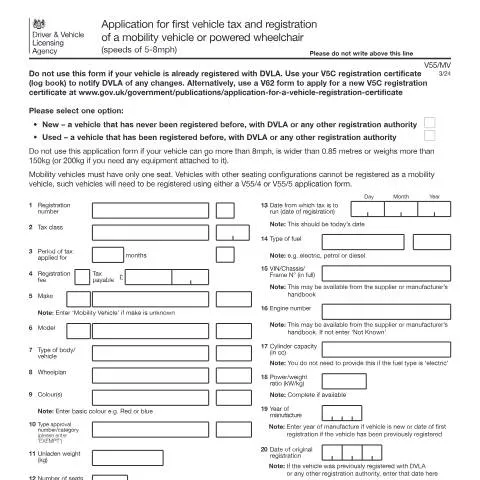
When Standard Vehicle Registration Rules Don't Apply: The V55/MV Exception
Most vehicle owners in the UK navigate the familiar territory of V5C registration certificates and standard DVLA procedures, but mobility vehicle users enter a distinctly different regulatory landscape. The V55/MV form represents the sole pathway for registering mobility vehicles and powered wheelchairs capable of travelling between 5-8mph—a narrow but crucial category that falls between pavement-bound mobility aids and road-going vehicles.
This specialised registration process acknowledges that mobility vehicles occupy a unique legal position. Unlike conventional cars, motorcycles, or even standard mobility scooters, these vehicles require formal registration with DVLA despite their limited speed capabilities. The V55/MV form bridges the gap between medical equipment and registered vehicles, ensuring proper documentation while recognising the specific needs of users with mobility challenges.
The form's existence reflects Parliament's recognition that certain mobility vehicles require official oversight without subjecting users to the full complexity of standard vehicle registration. This creates a streamlined yet comprehensive process that maintains safety standards while acknowledging the practical realities faced by mobility vehicle users.
Technical Boundaries That Determine Eligibility
The V55/MV form applies exclusively to vehicles meeting precise technical specifications, and understanding these boundaries prevents costly application errors. Speed capability must fall within the 5-8mph range—vehicles capable of exceeding 8mph require registration under different procedures, while those limited to under 5mph typically don't require DVLA registration at all.
Width restrictions prove equally critical: vehicles exceeding 0.85 metres cannot use this form. This measurement includes any permanent attachments or modifications, so users must account for mirrors, baskets, or medical equipment that forms part of the vehicle's standard configuration. The weight threshold stands at 150kg unladen, though this increases to 200kg when essential medical equipment is permanently attached.
| Specification | Standard Limit | Medical Equipment Exception |
|---|---|---|
| Maximum Speed | 5-8mph | No exception |
| Width | 0.85 metres | No exception |
| Unladen Weight | 150kg | 200kg with essential equipment |
| Seating Configuration | Single seat only | No exception |
The single-seat requirement represents perhaps the most misunderstood restriction. Vehicles designed with passenger seats, even occasional-use seats, cannot register as mobility vehicles regardless of their speed or size. Such vehicles require registration using V55/4 or V55/5 forms, subjecting them to standard vehicle taxation and regulation.
Navigating the Documentation Maze for New Versus Used Vehicles
The V55/MV form's complexity emerges most clearly in its documentation requirements, which vary significantly between new and previously registered vehicles. For new vehicles never registered anywhere, applicants must provide manufacturer certification of newness, including the specific frame or identity number. This cannot be a generic specification sheet—it must explicitly confirm the individual vehicle's new status.
Used vehicles present greater challenges, particularly regarding age verification. DVLA requires evidence of the manufacturing date, not merely the purchase date. Acceptable evidence includes manufacturer documentation, supplier declarations, or extracts from official vehicle manuals. Failure to provide adequate age verification results in Q registration, which carries implications for vehicle identification and potential resale value.
Speed and weight verification demands particular attention to detail. Manufacturer letters must be original or officially certified copies, while printed emails require clear identification of the sender's authority. Website extracts must display the manufacturer's or authorised supplier's URL and be dated to demonstrate currency. Generic specification sheets or user manual photocopies often prove insufficient unless they specifically reference the individual vehicle's model and configuration.
The form explicitly warns that all submitted documents are retained and not returned, requiring applicants to balance the need for comprehensive evidence against the loss of potentially valuable original documentation. This policy reflects DVLA's permanent record-keeping requirements but can create practical difficulties for users needing documents for warranty claims or insurance purposes.
Decoding Critical Form Sections and Their Administrative Implications
Section 1's registration number field remains blank for new applications—DVLA assigns numbers during processing. However, the tax class selection carries immediate legal implications. Mobility vehicles receive specific tax classification that determines their permitted usage patterns and exemptions. This classification cannot be changed without re-registration, making accurate initial selection crucial.
The period of tax application (Section 3) appears straightforward but contains subtleties. Most mobility vehicles qualify for exemption from vehicle excise duty, but the application must still specify the tax period to establish the registration's validity timeframe. The registration date (Section 13) should reflect the current date, not the intended usage start date, as this establishes the legal commencement of the vehicle's registered status.
Technical specifications in Sections 5-11 require careful attention to manufacturer terminology. The 'make' field should reflect the actual manufacturer, not the supplier or retailer. When the manufacturer is unknown—common with imported or older vehicles—entering 'Mobility Vehicle' provides an acceptable alternative. The model field must match manufacturer documentation exactly, as discrepancies can trigger verification delays.
Engine and power specifications (Sections 14-18) often prove challenging for electric vehicles, where traditional concepts like cylinder capacity don't apply. Electric vehicles should indicate 'Electric' as fuel type and may enter 'Not Known' for cylinder capacity. Power-to-weight ratios help DVLA verify speed capabilities but aren't always readily available from manufacturers.
The VIN/Chassis Number Challenge
Section 15's requirement for the full VIN, chassis, or frame number creates practical difficulties for mobility vehicles, which may use non-standard identification systems. Unlike conventional vehicles with standardised 17-character VINs, mobility vehicles might use manufacturer-specific numbering. The form accepts any unique identifier provided by the manufacturer, but applicants must ensure this matches all supporting documentation exactly.
Understanding DVLA's Processing Framework and Timeline Expectations
DVLA's standard four-week processing timeline for V55/MV applications assumes complete and accurate submissions with all required documentation. Incomplete applications face automatic return, restarting the entire process and potentially creating gaps in legal vehicle status. This policy reflects DVLA's streamlined processing approach but places the burden of accuracy entirely on applicants.
The Swansea processing centre handles all V55/MV applications centrally, regardless of the applicant's location. This centralisation ensures consistent application of mobility vehicle regulations but can create communication challenges for applicants accustomed to local DVLA office interactions. All correspondence occurs through the SA99 1BE postal address, with no provision for in-person application submission or status inquiries.
DVLA's data handling policies, referenced in the form's declaration section, carry particular significance for mobility vehicle users. The agency's authority to share information with enforcement bodies, insurance companies, and other authorised parties means registration creates a permanent official record. This can benefit users through simplified insurance processes but requires understanding of privacy implications.
Post-Registration Obligations and Ongoing Compliance
Unlike conventional vehicles, registered mobility vehicles don't require displayed number plates, but owners must maintain registration currency. The V5C registration certificate becomes the primary proof of legal status, required for insurance purposes and any future vehicle modifications. Changes to vehicle specifications, ownership, or keeper details require notification through standard DVLA procedures using the issued V5C.
Avoiding Common Pitfalls in the Application Process
The most frequent application failures stem from misunderstanding the vehicle classification boundaries. Applicants often assume their vehicle qualifies based on intended usage rather than technical specifications. A vehicle's capability to exceed 8mph disqualifies it from V55/MV registration, regardless of whether the owner intends to use this capability. Similarly, vehicles with removable passenger seats still count as multi-seat vehicles for registration purposes.
Documentation quality represents another major stumbling block. DVLA's requirement for manufacturer certification creates challenges when dealing with smaller suppliers or imported vehicles. Generic specification sheets, even when accurate, don't satisfy the form's requirements for specific manufacturer confirmation. Applicants must often contact manufacturers directly to obtain suitable documentation, a process that can add weeks to the preparation timeline.
The dealer information sections (original and selling dealer codes and addresses) frequently cause confusion for private sales or direct manufacturer purchases. When no dealer involvement exists, applicants should leave these sections blank rather than attempting to create artificial dealer relationships. False dealer information can constitute a criminal offence under the form's declaration requirements.
Date-related errors proliferate throughout applications, particularly around manufacturing dates versus registration dates versus first registration dates. The form's Section 20 specifically requests the date of original registration with any previous authority, not the UK registration date. For genuinely new vehicles, this field should remain blank, while imported vehicles must show their original registration date regardless of the issuing country.
Special Circumstances and Alternative Pathways
Certain situations fall outside the V55/MV form's standard scope while remaining within mobility vehicle regulations. Vehicles requiring modification after initial registration face particular complexity. Structural modifications affecting speed, weight, or dimensions may necessitate re-registration, potentially moving the vehicle into different regulatory categories entirely.
Corporate or institutional ownership creates additional documentation requirements. Business registrations must identify both the legal entity and the responsible individual, with specific provisions for partnerships, limited companies, and unincorporated associations. The form's declaration section requires careful attention to signing authority, as unauthorised signatures can invalidate the entire application.
International complications arise when dealing with imported vehicles or UK residents with overseas addresses. While the V55/MV form accepts international documentation, language barriers and differing technical standards can complicate verification processes. DVLA may require certified translations of foreign manufacturer documentation, adding both time and cost to the application process.
Emergency Registration Scenarios
No provision exists for expedited V55/MV processing, even in urgent medical circumstances. Users requiring immediate mobility vehicle access must rely on temporary arrangements while awaiting registration completion. Some insurance providers offer limited coverage for unregistered vehicles pending DVLA processing, but this varies significantly between providers and policy types.
The four-week processing timeline becomes particularly challenging when vehicle access directly impacts medical care or employment. Planning becomes essential, with applications submitted well in advance of anticipated need dates. The form's warning about potential delays for incomplete applications underscores the importance of comprehensive preparation rather than rushed submissions.
Understanding Mobility Vehicle Categories and Eligibility Requirements
The V55/MV form specifically caters to mobility vehicles, which encompass a broader range of vehicles than many applicants initially realise. Understanding which category your vehicle falls into is crucial for completing the application correctly and ensuring you receive the appropriate tax class.
Mobility vehicles typically include mobility scooters with a maximum speed exceeding 4mph, three-wheeled vehicles designed for disabled users, and certain four-wheeled vehicles that meet specific criteria. The key distinction lies in whether your vehicle is classified as a 'mobility scooter' under the Road Traffic Act 1988 or falls into the broader category of 'invalid carriages'.
For vehicles with a maximum speed between 4mph and 8mph, you'll need to register the vehicle but won't require a driving licence to operate it. These are often referred to as Class 2 invalid carriages. However, if your mobility vehicle exceeds 8mph, it's classified as a Class 3 invalid carriage and requires both registration and a valid driving licence or provisional licence to operate on public roads.
The weight restrictions are equally important to understand. Mobility vehicles must not exceed 254kg unladen weight for Class 2 vehicles, whilst Class 3 vehicles have different specifications depending on their design and intended use. Electric mobility vehicles often have additional considerations regarding battery weight and charging specifications that must be documented in your application.
Eligibility for mobility vehicle registration extends beyond simple ownership. The registered keeper must demonstrate a genuine need for the mobility aid, though this doesn't necessarily require formal medical documentation at the point of registration. However, certain benefits and exemptions may require additional evidence of disability or mobility needs.
Some mobility vehicles qualify for specific tax exemptions under the disabled persons' vehicle tax class. This exemption applies to vehicles used solely by or for the purposes of a disabled person, but the criteria are strictly defined. The vehicle must be registered in the name of the disabled person or someone acting on their behalf, and it must be used primarily for the disabled person's personal transport needs.
Documentation Requirements and Supporting Evidence
Completing the V55/MV form successfully requires assembling the correct documentation package, which varies significantly depending on your vehicle's origin, your personal circumstances, and any exemptions you're claiming. The DVLA's requirements are specific and non-negotiable, making proper preparation essential.
For new mobility vehicles purchased from registered dealers, you'll typically receive a Certificate of Conformity or similar manufacturer documentation. This certificate confirms that your vehicle meets UK safety and technical standards. However, imported mobility vehicles or those purchased second-hand may require additional technical inspection certificates or conversion documentation to prove compliance with UK regulations.
Identity verification follows standard DVLA protocols, but mobility vehicle applications often involve additional complexity when carers, family members, or appointed representatives are handling the registration process. If you're registering a vehicle on behalf of someone else, you'll need appropriate authority documentation, which might include lasting power of attorney papers, appointeeship letters from the DWP, or signed authorisation forms.
Insurance documentation for mobility vehicles can be more complex than standard vehicle insurance. Some mobility vehicles require specific mobility insurance policies rather than traditional motor insurance, whilst others may be covered under household insurance policies. The V55/MV form requires clear evidence of appropriate insurance coverage, and the DVLA will verify this information independently.
Address verification takes on additional importance for mobility vehicle registration, particularly when claiming exemptions or where the registered keeper differs from the vehicle user. Utility bills, council tax statements, or benefit award letters dated within the last three months provide acceptable proof of residence. However, if you're in temporary accommodation, care facilities, or supported living arrangements, additional documentation may be required to establish your permanent address.
For vehicles qualifying for disabled persons' tax exemptions, supporting evidence might include DLA or PIP award letters, blue badge documentation, or letters from healthcare professionals. Whilst not always required at the point of initial registration, having this documentation readily available can expedite processing and prevent delays if the DVLA requires additional verification.
Vehicle identification numbers (VINs) or chassis numbers must be clearly visible and accurately recorded on the V55/MV form. For some mobility vehicles, particularly smaller scooters, locating these identification marks can be challenging. They're typically found on the main frame, under the seat, or on the rear panel, but manufacturer documentation should specify the exact location.
Processing Timelines and Common Application Challenges
Understanding the DVLA's processing procedures for mobility vehicle registration helps set realistic expectations and enables you to plan accordingly. Unlike standard vehicle registrations, mobility vehicle applications often require additional scrutiny, particularly when exemptions or special circumstances are involved.
Standard processing times for V55/MV applications typically range from 2-4 weeks when all documentation is complete and accurate. However, applications claiming tax exemptions, involving imported vehicles, or requiring additional verification can take considerably longer. During peak periods, such as following changes to mobility benefit regulations or new vehicle model releases, processing times may extend further.
The DVLA operates a multi-stage verification process for mobility vehicle applications. Initial processing involves checking form completion and basic document authenticity. Subsequently, technical compliance verification ensures your vehicle meets UK standards, whilst eligibility verification confirms your entitlement to any claimed exemptions or special provisions.
Common application delays stem from incomplete or incorrect documentation rather than system backlogs. Missing signatures, illegible handwriting, or photocopied documents instead of originals frequently cause applications to be returned unprocessed. The V55/MV form's technical sections, particularly those relating to vehicle specifications and insurance details, are frequent sources of errors that trigger processing delays.
Address discrepancies between different supporting documents can cause significant delays, particularly when insurance documents show different addresses from identity verification papers. The DVLA's systems flag such inconsistencies for manual review, extending processing times whilst verification procedures are completed.
Applications involving modified or converted vehicles face additional scrutiny. If your mobility vehicle has been adapted from a standard vehicle or incorporates non-standard features, technical inspection reports or engineering certificates may be required. These specialist assessments can add several weeks to the overall processing timeline.
International applications, where either the applicant or the vehicle originates outside the UK, involve additional complexity. European mobility vehicles may benefit from mutual recognition agreements, but vehicles from other regions often require comprehensive technical assessments to ensure UK compliance. Brexit-related changes have introduced additional documentation requirements for EU-sourced vehicles, potentially extending processing times.
The DVLA's customer enquiry systems provide limited real-time updates on mobility vehicle application progress. Unlike online vehicle tax renewals, V55/MV applications rely primarily on postal communication, making it difficult to track application status until completion. However, the DVLA will contact applicants if additional information or documentation is required, typically within 10-14 days of receiving the initial application.
Rejected applications require complete resubmission rather than simple correction of identified issues. Understanding common rejection reasons - such as insufficient insurance coverage, incomplete technical specifications, or eligibility documentation gaps - enables more successful reapplication. The DVLA provides rejection reason codes, but interpreting these correctly often requires additional guidance or professional assistance.