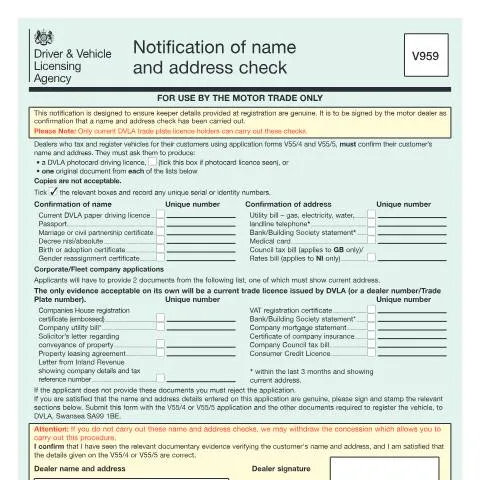
The Motor Dealer's Gateway to Vehicle Registration: Understanding the V959 Name and Address Check
When motor dealers handle vehicle registrations on behalf of their customers, they become the first line of defence against registration fraud. The V959 form represents a crucial checkpoint in this process, serving as the DVLA's mechanism to ensure that keeper details provided during vehicle registration are genuine and verifiable. This notification system places the responsibility squarely on licensed motor trade professionals to conduct thorough identity verification before submitting registration applications.
The form operates as both a declaration and a procedural safeguard, requiring dealers to confirm they have physically examined acceptable documentation proving their customer's identity and current address. Without this completed notification accompanying V55/4 or V55/5 registration applications, the entire registration process can be rejected, potentially causing significant delays and complications for both dealer and customer.
Eligibility and Trade Licence Requirements for V959 Submissions
Only current DVLA trade plate licence holders possess the authority to complete and submit V959 forms. This restriction ensures that identity verification remains within the regulated motor trade sector, where dealers have undergone appropriate vetting and hold recognised trade credentials.
The trade plate licence serves as the foundation for this privilege, with dealers required to reference either their dealer holder number or Trade Plate number on the completed form. This creates an audit trail linking each verification back to a specific licensed trader, enabling DVLA to monitor compliance and investigate any irregularities.
Dealers operating without current trade plate licences cannot legally use this system, regardless of their previous experience or customer relationships. The DVLA maintains strict oversight of trade licence validity, and attempting to use expired or suspended credentials can result in serious consequences including withdrawal of trading privileges.
Corporate and Fleet Application Variations
Business customers present additional complexity, as the V959 process differs significantly for corporate and fleet applications. Companies must provide documentation that not only confirms identity but also establishes legitimate business operations and current trading address.
The most straightforward route for business applications involves presenting a current trade licence issued by DVLA, which serves as standalone evidence requiring no additional documentation. However, most corporate customers will need to provide two documents from the specified business list, with at least one showing the current company address.
Documentary Evidence Requirements: Individual Customer Verification
The V959 form establishes a two-tier verification system for individual customers, requiring proof of both name and current address through specific documentary evidence. Dealers must physically examine original documents, as copies are explicitly rejected under all circumstances.
For name confirmation, customers can present a current DVLA paper driving licence, passport, marriage or civil partnership certificate, decree nisi or absolute, birth or adoption certificate, or gender reassignment certificate. Each document type carries its own verification considerations, with dealers required to record unique serial or identity numbers where present.
The photocard driving licence option offers the most streamlined approach, as it satisfies name verification requirements independently. However, dealers must still examine additional documentation for address confirmation, as the photocard licence alone cannot complete the verification process.
Address Verification Challenges and Time Sensitivity
Address confirmation presents particular challenges due to time-sensitive requirements. Utility bills, bank statements, and similar documents must be dated within the last three months and show the customer's current address. This restriction frequently catches customers unprepared, especially those who have recently moved or primarily use electronic billing.
| Document Type | Time Limit | Common Issues |
|---|---|---|
| Utility bills (gas, electricity, water, landline) | Within 3 months | Electronic billing, joint names |
| Bank/Building Society statements | Within 3 months | Online-only accounts, PO Box addresses |
| Council tax bills | Current year | Exempt properties, student accommodation |
| Medical cards | Current registration | Temporary registrations, recent moves |
Medical cards provide an alternative for customers struggling with utility bill requirements, though these must reflect current GP registration. Council tax bills offer another option, but dealers must distinguish between GB council tax bills and Northern Ireland rates bills, as the form specifically acknowledges this regional variation.
Corporate Documentation: Navigating Business Verification Complexities
Corporate customers face a more intricate verification landscape, with the V959 form requiring evidence of both legitimate business status and current trading address. The two-document requirement can be satisfied through various combinations, but each carries specific validation requirements that dealers must understand thoroughly.
Companies House registration certificates represent the gold standard for business verification, but only embossed versions are acceptable. Online printouts or copies fail to meet the form's requirements, often surprising business customers who assume digital certificates carry equal weight.
VAT registration certificates provide robust business credentials, though dealers must verify that the certificate remains current and matches the company details on the registration application. Suspended or cancelled VAT registrations cannot support V959 submissions, even if the physical certificate appears valid.
Specialist Business Documents and Their Applications
The form accommodates various business scenarios through specialist documentation options. Property-related documents such as solicitor's letters regarding conveyance or property leasing agreements serve customers establishing new business premises or relocating operations.
Financial documentation includes company mortgage statements and company insurance certificates, though these must clearly link to the business entity and show current address details. Consumer Credit Licences provide another avenue, particularly relevant for motor dealers registering vehicles for finance companies or leasing organisations.
Letters from Inland Revenue showing company details and tax reference numbers offer a government-backed verification route, though dealers must ensure these communications are recent and clearly identify the business entity making the application.
Completion Procedures and Critical Form Elements
Completing the V959 requires methodical attention to detail, as errors or omissions can invalidate the entire registration process. Dealers must tick the relevant boxes corresponding to each document examined and record unique serial or identity numbers where present on the documentation.
The form's checkbox system serves multiple purposes: it creates a clear record of which documents were examined, provides an audit trail for DVLA verification, and helps dealers ensure they have met all requirements before signing the declaration. Each ticked box represents a specific document type, with corresponding spaces for recording identifying numbers.
The dealer signature and stamp requirement establishes legal accountability, with the signing dealer taking personal responsibility for the verification process. This signature confirms that the dealer has physically examined the required documentation and is satisfied that the details provided are genuine and accurate.
Official Use Sections and Processing Integration
The form includes sections marked "Official Use only" for VRM (Vehicle Registration Mark) and VIN/Chassis/Frame numbers. These areas remain blank when dealers submit the form, as DVLA staff complete these sections during processing to link the verification to specific vehicle records.
This integration ensures that each V959 form becomes permanently associated with the vehicle registration it supports, creating a comprehensive audit trail that can be referenced in future investigations or compliance reviews.
Rejection Scenarios and Compliance Consequences
The V959 form operates under strict rejection criteria, with dealers required to refuse applications when customers cannot provide the specified documentation. This rejection authority places significant responsibility on motor trade professionals, who must balance customer service with regulatory compliance.
Incomplete documentation represents the most common rejection scenario, whether due to expired utility bills, photocopied documents, or missing elements from the corporate verification list. Dealers cannot accept alternative documentation not specified on the form, regardless of how convincing or official such documents might appear.
The consequences of inadequate verification extend beyond individual applications. The DVLA explicitly warns that dealers who fail to conduct proper name and address checks risk losing the concession that allows them to handle registrations on behalf of customers. This threat carries significant business implications, as losing registration privileges can severely impact a dealer's operational capabilities.
Monitoring and Audit Procedures
DVLA maintains ongoing monitoring of V959 submissions, using various indicators to identify potential compliance issues. Patterns of incomplete verification, unusual documentation combinations, or customer complaints can trigger detailed reviews of a dealer's verification procedures.
The dealer holder number or Trade Plate number recorded on each form enables DVLA to track verification patterns and identify dealers requiring additional guidance or enforcement action. This systematic approach ensures that the V959 system maintains its effectiveness as a fraud prevention mechanism.
Submission Process and Post-Completion Procedures
Once completed and signed, the V959 form must accompany the relevant V55/4 or V55/5 registration application when submitted to DVLA Swansea. The form cannot be submitted independently and has no purpose outside the vehicle registration process it supports.
The submission address remains consistent at DVLA, Swansea SA99 1BE, with all registration documentation sent together as a complete package. Separating the V959 from its associated registration application can cause processing delays and potential rejection of the entire submission.
Processing timescales follow standard DVLA registration procedures, though the additional verification step represented by the V959 form contributes to the overall processing time. Dealers should factor this verification requirement into their customer communications about registration timescales.
The completed V959 form becomes part of the permanent vehicle record, retained by DVLA as evidence that proper verification procedures were followed during initial registration. This creates a lasting audit trail that can be referenced years later if questions arise about the registration's validity or the circumstances surrounding its creation.
Understanding the V959 form's role in the broader vehicle registration ecosystem helps dealers appreciate its significance beyond mere administrative compliance. The form represents a crucial safeguard against registration fraud while enabling legitimate motor trade operations to provide comprehensive services to their customers. Proper completion and submission of V959 forms protects not only individual transactions but also the integrity of the entire vehicle registration system upon which the motor industry depends.
Processing Times and Follow-Up Procedures
The DVLA typically processes V959 notifications within 2 to 4 weeks from receipt, though processing times can vary during peak periods such as March (end of financial year) or September (plate change periods). Motor dealers should factor these timeframes into their customer service expectations, particularly when customers enquire about registration document delivery.
During processing, the DVLA may identify discrepancies that require clarification. Common scenarios include:
- Address verification issues – where the provided address cannot be matched against electoral roll or credit reference data
- Name format discrepancies – particularly with hyphenated surnames, titles, or names containing apostrophes
- Previous keeper complications – when outstanding finance or insurance claims affect the transfer
If additional information is required, the DVLA will contact the dealer directly rather than the customer. This contact typically comes via post to the dealer's registered address, though some communications may arrive electronically if the dealer has opted into digital correspondence.
Dealers should establish clear internal procedures for handling DVLA queries. Best practice includes maintaining a dedicated administrative contact who can respond promptly to requests for clarification. Delays in responding to DVLA queries can significantly extend processing times and may result in registration documents being returned to the dealer rather than sent to the customer.
For urgent cases – such as when a customer needs immediate proof of ownership for insurance purposes – dealers cannot expedite V959 processing directly. However, they can provide customers with a sales receipt and purchase invoice as interim documentation, clearly stating that official registration documents are pending DVLA processing.
Record Keeping and Audit Requirements
Motor dealers must maintain comprehensive records of all V959 submissions for a minimum period of six years from the date of submission. This requirement stems from both DVLA regulations and broader business record-keeping obligations under UK company law.
Essential records include:
- Original or certified copies of V959 forms with all sections completed
- Supporting documentation – photocopies of customer identification, proof of address, and any additional verification materials
- Transmission records – proof of posting or electronic submission confirmations
- Correspondence trail – any communications with DVLA regarding specific applications
These records serve multiple purposes beyond regulatory compliance. They provide crucial evidence in cases of disputed ownership, facilitate resolution of customer complaints, and support the dealer's position in any investigation by trading standards authorities or consumer protection agencies.
The DVLA conducts periodic audits of motor dealer practices, particularly focusing on compliance with V959 procedures. During such audits, inspectors will examine a sample of recent transactions to verify:
- Completeness and accuracy of submitted forms
- Timeliness of submissions – whether forms were sent within the required 14-day window
- Identity verification procedures – evidence that appropriate checks were conducted
- Record keeping standards – accessibility and organisation of retained documentation
Dealers found to have systemic deficiencies in their V959 processes may face sanctions ranging from additional training requirements to suspension of their ability to handle vehicle registrations. In severe cases involving fraudulent activity, criminal prosecution may result.
For electronic record keeping, dealers must ensure their systems comply with UK GDPR requirements regarding data security and retention. This includes implementing appropriate technical and organisational measures to protect customer personal data contained within V959 records.
Common Rejection Scenarios and Prevention Strategies
The DVLA rejects approximately 15-20% of V959 submissions due to various deficiencies, creating additional administrative burden for dealers and delays for customers. Understanding common rejection reasons enables dealers to implement quality control measures that significantly reduce rejection rates.
Incomplete customer information represents the most frequent cause of rejection. This typically involves:
- Partial postcodes – customers providing only the first part of their postcode
- Abbreviated addresses – using "Rd" instead of "Road" or omitting flat numbers
- Missing middle names or initials – particularly important when the customer's name appears differently on supporting documents
- Incorrect date formats – using American-style MM/DD/YYYY instead of DD/MM/YYYY
Prevention strategies include implementing standardised data capture procedures at the point of sale. Sales staff should be trained to request full, unabbreviated addresses and to verify spelling by reading information back to customers. Many successful dealers use address lookup tools integrated with their sales systems to ensure postcodes and address formats are correct.
Signature-related rejections occur when signatures on the V959 don't match those on supporting identification documents. This issue particularly affects elderly customers whose signatures may have changed over time, or customers signing in stressful situations who don't replicate their usual signature style.
Dealers can minimise signature issues by ensuring customers are relaxed and comfortable when signing, providing appropriate writing surfaces and implements, and politely requesting re-signing if the initial signature appears significantly different from identification documents.
Vehicle identification discrepancies cause rejections when VIN numbers or registration marks are incorrectly recorded. These errors often stem from misreading similar characters (0 vs O, 1 vs I) or transposing digits. Implementing double-checking procedures where a second staff member verifies vehicle details against physical plates and chassis numbers substantially reduces such errors.
Timing-related rejections occur when forms are submitted outside the 14-day window, often due to postal delays or administrative backlogs during busy periods. Dealers can mitigate this risk by submitting forms within 7-10 days of sale, allowing buffer time for postal delays or processing issues.
When rejections do occur, the DVLA returns the form with a rejection notice explaining the specific deficiency. Dealers should maintain a log of rejections to identify patterns and implement targeted improvements to their processes. Successful resubmission requires correcting the identified issue and may necessitate obtaining fresh signatures or updated documentation from customers.