When Your Vehicle Journeys Beyond UK Borders: The Three-Nation Exception
Picture this scenario: you've planned a lengthy continental European tour with your caravan, or perhaps you're relocating temporarily to work in Mexico for several months. Your UK vehicle registration and V5C logbook are perfectly valid domestically, but three specific destinations—Liechtenstein, Mexico, and Somalia—require something additional. The International Certificate for Motor Vehicles (ICMV) serves as your gateway to legal vehicle operation in these particular countries, where standard European or international driving documentation may not suffice.
This DVLA-issued certificate addresses a unique administrative gap. While most international vehicle travel relies on established conventions and reciprocal agreements, these three nations maintain distinct requirements that necessitate specific UK government certification of your vehicle's legitimacy and your legal status as its keeper.
Eligibility Criteria: More Than Just Vehicle Ownership
The ICMV application process centres on three non-negotiable prerequisites that determine your eligibility before you even begin completing form V1002/1. Understanding these requirements prevents wasted time and ensures your application proceeds smoothly through DVLA's verification systems.
The Twelve-Month Travel Window
Your intended vehicle export must not exceed twelve months duration. This temporal restriction reflects the certificate's purpose as documentation for temporary vehicle export rather than permanent relocation. Whether you're planning a six-week overland expedition through Mexico or an eight-month work assignment in Somalia, the ICMV covers short-to-medium term vehicle use abroad.
Importantly, this twelve-month period begins from your departure date, not from the certificate's issue date. DVLA's guidance emphasises planning ahead, as processing times can vary depending on the complexity of vehicle record verification.
V5C Ownership Documentation
You must possess a valid Vehicle Registration Certificate (V5C) issued by DVLA with your name listed as the registered keeper. This requirement excludes drivers using company vehicles where they're not the registered keeper, unless specific arrangements exist. The V5C must be current—if you've recently purchased the vehicle, ensure the registration transfer has completed and you've received the updated V5C before applying.
For vehicles with multiple keepers or complex ownership structures, only the person named on the V5C as the registered keeper can apply. This prevents unauthorised vehicle export and ensures clear accountability for the vehicle's international use.
Registered Keeper Status
Being the registered keeper differs from being the legal owner, though often these roles coincide. The ICMV application specifically requires registered keeper status, as this person holds legal responsibility for the vehicle's compliance with UK regulations and its proper use abroad.
| Requirement | Documentation Needed | Common Issues |
|---|---|---|
| 12-month travel limit | Travel itinerary or proof of temporary assignment | Exceeding duration invalidates certificate |
| Valid V5C in applicant's name | Current V5C document | Recent purchases may have pending transfers |
| Registered keeper status | V5C confirmation | Company vehicles often ineligible |
Navigating the V1002/1 Application Form
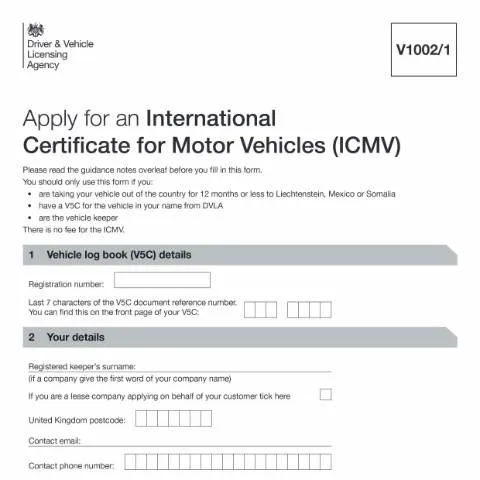
The application form itself reflects DVLA's commitment to straightforward, accessible government services. Form V1002/1 comprises three main sections, each requiring specific information that DVLA uses to verify your eligibility and issue the appropriate certificate.
Vehicle Log Book Details: Precision Matters
Section 1 focuses entirely on your V5C information. You'll need your vehicle's registration number—the familiar format like "AB12 CDE" displayed on your number plates. Additionally, DVLA requires the last seven characters of your V5C document reference number, found prominently on the front page of your logbook.
This dual verification system prevents fraudulent applications by cross-referencing your stated vehicle registration with the specific V5C document in DVLA's records. Ensure you're looking at the correct reference number, as the V5C contains multiple reference codes for different purposes.
Personal Information and Contact Details
Section 2 captures your personal details as the registered keeper. If you're an individual, provide your surname as it appears on the V5C. For company applications, enter the first word of your registered company name—this typically means the company's primary name element, excluding prefixes like "The" or suffixes like "Ltd".
The form includes a specific checkbox for lease companies applying on behalf of customers. This provision accommodates business arrangements where leasing companies maintain registered keeper status but facilitate international travel for their clients. If you're a lease company, ticking this box alerts DVLA to the commercial nature of your application.
Your UK postcode and contact information enable DVLA to communicate effectively throughout the application process and send your completed certificate to the correct address. The destination country field helps DVLA understand your specific travel requirements and ensure appropriate certificate formatting.
Declarations: Legal Responsibilities
Section 3 contains three critical declarations that carry legal weight. By signing, you confirm that you are indeed the vehicle's registered keeper, possess a valid V5C in your name, and have provided accurate information throughout the application.
These declarations aren't merely administrative formalities—they establish legal accountability for the information provided and the certificate's subsequent use. False declarations can result in prosecution under relevant fraud legislation, emphasising the importance of accuracy and honesty.
Submission Methods: Digital Efficiency Meets Traditional Post
DVLA offers two submission routes for ICMV applications, reflecting both modern digital preferences and traditional postal reliability. Your choice may depend on urgency, personal preference, or specific circumstances surrounding your travel timeline.
Email Applications: Speed and Convenience
Digital submission via [email protected] offers the fastest processing route. You'll need to scan or photograph your completed form clearly, ensuring all fields are legible and your signature is visible. DVLA's digital processing systems can handle standard image formats, but clarity remains paramount for successful processing.
Email submission also provides automatic confirmation of receipt, giving you assurance that your application has reached DVLA's processing team. This method particularly suits applicants with tight travel deadlines, though processing times still depend on verification requirements.
Postal Applications: Traditional Reliability
Traditional postal submission to ICMV Vehicle Business Support, D10, DVLA, Swansea SA6 7JL remains popular among applicants who prefer physical documentation or lack reliable scanning facilities. This method ensures your original signature reaches DVLA, eliminating any potential issues with digital signature clarity.
Postal applications typically take longer due to handling and internal routing, but they provide a tangible submission record if you use recorded delivery services. Consider your travel timeline when choosing this option.
Processing and Verification: Behind the Scenes at DVLA
Once your application reaches DVLA, a comprehensive verification process begins. Understanding this process helps set realistic expectations and explains why processing times can vary between applications.
Vehicle Record Verification
DVLA's first step involves cross-referencing your provided information with their extensive vehicle database. This verification confirms that your V5C details match official records, your registration remains current, and no outstanding issues exist that might prevent international travel.
The verification process may identify discrepancies requiring clarification or additional documentation. For instance, if recent registration changes haven't fully processed, or if your vehicle has outstanding recalls or compliance issues, DVLA may need to investigate further before issuing your certificate.
Registered Keeper Confirmation
Beyond vehicle verification, DVLA confirms your status as the legitimate registered keeper. This step prevents unauthorised certificate issuance and ensures that only eligible individuals receive ICMVs for their vehicles.
Complex ownership arrangements, such as vehicles held in trust or under finance agreements, may require additional verification steps. DVLA's thorough approach protects both vehicle owners and the integrity of the international certification system.
Certificate Delivery and Practical Usage
Upon successful verification, DVLA dispatches your ICMV to the address recorded on your V5C. This security measure ensures certificates reach legitimate applicants and prevents interception by unauthorised parties.
Certificate Validity and Limitations
Your ICMV remains valid for the duration specified in your application, up to the maximum twelve-month limit. The certificate specifically covers vehicle use in Liechtenstein, Mexico, and Somalia—it does not provide additional authorisation for other countries where different international agreements apply.
Keep your ICMV with your vehicle documentation throughout your international travel. Border officials, local authorities, and insurance providers in destination countries may require sight of this certificate to verify your vehicle's legal status and your authorisation to operate it within their jurisdiction.
Practical Considerations for International Travel
While the ICMV addresses specific legal requirements in these three nations, remember that international vehicle travel often requires additional documentation. You may need international driving permits, specific insurance coverage, temporary import permits, or customs declarations depending on your destination and travel duration.
Research local requirements thoroughly, as the ICMV represents just one element of comprehensive international travel preparation. Each destination country maintains its own entry requirements, vehicle standards, and documentation expectations that operate independently of the ICMV system.
Cost-Free Service: Government Efficiency in Action
The ICMV application process represents one of DVLA's free-of-charge services, reflecting the government's commitment to facilitating legitimate international travel without imposing additional financial barriers on citizens and businesses.
This no-cost approach contrasts with many other international documentation services and demonstrates DVLA's recognition that vehicle export requirements should not create prohibitive expenses for travellers. The free service applies regardless of your chosen submission method or the complexity of verification required.
However, related services—such as obtaining certified copies of your V5C or securing international driving permits—may incur separate charges from relevant authorities. Budget for these additional requirements when planning your international vehicle travel.
Data Protection and Privacy Safeguards
DVLA's handling of ICMV applications operates under strict data protection protocols established by the Data Protection Act 2018 and UK GDPR regulations. Your personal information receives the same protection afforded to all DVLA services, with access limited to authorised personnel processing your application.
The agency may share your data with police and enforcement bodies where legal obligations require such disclosure, and with other parties where specific legal provisions permit. DVLA's privacy policy, available through their official channels, provides comprehensive details about data processing, retention periods, and your rights regarding personal information.
Understanding these protections reassures applicants that their sensitive vehicle and personal information remains secure throughout the application process and beyond certificate issuance.
ICMV Requirements for Different Vehicle Categories and Special Cases
The International Certificate for Motor Vehicles applies to various vehicle categories, each with specific documentation requirements and potential restrictions. Understanding these distinctions is crucial for ensuring your application proceeds smoothly and your certificate remains valid abroad.
Standard Motor Cars and Light Vehicles
For conventional passenger cars under 3.5 tonnes gross vehicle weight, the ICMV application process follows the standard procedure outlined by the DVLA. Your V5C (log book) must clearly indicate the vehicle category as 'M1' for passenger cars or 'N1' for light commercial vehicles. The certificate will reflect these classifications using international coding standards recognised under the 1968 Vienna Convention on Road Traffic.
Particular attention should be paid to engine specifications listed on your V5C. Discrepancies between your registration document and the actual vehicle—such as engine modifications or conversions—may result in application delays or refusal. If you've made significant modifications to your vehicle, you must notify the DVLA and obtain an updated V5C before applying for your ICMV.
Motorcycles and Mopeds
Motorcycle ICMVs require additional considerations, particularly regarding engine capacity and power output. Your V5C must accurately reflect whether your machine is classified as a moped (up to 50cc), motorcycle (over 50cc), or electric equivalent. Some countries impose specific restrictions on motorcycle categories, so verify destination requirements before travelling.
For motorcycles with sidecars, ensure your V5C correctly records this configuration. The international certificate will note this variation, as some jurisdictions treat motorcycle-sidecar combinations differently from solo motorcycles for licensing and insurance purposes.
Commercial and Heavy Goods Vehicles
HGV operators seeking ICMVs face more complex requirements. Vehicles exceeding 3.5 tonnes require additional documentation, including your Operator's Licence details and potentially your Certificate of Professional Competence (CPC) card information. The DVLA may request proof of commercial insurance and goods vehicle test certificates (MOT equivalent for commercial vehicles).
Articulated vehicles (tractor units and trailers) may require separate certificates for each component, depending on your destination country's regulations. Check with the relevant embassy or consulate to confirm whether combined or separate documentation is required.
Classic and Historic Vehicles
Vehicles over 40 years old classified as historic by the DVLA present unique considerations for ICMV applications. While these vehicles may be exempt from certain UK requirements like MOT testing, destination countries may still require proof of roadworthiness. Consider obtaining a voluntary MOT certificate before applying if you plan to drive in countries with strict vehicle inspection requirements.
Historic vehicle ICMVs may take longer to process, as the DVLA may need to verify registration details against older records. If your V5C shows gaps in registration history or previous export markers, provide any additional documentation you possess to support your application.
Country-Specific Requirements and Bilateral Agreements
While the ICMV provides standardised international recognition, individual countries may impose additional requirements or maintain specific agreements that affect UK drivers. Understanding these variations helps avoid complications during border crossings and ensures compliance with local regulations.
European Union and EEA Considerations
Post-Brexit arrangements have altered the landscape for UK drivers in EU countries. While the ICMV remains valid, some EU member states may require additional documentation or impose different procedures for UK-registered vehicles. France, for example, may request proof of insurance coverage that meets French minimum requirements, even with a valid ICMV.
The Republic of Ireland maintains special arrangements with the UK under the Common Travel Area agreement. However, if you plan to travel onwards to other EU countries from Ireland, ensure your documentation meets those destinations' requirements. Some countries may treat vehicles entering via Ireland differently from those arriving directly from Britain.
Germany and Austria have specific requirements for vehicles transiting through their territories to reach other destinations. Your ICMV should be accompanied by valid insurance documentation and, in some cases, environmental compliance certificates for vehicles entering low-emission zones in major cities.
Non-European Destinations
Countries outside Europe may have varying recognition of ICMVs. The United States, for instance, generally accepts ICMVs for temporary visits but may require additional state-specific documentation for extended stays. Each US state maintains different regulations, so research requirements for your specific destinations.
Australia and New Zealand typically accept ICMVs for short-term visits but may require additional permits for vehicles imported temporarily. These countries also maintain strict biosecurity controls, so ensure your vehicle meets cleanliness standards before shipping or driving across borders.
Middle Eastern countries often require additional documentation beyond the ICMV, including detailed customs declarations and sometimes religious or cultural compliance certificates. The UAE and Saudi Arabia, for example, may require proof that your vehicle meets local specification standards, particularly regarding safety equipment and emissions controls.
Carnet de Passages and Temporary Import Permits
Some destinations require a Carnet de Passages en Douane in addition to your ICMV. This customs document, issued by the RAC or AA in the UK, provides financial guarantee for temporary vehicle imports. Countries commonly requiring carnets include many African nations, parts of Asia, and some South American countries.
The carnet system operates as a financial security, ensuring you'll re-export your vehicle rather than selling it locally without paying import duties. This requirement is separate from the ICMV application process but equally important for legal vehicle operation in affected countries.
Processing times for carnets can extend several weeks, and the financial guarantees required may be substantial—sometimes equivalent to the vehicle's full value plus import duties. Plan accordingly if your destination requires both an ICMV and carnet documentation.
Practical Considerations for International Travel
Successfully obtaining your ICMV represents just the first step in preparing for international vehicle travel. Practical considerations around insurance, equipment requirements, and emergency procedures can significantly impact your journey's success and legal compliance.
Insurance and Liability Coverage
Your UK motor insurance policy's international coverage varies significantly between providers and policy types. While many comprehensive policies include limited European coverage, this may not meet minimum requirements in all countries. Contact your insurer well before departure to confirm coverage levels and obtain necessary documentation.
Some insurers provide 'Green Card' documentation (technically called the International Motor Insurance Certificate) that proves your coverage meets minimum standards in participating countries. While no longer mandatory for EU travel post-Brexit, green cards remain valuable evidence of adequate insurance coverage.
Consider purchasing additional international motor insurance if your UK policy provides insufficient coverage. Specialist international motor insurance can provide higher liability limits, comprehensive coverage in more countries, and importantly, local claims handling services that understand regional requirements and procedures.
Vehicle Equipment and Safety Requirements
Different countries mandate specific safety equipment that UK vehicles may not carry as standard. France requires headlight deflectors, breathalysers (though not currently enforced), and high-visibility vests for all occupants. Germany mandates first aid kits and warning triangles, while some Eastern European countries require additional lighting equipment.
Headlight adjustment for right-hand-drive vehicles driving on the right requires careful attention. Temporary deflector kits are available, but some countries prefer or require professional headlight adjustment. LED and xenon headlights may need specialist attention that deflector kits cannot provide adequately.
Winter equipment requirements vary dramatically across Europe. Countries like Austria, Germany, and Switzerland may require winter tyres or snow chains during certain periods. Some Alpine regions mandate specific tyre tread depths or temperature ratings that UK all-season tyres may not meet.
Emergency Procedures and Breakdown Support
UK breakdown coverage often doesn't extend internationally, or provides only basic repatriation services. European breakdown cover through organisations like the AA, RAC, or Green Flag can provide roadside assistance, accommodation, and vehicle recovery services across multiple countries.
Understanding local emergency procedures is crucial for legal compliance and personal safety. Most European countries use standardised emergency numbers (112), but local police and breakdown services may have different procedures for foreign-registered vehicles. Carry contact information for your insurance provider, breakdown service, and the British Embassy or Consulate in countries you'll visit.
Document storage becomes critical during international travel. Keep your ICMV, insurance documents, and vehicle registration in easily accessible but secure locations. Many experienced international drivers carry photocopies separately from originals and store digital copies securely online for emergency access.
Currency and Payment Considerations
International travel involves various payment requirements beyond fuel and accommodation. Toll roads, congestion charges, environmental fees, and parking charges may require local currency or specific payment methods. Some countries operate electronic toll systems that require advance registration or special equipment.
France's toll autoroute system accepts most international cards, but some automated systems may reject certain UK cards. Switzerland requires an annual motorway vignette for motorway use, available at border crossings and some UK motoring organisations before departure. Austria operates a similar system with both annual and shorter-duration options.
Urban congestion charges are increasingly common across European cities. London's system is well-known, but cities like Milan, Stockholm, and various German urban areas operate different schemes. Research these requirements for cities on your route, as penalties for non-compliance can be substantial and may follow you back to the UK through international enforcement agreements.