When Standard Type Approval Falls Short: The Partial MSVA Route
Motorcycles entering the UK market don't always follow the conventional route of full European type approval. Whether you're dealing with a limited production run, a modified vehicle that no longer matches its original certification, or a motorcycle requiring specific technical exemptions, the Partial Motorcycle Single Vehicle Approval (PMSVA) process offers a targeted solution. Unlike the comprehensive MSVA examination that scrutinises every aspect of vehicle safety and environmental compliance, partial approval focuses on specific elements that require ministerial clearance whilst relying on existing Certificate of Conformity documentation for the remainder.
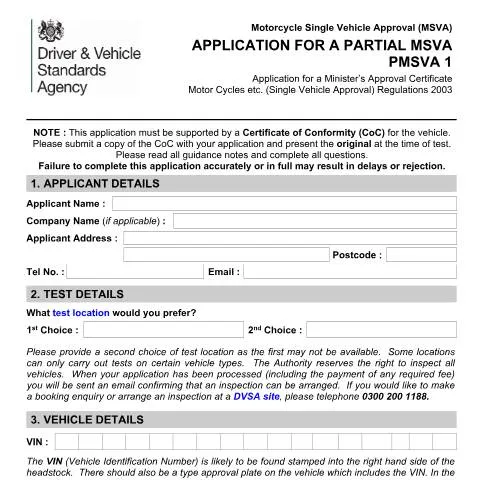
The PMSVA 1 form serves as the gateway to this specialised approval process, administered by the Driver and Vehicle Standards Agency under the Motor Cycles etc. (Single Vehicle Approval) Regulations 2003. This isn't simply a reduced version of standard approval—it's a distinct regulatory pathway designed for vehicles that meet most requirements but need targeted assessment for particular components or configurations.
Decoding Vehicle Classifications and Technical Scope
The partial MSVA system operates across a carefully structured classification framework that determines both the examination scope and associated fees. Understanding these distinctions proves crucial for accurate application completion and realistic timeline expectations.
| Class | Vehicle Type | Key Specifications | Common Partial MSVA Scenarios |
|---|---|---|---|
| Class 1 | 2-wheeled motorcycle | Engine capacity ≤200cc | Modified exhaust systems, lighting configurations |
| Class 2 | 2-wheeled motorcycle | Engine capacity >200cc | Performance modifications, braking system changes |
| Class 3 | 3-wheeled vehicle | Unladen weight | Stability systems, steering modifications |
| Class 4 | 3-wheeled vehicle | Unladen weight ≥450kg | Structural alterations, safety system integration |
| Class 4 | 4-wheeled vehicle | Quadricycles | Parking brake systems specifically |
The Vehicle Identification Number becomes particularly critical in partial MSVA applications. Examiners cross-reference the VIN against the submitted Certificate of Conformity to verify which components retain their original approval status and which require fresh assessment. On motorcycles, you'll typically locate this stamped into the right-hand side of the headstock, though checking the type approval plate provides additional confirmation.
For four-wheeled vehicles entering the partial MSVA process, the scope narrows considerably—parking brake systems represent the primary focus. This specificity reflects the regulatory approach where quadricycles meeting broader safety standards may still require targeted approval for particular braking configurations not covered under their original certification.
Certificate of Conformity: The Foundation Document
No element proves more fundamental to partial MSVA success than proper Certificate of Conformity handling. The DVSA requires both a copy submitted with your application and the original document presented at examination time. This dual requirement isn't bureaucratic redundancy—it serves specific verification purposes throughout the approval process.
During initial application processing, DVSA examiners use the submitted CoC copy to determine examination scope and identify which vehicle systems require partial approval assessment. The original document then serves for detailed technical verification during the physical inspection, allowing examiners to confirm manufacturing specifications against actual vehicle configuration.
Critical timing consideration: If your CoC bears any amendments, translations, or supplementary technical documentation, ensure all materials accompany both the copy and original submissions. Missing supplementary documents frequently trigger application delays or require complete resubmission, particularly where modifications affect safety-critical systems covered under the original approval.
Vehicles imported from non-EU manufacturers may present CoC documents requiring technical translation or interpretation. While DVSA examiners possess extensive technical expertise, complex foreign-language documentation can extend examination timelines. Consider engaging qualified technical translation services for detailed component specifications, though this represents a practical recommendation rather than a regulatory requirement.
Strategic Test Location Selection and Booking Logistics
DVSA operates multiple examination centres across England, Scotland, and Wales, but not every facility handles all vehicle classifications or partial MSVA examinations. Your location preferences directly impact both scheduling flexibility and examination capability, making strategic selection essential for efficient processing.
The two-choice requirement isn't merely administrative convenience—certain DVSA sites specialise in particular vehicle types or technical assessments. Larger centres typically offer broader capability ranges and more frequent examination slots, whilst smaller facilities may provide shorter waiting times but limited technical scope. Urban centres generally accommodate Class 2 and Class 4 vehicles more readily, given their higher-capacity testing equipment and specialist examiner availability.
Booking Process Timeline and Flexibility
Once DVSA processes your application and confirms fee payment, you'll receive email notification to arrange your examination appointment through the dedicated booking line (0300 200 1188). This two-stage process allows DVSA to verify application completeness and technical feasibility before committing examination resources.
Booking availability varies significantly by location and season. Peak periods—typically spring months when motorcycle activity increases—see extended waiting times, particularly for Class 2 vehicles requiring comprehensive technical assessment. Winter months often provide greater scheduling flexibility, though some rural centres operate reduced examination schedules during these periods.
DVSA reserves authority to inspect vehicles at alternative locations if technical requirements exceed your preferred centre's capabilities. This occasionally occurs with highly modified vehicles or those requiring specialist measurement equipment not available at smaller facilities.
Payment Mechanisms and Financial Considerations
The PMSVA payment structure accommodates different user profiles through three distinct mechanisms, each offering particular advantages depending on your examination frequency and organisational setup.
Individual Applications: Traditional Payment Methods
Postal applications accept cheques or postal orders made payable to 'Driver and Vehicle Standards Agency'. This method suits occasional users but introduces processing delays as DVSA must clear payments before scheduling examinations. Credit and debit card payments provide faster processing—once your application reaches DVSA, they'll email payment instructions allowing immediate fee settlement and quicker examination scheduling.
Commercial Operations: Pre-Funded Account Benefits
Regular MSVA users—motorcycle importers, conversion specialists, or testing organisations—benefit significantly from DVSA pre-funded customer accounts. These accounts eliminate per-application payment processing delays and provide detailed transaction reporting for business accounting purposes. Account delegates can authorise payments directly on application forms, streamlining the entire approval process.
Important authorisation requirement: Only designated account delegates may sign applications using pre-funded accounts. Unauthorised signatures trigger automatic application rejection, requiring complete resubmission with proper delegate authorisation.
Cancellation Policy and Risk Management
DVSA's cancellation policy operates on clear working day calculations that can significantly impact your financial exposure, particularly for urgent or seasonal examination requirements.
Three clear working days' notice provides full flexibility—you can reschedule to a later appointment or receive complete fee refunds. This policy recognises legitimate business circumstances: delayed vehicle delivery, technical preparation issues, or documentation complications that prevent timely examination attendance.
Less than three working days' notice results in complete fee forfeiture, regardless of circumstances. This strict policy reflects DVSA's resource allocation commitments and examiner scheduling constraints. Bank holidays and weekends don't count as working days, so Friday appointments require Tuesday notification for full refund eligibility.
Strategic Scheduling Recommendations
Given the forfeiture risk, consider scheduling examinations with adequate preparation buffers, particularly for complex modifications or imported vehicles requiring extensive documentation review. Many applicants book preliminary technical consultations with qualified engineers before submitting PMSVA applications, identifying potential compliance issues that could delay or prevent successful examination completion.
Application Completion Standards and Common Oversights
DVSA emphasises that incomplete or inaccurate applications face delays or outright rejection, but specific completion standards extend beyond basic form filling. Understanding these requirements prevents costly resubmission cycles and examination delays.
The signature requirement applies universally, whether submitting postal or electronic applications. Electronic submissions accept typed signatures, but the declaration section must contain actual name entry—automated form-filling software that leaves signature fields blank triggers immediate rejection.
Technical Detail Accuracy Requirements
Vehicle details must precisely match CoC documentation, particularly VIN transcription and technical specifications. Minor transcription errors—incorrect engine capacity figures or weight classifications—can invalidate entire applications, requiring fresh submission with corrected information and additional fee payment.
Email addresses prove particularly critical as DVSA conducts most post-application communication electronically. Ensure email accounts remain accessible throughout the examination process, as booking confirmations, technical queries, and result notifications arrive exclusively through electronic channels.
Company applications require clear identification of authorised representatives, particularly where multiple staff members might handle different aspects of the approval process. DVSA correspondence addresses the named applicant exclusively, so internal communication arrangements should ensure appropriate staff receive booking confirmations and technical correspondence.
Post-Application Process Management and Follow-Up Protocols
Successfully submitted applications enter DVSA's processing pipeline, but understanding subsequent stages helps manage expectations and identify potential issues requiring intervention.
Initial processing focuses on administrative completeness—form accuracy, payment verification, and CoC documentation review. This stage typically completes within five working days for straightforward applications, though complex technical documentation or payment issues can extend timelines considerably.
Technical review follows administrative clearance, where DVSA engineers assess examination requirements against your vehicle specifications and requested test location capabilities. This stage may generate technical queries requiring additional information or documentation clarification before examination scheduling proceeds.
Communication Management and Escalation Procedures
DVSA customer service (0300 123 9000) provides general enquiry support, whilst the dedicated MSVA booking line (0300 200 1188) handles examination-specific queries once applications receive processing confirmation. Technical enquiries should direct to [email protected], providing application reference numbers and specific technical questions for efficient response handling.
Processing delays beyond standard timelines may indicate documentation issues, payment complications, or technical assessment challenges requiring specialist review. Proactive communication with DVSA customer service can identify specific delay causes and potential resolution pathways, particularly valuable for time-sensitive commercial requirements or seasonal examination needs.
Specific Documentation Requirements for Different Motorcycle Categories
The documentation you'll need for your partial MSVA application varies significantly depending on your motorcycle's category and intended use. For category A motorcycles (two-wheeled motor vehicles without sidecar exceeding 50cc or 45km/h), you must provide detailed technical specifications including engine displacement certificates, power output documentation, and noise emission test results from an approved testing facility.
If you're applying for a three-wheeled motorcycle or motorcycle with sidecar, additional stability and handling documentation becomes mandatory. The DVSA requires specific centre of gravity calculations, wheel track measurements, and in some cases, dynamic stability test results. These vehicles often need supplementary braking system documentation, particularly if the sidecar or third wheel affects the original braking configuration.
For electric motorcycles, the documentation focus shifts to battery specifications, charging system compatibility, and electromagnetic compatibility (EMC) certificates. You'll need to demonstrate compliance with specific voltage safety requirements and provide evidence of battery management system functionality. The DVSA also requires documentation proving the vehicle's range capabilities and charging infrastructure compatibility within UK standards.
Historic or vintage motorcycles seeking partial MSVA present unique documentation challenges. You may need to provide provenance documentation, original manufacturer specifications (where available), and evidence of any modifications made during restoration. The DVSA often requires detailed photographic evidence of the restoration process, particularly for safety-critical components like brakes, steering, and suspension systems.
Regardless of category, all applications must include a completed VTG6 application form, though the supporting schedules vary. Schedule 1 covers basic vehicle identification, Schedule 2 addresses technical compliance areas, and Schedule 3 (when applicable) covers specific exemptions you're requesting. Each schedule requires different supporting evidence, so reviewing the specific requirements for your motorcycle category before gathering documentation saves considerable time.
Common Rejection Reasons and How to Avoid Them
Understanding why partial MSVA applications get rejected helps you prepare a stronger submission from the outset. Incomplete technical documentation represents the most frequent rejection reason. The DVSA consistently rejects applications lacking proper engine certification, emissions compliance certificates, or adequate technical drawings. Ensure every technical document includes clear part numbers, specifications, and certification marks where required.
Inadequate photographic evidence causes numerous rejections, particularly for modified or kit-built motorcycles. The DVSA requires clear, well-lit photographs showing all safety-critical components from multiple angles. Blurry images, poor lighting, or photos that don't clearly show component details will result in rejection. Take photographs in good natural light, ensuring all serial numbers, certification marks, and component details are clearly visible.
Many applicants underestimate the importance of component traceability. If your motorcycle uses non-original parts, you must provide clear documentation proving each component's compliance with relevant safety standards. This includes brake components, lighting systems, tyres, and any structural modifications. Generic or uncertified components, even if functionally adequate, will trigger rejection if proper compliance documentation isn't provided.
Incorrect application routing also causes delays and rejections. Some applicants submit partial MSVA applications for vehicles that should undergo full type approval, while others attempt individual vehicle approval when partial MSVA would be more appropriate. The DVSA's guidance documents clearly outline which route applies to different scenarios, but the distinctions can be subtle for edge cases.
Timing-related rejections occur when applicants submit incomplete applications hoping to complete documentation during the assessment process. The DVSA won't hold incomplete applications while you source missing documents. Instead, they'll reject the application and require full resubmission once you've gathered all required materials. This approach often extends the overall timeline significantly compared to waiting until you have complete documentation before initial submission.
To avoid these pitfalls, use the DVSA's pre-submission checklist and consider engaging with their technical helpline before finalising your application. They can provide guidance on specific documentation requirements for your motorcycle's configuration, potentially identifying issues before formal submission.
Post-Approval Obligations and Ongoing Compliance
Receiving partial MSVA approval marks the beginning, not the end, of your compliance obligations. The DVSA issues a Certificate of Conformity that specifies exactly which regulatory requirements your motorcycle meets and, crucially, which ones remain your responsibility to address. This certificate becomes essential documentation for subsequent registration, insurance, and any future modifications.
Registration obligations follow immediately after MSVA approval. You must register your motorcycle with the DVLA within specific timeframes, typically using form V55/5 for new vehicles or V55/4 for imported vehicles. The registration process requires your MSVA certificate, proof of identity, and evidence of legal importation (where applicable). Delays in registration can complicate insurance arrangements and legal road use.
Your ongoing compliance responsibilities depend heavily on which areas weren't covered by the partial approval. Common ongoing obligations include annual emissions testing, periodic safety inspections, and maintaining compliance with any conditional requirements specified in your certificate. For example, if your approval was conditional on using specific tyre specifications, changing to different tyres without proper assessment could invalidate your approval status.
Modification restrictions apply strictly after partial MSVA approval. Any changes to safety-critical components, engine specifications, or structural elements typically require reassessment or additional approval procedures. The DVSA maintains detailed guidance on which modifications trigger reassessment requirements, but the general principle is that any change affecting the areas covered by your original approval needs formal evaluation.
Record-keeping obligations continue throughout your motorcycle's life. You must maintain all original approval documentation, any subsequent modification approvals, and evidence of ongoing compliance with conditional requirements. These records become essential if you sell the vehicle, need insurance assessments, or face regulatory inspections.
For commercial operators or those planning to manufacture multiple units, additional obligations may apply. The DVSA can impose production monitoring requirements, quality system audits, or batch testing obligations depending on your intended production scale and market approach. These requirements typically involve formal quality management systems and regular compliance reporting to the DVSA.
Consider establishing a compliance monitoring system early in the process. This might include calendar reminders for periodic inspections, documentation filing systems for ongoing compliance evidence, and relationships with qualified testing facilities for any required ongoing assessments. Proactive compliance management prevents issues that could affect your motorcycle's legal status or resale value.