When UK VAT Becomes Reclaimable for Foreign Enterprises
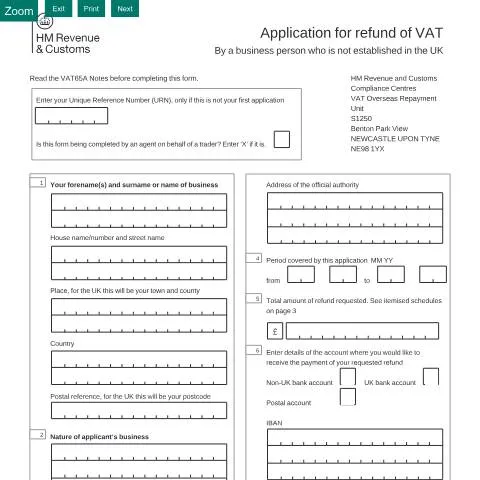
Foreign businesses operating across borders often face the complexity of Value Added Tax systems that vary dramatically between jurisdictions. For enterprises established outside the United Kingdom but conducting business activities within UK territory, the VAT65A application represents a crucial mechanism for recovering tax charges that would otherwise represent an unrecoverable cost burden. Unlike domestic businesses registered for UK VAT who can offset input tax through their regular returns, overseas entities require this specialised refund process to reclaim VAT paid on legitimate business expenses incurred during their UK operations.
The VAT65A form addresses a fundamental principle of international tax equity: businesses should not suffer economic double taxation merely because they operate across national boundaries. When a German manufacturer purchases services from a UK consultant, or when a French logistics company pays for warehouse facilities in Birmingham, the VAT charged on these transactions can be substantial. Without proper reclaim mechanisms, these costs would create competitive disadvantages for international businesses compared to their UK-established counterparts.
Navigating the Complex Eligibility Framework
Understanding who qualifies for VAT65A refunds requires careful analysis of both the applicant's status and the nature of their UK business activities. The form explicitly addresses three distinct categories of permissible activity during the refund period, each carrying specific implications for eligibility.
The "No Supply" Category
Businesses ticking the "no supply of goods or services" box represent the most straightforward category. These entities typically include overseas companies conducting market research, attending trade exhibitions, or establishing preliminary business relationships without yet engaging in taxable supplies. A Japanese technology firm visiting UK suppliers or attending conferences in London would fall into this category, provided they make no sales or service provisions during their visit.
Reverse Charge Service Provisions
The second category covers businesses providing "services in respect of which tax is payable solely by the person to whom they are supplied". This reflects the UK's reverse charge mechanism, where the responsibility for accounting for VAT shifts from the supplier to the recipient. Professional services, consultancy, and certain digital services often fall under these arrangements. An Italian software developer providing bespoke programming services to a UK client would typically qualify, as the UK client becomes responsible for accounting for the VAT under reverse charge rules.
Transport Service Exemptions
The third permissible activity involves "certain supporting exempted transport services". This category acknowledges the international nature of transport operations and the complex VAT treatments that apply to cross-border movements. Airlines, shipping companies, and international freight operators frequently qualify under this provision, reflecting the practical reality that transport services often span multiple jurisdictions with varying tax treatments.
Decoding the Application Structure and Critical Data Points
The VAT65A form's design reflects HMRC's systematic approach to processing international refund claims, with each section serving specific verification and processing functions. Understanding the underlying logic helps applicants provide complete, accurate information that expedites processing.
Unique Reference Numbers and Repeat Applications
The prominence of the Unique Reference Number (URN) field indicates HMRC's sophisticated tracking system for repeat applicants. Businesses that regularly incur UK VAT through ongoing activities receive URNs that streamline subsequent applications. This system recognises that many overseas businesses maintain regular UK operations—conference organisers who book UK venues annually, or European manufacturers who regularly purchase UK components.
| Application Type | URN Required | Processing Implications |
|---|---|---|
| First-time applicant | Leave blank | Full documentation review |
| Repeat applicant | Enter existing URN | Expedited processing possible |
| Agent submission | Include if available | Additional authorisation checks |
Business Registration Authority Requirements
Section 3's requirement for details of the "official authority" in the applicant's home country serves multiple verification purposes. HMRC uses this information to confirm the applicant's legitimate business status and to facilitate potential information exchanges with overseas tax authorities. The specific request for both the authority's name and address enables HMRC to verify registration details directly when necessary.
This requirement reflects the UK's commitment to preventing fraudulent claims while maintaining efficient processing for legitimate businesses. A Norwegian company would provide details of the Brønnøysund Register Centre, while a Canadian business would reference the appropriate provincial business registry.
Financial Architecture: Banking Details and Currency Considerations
The VAT65A form's banking section reveals the sophisticated financial infrastructure required to process international refunds efficiently. The distinction between UK and non-UK bank accounts reflects practical processing realities and cost considerations for both HMRC and applicants.
IBAN and SWIFT Code Requirements
For non-UK accounts, the mandatory IBAN (International Bank Account Number) and SWIFT code requirements enable secure, traceable international transfers. These standardised identifiers reduce processing errors and ensure refunds reach intended recipients. The form's accommodation of multiple currencies acknowledges that businesses may prefer to receive refunds in their operating currency, though this may involve exchange rate considerations at the time of payment.
UK bank accounts offer potential advantages in processing speed and reduced transfer costs, explaining why some overseas businesses establish UK banking relationships specifically for VAT refund purposes. However, HMRC accepts that this isn't practical for all applicants, hence the comprehensive international banking options.
Postal Account Provisions
The inclusion of "postal account" options recognises that banking infrastructure varies globally. In some jurisdictions, postal banking systems remain significant financial service providers, particularly for smaller businesses or in regions with limited commercial banking access.
The Itemised Schedule: Where Detail Determines Success
Page 3's itemised schedule represents the technical heart of the VAT65A application, where success or failure often hinges on meticulous documentation and accurate categorisation. This section transforms abstract refund requests into concrete, verifiable business transactions.
Invoice Documentation Standards
The requirement for consecutive numbering starting with "1" serves both organisational and audit purposes. HMRC's processing systems rely on this systematic approach to track individual transactions through their verification process. Each invoice must demonstrate clear VAT liability and business purpose, with supporting documentation that establishes the overseas entity's right to reclaim the tax charged.
The supplier's VAT registration number becomes crucial verification data. HMRC can cross-reference these numbers against their own records to confirm that the VAT was properly charged and accounted for by the UK supplier. Missing or incorrect VAT numbers frequently trigger additional verification requirements that delay processing.
Transaction Categorisation and Exclusions
Understanding what cannot be reclaimed proves as important as identifying eligible expenses. The form explicitly excludes VAT on exported goods and travel agent services for travellers' direct benefit. These exclusions reflect policy decisions about where VAT burdens should ultimately rest.
Exported goods exclusions prevent double benefits—businesses already benefit from zero-rated export supplies, so input tax recovery would create unintended advantages. Travel agent exclusions recognise the complex, multi-jurisdictional nature of travel services where determining the appropriate VAT treatment location becomes problematic.
Agent Authorisation and Professional Representation
The VAT65A form's accommodation of agent completion reflects the practical reality that international VAT reclaims often require specialist expertise. Professional advisers familiar with UK VAT rules and HMRC procedures can significantly improve application success rates and processing speeds.
Consent and Communication Protocols
Agent involvement triggers additional consent requirements, particularly regarding email communications. The form's detailed email consent provisions reflect data protection obligations under UK GDPR and the Data Protection Act 2018. HMRC cannot correspond directly with agents without explicit client authorisation, and email communications require informed consent about associated risks.
The distinction between client and agent consent acknowledges that professional representatives may have different risk tolerances regarding electronic communications. Some businesses prefer all correspondence to flow through their advisers, while others want direct HMRC contact for transparency.
Processing Realities and Timeline Expectations
While the VAT65A form itself doesn't specify processing timeframes, understanding HMRC's operational constraints helps set realistic expectations. International refund claims require more extensive verification than domestic applications, involving potential overseas authority contact and detailed transaction analysis.
Documentation Quality Impact
Complete, accurate applications with clear supporting documentation typically process more quickly than those requiring additional information requests. HMRC's Newcastle processing centre handles significant volumes of international claims, and applications requiring minimal intervention receive priority attention.
The requirement for two copies of each itemised schedule reflects HMRC's internal processing needs while ensuring applicants retain complete records. This duplication requirement has practical implications for businesses submitting extensive claims with numerous supporting documents.
Strategic Considerations for Ongoing UK Business Activities
For overseas businesses with regular UK operations, the VAT65A process represents part of a broader tax efficiency strategy. Understanding the interplay between refund claims and potential UK VAT registration requirements helps businesses optimise their tax positions.
Businesses exceeding certain turnover thresholds or conducting specific types of UK activities may find mandatory UK VAT registration more efficient than periodic refund applications. The VAT65A system works best for businesses with irregular or limited UK VAT exposure, while high-activity businesses often benefit from full UK VAT registration despite the additional compliance obligations.
The form's emphasis on business activity categorisation helps HMRC identify businesses that might benefit from registration advice, creating opportunities for proactive tax planning discussions that benefit both the business and UK tax administration efficiency.
Digital VAT Refund Processing and HMRC's Online Systems
HMRC has significantly modernised VAT refund processing for overseas businesses through digital-first initiatives. The VAT Online Services platform now handles most international refund claims, though certain legacy paper processes remain for specific circumstances.
Overseas businesses must register for HMRC's digital services before submitting electronic claims. This registration requires your overseas VAT registration number, business address verification, and designated contact person details. The system generates a unique Government Gateway ID, which becomes your permanent identifier for all future VAT interactions with HMRC.
Electronic submission offers substantial advantages over paper forms. Processing times typically reduce from 12-16 weeks to 6-10 weeks for straightforward claims. The system automatically validates VAT registration numbers against EU and international databases, flagging potential discrepancies before submission rather than during assessment.
However, certain claim types still require paper submission. Claims exceeding £100,000, those involving complex supply chains across multiple jurisdictions, or refunds relating to goods permanently exported from the UK often need manual assessment. HMRC's VAT Central Unit in Southend-on-Sea handles these high-value or complex cases.
The digital system provides real-time claim tracking through numbered reference codes. Businesses can monitor assessment progress, respond to HMRC queries electronically, and receive automated notifications when additional documentation is required. This transparency significantly reduces administrative burden compared to traditional postal correspondence.
Technical requirements for digital submission include compatible PDF software for supporting documents, with file size limits of 10MB per attachment. HMRC accepts most standard document formats, though scanned receipts must meet minimum resolution standards for automated processing systems to extract key data points.
Sector-Specific VAT Refund Considerations and Industry Variations
Different business sectors face unique VAT refund challenges when operating across UK borders. Understanding these sector-specific nuances can prevent common claim rejections and streamline the refund process.
Construction and contracting businesses frequently encounter complex VAT scenarios when working on UK projects. Overseas contractors must distinguish between services performed in the UK versus their home country. VAT incurred on UK-sourced materials, plant hire, and subcontractor services may be reclaimable, but labour costs and overseas-sourced materials typically are not. The Construction Industry Scheme (CIS) can further complicate matters, as VAT treatment differs from standard commercial arrangements.
For manufacturing and industrial businesses, VAT refunds often relate to raw materials, components, and machinery purchases. These businesses must demonstrate that goods were genuinely exported from the UK or incorporated into products subsequently exported. HMRC requires detailed production records showing the transformation process and final destination of finished goods. Waste materials or by-products sold within the UK may affect the overall refund calculation.
Professional services firms including consultants, legal practices, and accountancy firms face different challenges. VAT on UK office expenses, travel, and accommodation may be reclaimable if directly related to UK client work. However, general overhead costs or expenses relating to non-UK clients typically don't qualify. The place of supply rules for services can significantly impact VAT treatment, particularly for digital or remote service delivery.
Transport and logistics businesses deal with complex cross-border VAT scenarios. Fuel purchases within the UK, vehicle maintenance, and depot costs may qualify for refunds. However, businesses must carefully track which expenses relate to UK-destination transport versus international transit. The VAT treatment of empty running, return journeys, and multi-drop deliveries requires detailed journey logs and customer documentation.
Event management and exhibition businesses often incur substantial UK VAT on venue hire, equipment rental, and contractor services. These costs may be reclaimable if the event generates overseas revenue or promotes non-UK business activities. However, businesses must demonstrate clear business purpose and avoid personal or entertainment elements that could disqualify the claim.
Each sector must maintain industry-appropriate records. Manufacturing businesses need production schedules and export documentation, while service providers require detailed timesheets and client correspondence. HMRC's sector-specific guidance documents provide additional clarity, though these are regularly updated to reflect changing business practices and EU relationship developments.
Post-Brexit VAT Refund Changes and Ongoing Implications
Brexit fundamentally altered VAT refund procedures for businesses registered outside the UK, creating new administrative requirements and changing established processes that operated for decades under EU frameworks.
The most significant change affects EU-based businesses, which previously claimed UK VAT refunds through their domestic tax authorities under the EU VAT Directive. These businesses now follow the same procedures as other international entities, dealing directly with HMRC rather than their home country tax offices. This shift has created additional administrative burden and extended processing times as businesses adapt to unfamiliar UK systems.
New reciprocal agreements between the UK and individual EU member states are still developing. Some countries maintain streamlined processes through bilateral tax treaties, while others default to standard international procedures. Businesses should verify current arrangements with both UK and home country tax authorities, as these agreements evolve regularly through diplomatic negotiations.
The Northern Ireland Protocol creates unique VAT scenarios for businesses operating across the Irish border. Companies registered in the Republic of Ireland may face different VAT treatment depending on whether goods or services relate to Northern Ireland or Great Britain. This complexity requires careful record-keeping to distinguish between different UK regions and their respective VAT implications.
Customs and VAT alignment issues have emerged for businesses importing goods into the UK before re-export. Previously, EU businesses could move goods freely without customs intervention, but now must navigate both customs duty and VAT implications. This affects refund calculations, as businesses may need to account for customs duties paid alongside VAT when claiming refunds for subsequently exported goods.
HMRC has introduced enhanced verification procedures for post-Brexit claims, particularly from EU businesses. Additional documentation requirements include proof of genuine commercial activity, evidence of arm's length pricing for related party transactions, and detailed explanations of supply chain arrangements. These measures aim to prevent VAT fraud while ensuring legitimate businesses can access entitled refunds.
The timing of Brexit transition affects claims spanning the 31 December 2020 deadline. Businesses with transactions occurring both before and after Brexit may need to split claims according to different procedural requirements. Pre-Brexit transactions might still follow old EU procedures if claims were initiated before the transition period ended, while post-Brexit transactions definitely follow current international procedures.
Currency fluctuations since Brexit have also impacted VAT refund values for overseas businesses. Claims calculated in pounds sterling may have significantly different home currency values between submission and payment dates. While HMRC pays refunds in pounds, businesses should consider exchange rate exposure when planning cash flow around expected refund receipts.