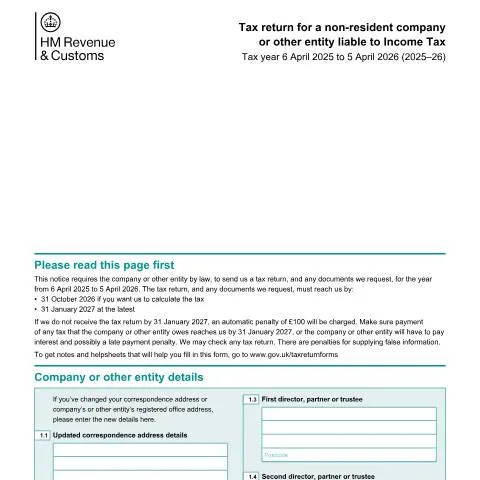
Understanding the SA700 Return Within the UK Tax Landscape for Non-Resident Companies
The Self Assessment SA700 return occupies a distinct position within HMRC's tax collection framework, specifically targeting non-resident companies and other entities that generate income subject to UK Income Tax. Unlike Corporation Tax returns that capture the broader activities of UK-resident companies, the SA700 focuses exclusively on Income Tax liabilities arising from specific UK sources.
This return becomes necessary when a foreign company operates in the UK without establishing a permanent establishment, yet derives income from activities such as trading, property lettings (though property income reporting has since moved to separate forms), or receives royalties and similar payments. The distinction is crucial: whilst resident companies file CT600 returns for Corporation Tax, non-resident entities use SA700 when their UK activities fall under the Income Tax regime rather than Corporation Tax.
The SA700 sits alongside other specialist returns in HMRC's portfolio, including the SA800 for partnerships and SA900 for trusts. Each serves specific taxpayer categories, with the SA700 addressing the unique compliance needs of overseas entities that cannot simply ignore their UK tax obligations despite their non-resident status.
Decoding the SA700's Core Sections and Critical Data Points
The SA700 return divides into several interconnected sections, each demanding careful attention to avoid costly errors or delays.
Entity Details and Contact Information
Section 1 captures fundamental company information, including correspondence addresses and registered office details. Box 1.1 and 1.2 require updated addresses only when changes have occurred since the last submission. HMRC uses these details for all future correspondence, making accuracy essential.
Particularly important are boxes 1.3 and 1.4, which record director, partner, or trustee information. For companies with more than two such officers, additional details must appear in the supplementary information box 11.1 on page 6. This requirement often catches overseas entities unprepared, especially when dealing with complex ownership structures.
Business Details and Accounting Periods
Section 3 demands precise accounting period information. Boxes 3.2 and 3.3 establish the accounting period start and end dates, which may not align with the tax year running from 6 April to 5 April. This misalignment frequently creates confusion when apportioning income and expenses.
Box 3.7 addresses situations where accounts don't cover the standard period from the last accounting date. Such circumstances require detailed explanations in box 11.1, particularly when businesses have changed accounting dates or experienced irregular trading patterns.
Profit and Loss Calculations
The profit and loss section presents the most complex aspects of SA700 completion. Box 3.15 captures net profits, whilst box 3.16 records allowable losses. The interplay between these figures and subsequent loss relief calculations requires careful consideration of UK tax rules.
Boxes 3.16C and 3.16D address transition profit spreading, a provision introduced for specific circumstances where profits need apportioning across multiple tax years. This typically applies when accounting practices change or when businesses adjust their reporting methods to comply with UK requirements.
| Box Reference | Purpose | Key Consideration |
|---|---|---|
| 3.20 | Losses brought forward | Must trace back to original loss computations |
| 3.21 | Losses offset current year | Cannot exceed current year profit |
| 3.22 | Taxable profit after losses | Excludes transition profit amounts |
Navigating Other Income Categories and Tax Calculations
Section 4 addresses other UK income beyond direct trading activities. This encompasses royalties, trust income, and various investment returns that fall within the UK tax net despite the entity's non-resident status.
The gross income calculation in box 4.3 combines net income with any Income Tax already suffered at source. This mechanism prevents double taxation whilst ensuring HMRC captures the full income picture for assessment purposes.
Section 5 offers optional tax calculation facilities. Entities can choose whether to calculate their own tax liability or leave this to HMRC. Self-calculation provides greater control and often faster processing, but demands thorough understanding of current tax rates and reliefs.
The 20% rate applied in box 5.7 reflects the standard Income Tax rate for non-resident companies. However, tax treaties may modify this rate, requiring entities to consider their specific circumstances and potential treaty benefits.
Payment on Account Requirements
When tax due exceeds £1,000, payment on account provisions apply for the following tax year. Box 5.8 calculates this as 50% of the current year's liability, creating cash flow implications that overseas entities must plan for carefully.
Claims to reduce payments on account (box 5.9) require justification in the additional information section. Common grounds include expected reduced activity or changes in income patterns, but HMRC scrutinises such claims closely.
Repayment Mechanisms and Banking Arrangements
Section 6 addresses overpayment situations and repayment preferences. Non-resident entities face particular challenges here, as HMRC's preference for UK bank accounts may not align with their operational arrangements.
Direct bank transfers to UK accounts offer the fastest repayment method, typically processing within 10-15 working days. However, entities without UK banking facilities must rely on payable orders, which take considerably longer and involve additional administrative steps.
The nominee arrangement option (boxes 6.2 and 6.4) allows repayments to third-party UK accounts, often utilised by entities working through UK-based agents or advisers. This requires careful documentation of authority and identification details.
Submission Channels and Deadline Management
The SA700 accepts both online and paper submissions, though HMRC strongly encourages digital filing through their online services. Paper returns require posting to specific HMRC processing centres, with delivery confirmation recommended given the penalty implications of late submission.
Two critical deadlines govern SA700 submission:
- 31 October 2026 for entities wanting HMRC to calculate tax liability
- 31 January 2027 as the absolute final deadline
Missing the January deadline triggers an automatic £100 penalty, with additional penalties accumulating for extended delays. The payment deadline also falls on 31 January 2027, meaning entities must coordinate both submission and payment to avoid interest charges.
Online submission provides immediate confirmation and integrates with HMRC's payment systems, whilst paper returns involve longer processing times and potential postal delays. For non-resident entities managing compliance from overseas, the certainty of online submission often outweighs any perceived complexity.
Complex Scenarios and Specialist Considerations
Certain situations demand particular attention when completing SA700 returns. Multi-jurisdictional entities must carefully apportion income between UK and overseas sources, often requiring detailed supporting calculations and documentation.
Entities with varying accounting periods face additional complexity when aligning their natural business cycles with UK tax year requirements. This particularly affects seasonal businesses or those with project-based income patterns.
Treaty Benefits and International Provisions
Double taxation treaties may modify the standard 20% Income Tax rate applied to non-resident companies. However, claiming treaty benefits requires careful documentation and may involve separate applications to HMRC's Treaty Team.
The interaction between UK domestic law and international agreements creates scenarios where entities must consider both SA700 obligations and potential treaty claims simultaneously. This dual approach often requires specialist advice to optimise tax positions whilst maintaining compliance.
Group Situations and Connected Parties
Non-resident companies forming part of larger corporate groups face additional considerations around transfer pricing and profit attribution. The SA700 may need supplementing with detailed transfer pricing documentation, particularly for entities with significant intra-group transactions.
Connected party transactions require particular scrutiny, as HMRC increasingly focuses on profit-shifting arrangements that might understate UK tax liabilities.
Post-Submission Processes and HMRC Engagement
Following SA700 submission, entities enter HMRC's compliance monitoring framework. The return may undergo various checks, from automated validation through to detailed enquiries examining specific aspects of the tax computation.
Processing acknowledgement typically occurs within 2-4 weeks for paper returns, or immediately for online submissions. Any tax due appears on the entity's HMRC account, with payment references provided for bank transfers or other settlement methods.
HMRC's enquiry powers extend for 12 months after submission (or longer in cases of suspected irregularities). Non-resident entities should maintain comprehensive records of their UK activities and supporting calculations, as overseas location doesn't exempt them from HMRC's information-gathering powers.
Ongoing Compliance Obligations
Successful SA700 submission creates ongoing relationships with HMRC, including potential requirements for future returns if UK income continues. Entities must monitor whether their activities remain within the Income Tax regime or whether changes might shift them into Corporation Tax territory.
The annual cycle of SA700 filing becomes part of the entity's compliance calendar, requiring coordination with overseas tax obligations and planning for any changes in UK tax legislation that might affect future submissions.
Complex Ownership Structures and Multi-Tier Holdings
Non-resident companies operating through complex ownership arrangements face particular challenges when completing SA700 returns. Companies that form part of multi-tier holding structures must carefully navigate the attribution of income and expenses across different jurisdictions, ensuring compliance with both UK tax obligations and international transfer pricing requirements.
When a non-resident parent company holds UK subsidiaries through intermediate holding companies in different territories, the SA700 must reflect the actual economic substance of transactions. HMRC scrutinises arrangements where profits might be artificially shifted through jurisdictions with favourable tax treaties. Companies must maintain comprehensive documentation showing that pricing between related entities reflects arm's length principles, particularly for management charges, royalties, and financing arrangements.
Beneficial ownership disclosure requirements have become increasingly stringent under the Economic Crime (Transparency and Enforcement) Act 2022. Non-resident companies must identify persons of significant control (PSCs) and register these details with Companies House where applicable. This information directly impacts SA700 completion, as HMRC cross-references ownership data with declared income streams and claimed reliefs.
Trust structures add another layer of complexity. Where non-resident companies are owned by discretionary trusts or family trusts established in offshore jurisdictions, the SA700 must clearly identify the trust arrangement and demonstrate that UK-source income is properly attributed. Special attention is required for distributions received from UK trusts, which may carry tax credits that affect the company's overall UK tax liability.
Joint venture arrangements require careful consideration of whether the non-resident company is treated as a partner in an unincorporated partnership or as a corporate joint venturer. This classification significantly impacts how profits and losses are reported on SA700, particularly where the joint venture involves UK property development or trading activities.
Interaction with Diverted Profits Tax and Hybrid Mismatch Rules
The Diverted Profits Tax (DPT) regime, introduced to counter aggressive tax planning by multinational enterprises, creates additional reporting obligations for certain non-resident companies completing SA700 returns. Companies with UK turnover exceeding £10 million or those involved in arrangements that lack economic substance may face DPT charges at 25%, significantly higher than standard corporation tax rates.
SA700 completion must consider whether transactions fall within DPT scope, particularly where non-resident companies use intellectual property holding structures or intra-group financing arrangements. The "insufficient economic substance" test examines whether tax benefits obtained from arrangements are commensurate with the economic activity undertaken in the relevant territory. Companies must demonstrate that their overseas operations possess genuine decision-making functions and appropriate levels of staffing and assets.
Hybrid mismatch rules, implemented following OECD BEPS recommendations, directly impact SA700 reporting for non-resident companies using hybrid financial instruments or entities. These rules deny deductions or require income inclusions where arrangements exploit differences in tax treatment between jurisdictions. Common scenarios include loans that are treated as equity in one jurisdiction but debt in another, or payments to hybrid entities that are transparent in one country but opaque in another.
When completing SA700, companies must identify any payments that could constitute hybrid mismatches and adjust their UK tax computation accordingly. This includes imported mismatch scenarios where the company receives deductible payments that are not included in ordinary income by the payee jurisdiction. The complexity increases where multiple hybrid instruments or entities are used in structured arrangements.
Interest restriction rules under the corporate interest restriction regime also interact with SA700 reporting. Non-resident companies that are part of large multinational groups (consolidated gross revenues exceeding £500 million) must consider whether their UK interest expenses are restricted to 30% of UK tax-EBITDA. This calculation requires careful allocation of group debt and interest expenses, particularly where financing arrangements span multiple jurisdictions.
Post-Brexit Implications and Changing Treaty Networks
Brexit has fundamentally altered the tax landscape for non-resident companies with UK operations, requiring careful reconsideration of SA700 reporting strategies. The end of EU tax directives' automatic application means that many reliefs previously available to EU-resident companies now depend entirely on bilateral double taxation agreements or unilateral UK provisions.
The most significant change affects withholding tax obligations on UK-source income. EU companies previously benefiting from the Interest and Royalties Directive or Parent-Subsidiary Directive must now rely on specific treaty provisions or demonstrate equivalent exchange of information agreements with their home jurisdictions. This shift requires SA700 filers to carefully review their entitlement to reduced withholding rates and ensure proper documentation supports any claims.
State aid implications have also evolved post-Brexit. Certain tax arrangements that might previously have fallen within EU state aid rules now require assessment under the UK's domestic subsidy control regime. Non-resident companies receiving preferential tax treatment through specific reliefs or arrangements must consider whether such benefits constitute subsidies requiring notification or approval under the Subsidy Control Act 2022.
The UK's changing approach to tax treaty negotiations has resulted in updated agreements with key trading partners, often incorporating enhanced anti-abuse provisions and improved dispute resolution mechanisms. Recent treaties include more robust limitation of benefits clauses and principal purpose test provisions that may affect non-resident companies' ability to access treaty benefits. SA700 filers must stay current with these evolving provisions and ensure their arrangements meet updated treaty requirements.
Digital services tax considerations have become increasingly relevant for non-resident technology companies. The UK's digital services tax applies to certain online marketplace services, search engines, and social media platforms with global revenues exceeding £500 million and UK revenues above £25 million. While this tax operates separately from corporation tax, interactions between DST and SA700 reporting can arise where companies have both digital and conventional UK operations.
Exchange control and reporting obligations have also evolved, particularly for companies from jurisdictions with complex regulatory relationships with the UK. Enhanced due diligence requirements under the Economic Crime (Transparency and Enforcement) Act affect both initial registration and ongoing compliance obligations, with direct implications for SA700 accuracy and completeness.