When Trusts and Estates Must Navigate Self Assessment Obligations
The death of a settlor, the establishment of a new trust arrangement, or the complex administration of an estate can trigger unexpected tax reporting requirements that catch many trustees and personal representatives off guard. The Self Assessment: Trust and Estate Tax Return (SA900) represents one of the most intricate filing obligations within the UK tax system, demanding detailed disclosure of income, capital gains, and complex trust arrangements that often span multiple tax years.
Unlike individual self assessment returns, the SA900 serves a dual purpose: it captures the tax position of both active trust arrangements and estates under administration, each with distinctly different reporting thresholds and calculation methods. The complexity intensifies when trustees must determine whether they're dealing with bare trusts, interest in possession trusts, or more sophisticated arrangements involving non-resident elements or charitable purposes.
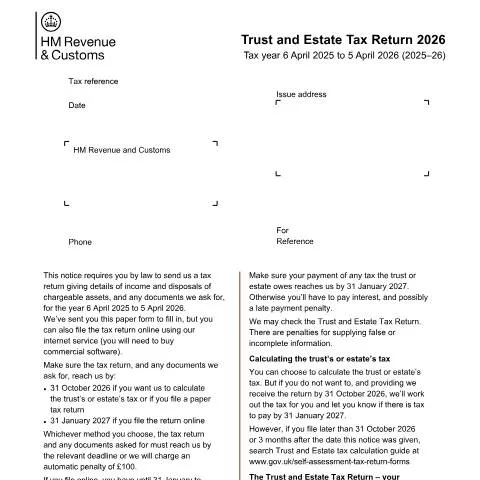
The statutory notice accompanying each SA900 carries legal weight, requiring recipients to provide comprehensive details of income and chargeable asset disposals for the tax year running from 6 April to 5 April. This isn't merely an administrative formality—failure to comply triggers automatic penalties, starting with £100 for late filing, regardless of whether any tax is actually due.
Decoding the Complex Web of Trust Types and Filing Requirements
The SA900 form recognises that not all trusts and estates face identical reporting burdens. The legislation provides several fast-track routes that allow certain arrangements to bypass lengthy sections of the return, but identifying eligibility requires careful analysis of the specific circumstances.
Bare Trust Simplifications
Trustees managing bare trusts—where beneficiaries hold immediate and absolute title to both capital and income—benefit from the most streamlined approach. These arrangements can proceed directly to Question 17 on page 10, effectively skipping the complex income and deduction calculations that burden other trust types. However, this exemption doesn't apply to unauthorised unit trusts, which must complete the full return despite their seemingly straightforward structure.
The bare trust exemption reflects the tax transparency principle: since beneficiaries are directly liable for tax on trust income and gains, the trust itself serves merely as a legal wrapper rather than a separate taxable entity.
Estate Administration Shortcuts
Personal representatives managing estates during the administration period can access significant filing simplifications, but only when all of several stringent conditions align:
- All income must arise within the UK
- No relief claims are being made under Questions 10A and 10B
- No annual payments have been made from capital
- All income received carries tax already deducted at source
- The estate involves no complex instruments like deeply discounted securities, gilt strips, or offshore income gains
- No capital payments have been received from non-resident or immigrating trusts
When these conditions are satisfied and no chargeable disposals have occurred, personal representatives can jump directly to Question 17. If chargeable disposals are involved, they must complete Questions 5 and 6 before proceeding to Questions 17 to 22.
Interest in Possession Trust Considerations
Interest in possession trusts face the most complex qualification criteria for simplified filing. These arrangements must demonstrate that beneficiaries receive trust income directly, all UK-sourced income has suffered tax at source, and numerous negative confirmations apply—from the absence of accrued income profits to confirmation that no capital payments have been made to relevant children of the settlor during the settlor's lifetime.
The requirement to confirm the trust "has never been non-resident and has never received any capital from another trust which is, or at any time has been, non-resident" highlights HMRC's particular scrutiny of arrangements with international elements.
Navigating Supplementary Pages and Specialised Reporting
The core SA900 return spans twelve pages, but many trusts and estates require additional supplementary pages to capture specific types of income or capital gains. Page 3 of the return provides a checklist to determine which additional forms are necessary, though this determination often requires detailed knowledge of the trust's investment portfolio and transaction history.
| Trust/Estate Characteristic | Likely Supplementary Requirements | Key Considerations |
|---|---|---|
| Property rental income | Property pages | Separate calculations for furnished vs unfurnished lettings |
| Foreign income or gains | Foreign income pages | Double taxation relief claims may apply |
| Trading activities | Self-employment pages | Unusual for most trusts but possible for trading settlements |
| Charitable purposes | Charity supplementary pages | Mandatory even when claiming full exemption |
Charitable trusts face mandatory supplementary filing requirements regardless of their tax position. Even when claiming complete exemption from tax on all income and gains, trustees must complete charity-specific pages alongside selected questions from the main return, including Questions 10, 11, 19, 20, and 22.
Strategic Timing and Filing Method Decisions
The SA900 presents trustees and personal representatives with a crucial strategic choice between paper and online filing, each carrying different deadlines and practical implications that extend far beyond mere convenience.
The Paper Filing Option
Paper returns must reach HMRC by 31 October following the end of the tax year—31 October 2026 for the 2025-26 tax year. This earlier deadline serves a specific purpose: it allows trustees to delegate tax calculations to HMRC rather than computing the liability themselves. For complex trust arrangements involving multiple income sources and intricate reliefs, this can provide valuable assurance that calculations follow current legislation correctly.
However, the paper route requires trustees to anticipate their filing needs well in advance. The three-month calculation period means HMRC won't communicate any tax due until late January, potentially compressing the payment window for those requiring additional time to arrange settlement.
Online Filing Advantages
Digital submission extends the filing deadline to 31 January 2027 and provides immediate on-screen acknowledgement of receipt. This instant confirmation eliminates uncertainty about whether HMRC has received the return, addressing a common concern given the severe penalties for late filing.
Online filing requires commercial software rather than HMRC's own digital platform—a distinction that surprises many trustees familiar with individual self assessment. The software requirement reflects the complexity of trust tax calculations, which demand more sophisticated computational tools than standard self assessment systems provide.
Late Issue Accommodations
When HMRC issues an SA900 after 31 July, special provisions extend the filing deadline to the later of the standard deadline or three months from the issue date. This accommodation recognises that late identification of filing requirements shouldn't automatically trigger penalties, provided trustees respond promptly once notified.
Understanding Income Categories and Calculation Complexities
The SA900 distinguishes between various income types that receive different tax treatment within trust and estate contexts. Unlike individual taxpayers who benefit from personal allowances and standard rate bands, trusts face a compressed rate structure that quickly escalates to higher rates of tax.
Dividend Income Particularities
Trust dividend income attracts special attention due to the interaction between dividend tax credits and trust rate taxation. The standard dividend allowance available to individuals doesn't apply to trust arrangements, meaning even modest dividend receipts can generate unexpected tax liabilities for trustees unfamiliar with these rules.
Discretionary trusts face particularly harsh treatment, with dividend income above £1,000 taxed at 39.35% from the first pound—significantly higher than the rates applying to individual recipients. This differential reflects policy decisions designed to prevent tax advantages from trust-based income splitting arrangements.
Capital Gains Complications
Trust capital gains benefit from an annual exemption, but at approximately half the level available to individuals. The calculation becomes more complex when trusts have been non-resident during any part of their existence, as special anti-avoidance rules may attribute gains to UK tax years when the trust was resident.
Personal representatives managing estates benefit from the deceased's full annual exemption for the tax year of death, plus additional exemptions for subsequent administration years. However, these reliefs require careful timing of disposals to maximise their benefit.
Compliance Monitoring and Penalty Frameworks
HMRC maintains robust systems for monitoring SA900 compliance, with particular focus on high-value estates and complex trust arrangements. The department's risk assessment algorithms flag returns showing unusual patterns, significant year-on-year variations, or characteristics suggesting incomplete disclosure.
Automatic Penalty Triggers
The £100 automatic penalty for late filing applies regardless of whether any tax is due, reflecting HMRC's position that filing obligations exist independently of tax liabilities. This penalty can escalate rapidly: returns filed more than three months late incur additional daily penalties of £10, capped at 90 days but potentially reaching £900 before further escalation penalties apply.
For high-value estates and trusts, penalties can reach 5% or even 10% of the tax due when returns are filed six or twelve months late respectively. These percentage-based penalties can result in substantial sums for arrangements involving significant asset values or income streams.
Accuracy and Completeness Expectations
Beyond timing requirements, HMRC expects SA900 returns to demonstrate thorough consideration of all relevant income sources and reliefs. The warning about penalties for "supplying false or incomplete information" encompasses not just deliberate omissions but also failures to investigate potential tax liabilities thoroughly.
Trustees must consider whether beneficiaries have received benefits that might trigger additional reporting requirements, whether offshore structures require disclosure under international information exchange agreements, and whether anti-avoidance provisions might apply to arrangements that appear straightforward on their surface.
Payment Obligations and Cash Flow Management
Regardless of filing method or deadline, any tax calculated as due must reach HMRC by 31 January following the end of the tax year. This creates potential timing mismatches for trustees who delegate calculations to HMRC through early paper filing, as they may receive their tax computation only weeks before payment is due.
Interest charges apply from the payment deadline on any outstanding amounts, calculated daily and compounding. Late payment penalties add further costs: 5% of the unpaid tax after 30 days, another 5% after six months, and a final 5% after twelve months. For substantial trust tax liabilities, these penalties can accumulate to significant sums.
Trustees managing illiquid estates or trusts with assets difficult to value may need to consider interim payments or time-to-pay arrangements. HMRC generally expects approaches before the payment deadline, particularly for arrangements involving property sales or complex asset realisations that cannot be completed within the standard timetable.
Practical Payment Strategies
Many trustees underestimate the cash flow implications of trust taxation, particularly when beneficiaries have already received distributions based on pre-tax valuations. Effective planning requires early engagement with tax calculations, whether through professional advisors or HMRC's calculation service, to ensure adequate liquidity exists for settlement.
The interaction between trust tax liabilities and inheritance tax payments can create additional complexity for estate administrations, as both taxes may fall due within similar timeframes while estate assets remain subject to probate procedures or property market conditions.
Complex Trust Structures and Multiple Entity Reporting
When dealing with sophisticated trust arrangements, the SA900 often intersects with multiple reporting obligations that require careful coordination. Discretionary trusts holding shares in family companies may trigger additional disclosure requirements under the trust registration service, whilst the beneficiary information must align with any distributions reported on individual Self Assessment returns.
Mixed trusts—those with both UK and overseas elements—present particular complexity. Where a trust has UK resident trustees but holds foreign assets, the SA900 must capture the worldwide income position whilst claiming appropriate reliefs for overseas taxes paid. The remittance basis provisions rarely apply to trusts, meaning most foreign income faces immediate UK tax liability regardless of whether funds are brought into the UK.
Bare trusts, whilst simpler in concept, require precise reporting of the underlying beneficiary's tax position. The SA900 serves primarily as a transparent reporting vehicle, but trustees must ensure they have obtained sufficient information from beneficiaries to complete accurate returns. Where beneficiaries are non-UK resident, additional complexity arises around the application of double taxation treaties and the availability of personal allowances.
Corporate trustees introduce another layer of complexity, particularly where the trustee company has its own corporation tax obligations. The SA900 reporting must be carefully coordinated with the company's CT600 corporation tax return to avoid double taxation or incorrect relief claims. HMRC's Trust Registration Service requires updating when corporate trustees are appointed or removed, with the SA900 reflecting any changes in the tax year concerned.
Pilot trusts—minimal value trusts established to utilise inheritance tax nil rate bands—may seem straightforward but require meticulous record-keeping. Even where annual income is minimal, the SA900 must be completed if the trust has any taxable income or gains, and the connection to related settlements must be properly disclosed to ensure inheritance tax calculations remain accurate across the wider family structure.
Inheritance Tax Integration and Estate Administration Crossover
The SA900's relationship with inheritance tax reporting creates significant compliance intersections that trustees must navigate carefully. Where trusts arise on death, the SA900 period may overlap with the estate administration period, requiring coordination between the estate's income tax position and the trust's emerging tax obligations.
Discretionary trusts face inheritance tax charges at ten-year anniversaries and on capital distributions, but these charges interact with the income tax position reported on SA900. The inheritance tax paid can sometimes be deducted against income tax liabilities, but only where specific conditions are met and proper claims are made within the SA900 return.
Interest in possession trusts created before 22 March 2006 benefit from different inheritance tax treatment, but this historical position must be reflected accurately in current SA900 reporting. Where life tenants have died during the tax year, the transition from interest in possession to discretionary trust status can trigger both immediate inheritance tax charges and changes in income tax treatment that must be captured within a single SA900 return.
Estates in administration present unique SA900 challenges where the administration period extends beyond two years. The estate may need to complete SA900 returns as if it were a trust, whilst simultaneously dealing with inheritance tax account amendments and distributions to beneficiaries. The interaction between estate income, inheritance tax reliefs, and ongoing trust obligations requires careful professional advice to avoid inadvertent errors.
Agricultural and business property reliefs claimed for inheritance tax purposes may affect the income tax treatment of subsequent trust income. Where assets qualifying for 100% business property relief are held in trust, the SA900 must reflect the correct tax treatment of any income generated, which may differ from the inheritance tax valuation approach used in IHT accounts.
International Dimensions and Cross-Border Compliance
UK trusts with international elements face increasingly complex reporting obligations that extend well beyond the basic SA900 requirements. The Common Reporting Standard (CRS) and Foreign Account Tax Compliance Act (FATCA) create additional disclosure obligations for trustees, whilst the SA900 must capture the UK tax consequences of these international arrangements.
Non-resident trusts with UK source income must complete SA900 returns, but the calculation of UK tax liability depends on the precise nature of the income and the residence status of both trustees and beneficiaries. Rental income from UK property remains fully taxable, but the availability of personal allowances and the application of double taxation treaties can significantly affect the final tax liability.
Deemed domicile provisions affect long-term UK residents who are trustees of overseas trusts, potentially bringing previously exempt foreign income within the UK tax net. The SA900 must reflect these changes in tax status, often requiring retrospective calculations and amended returns for earlier years where the deemed domicile provisions first apply.
Transfer pricing rules can apply to trusts where transactions occur between the trust and connected companies or other entities. The SA900 must include appropriate transfer pricing disclosures where transactions exceed the relevant thresholds, and trustees must maintain documentation supporting the arm's length nature of any cross-border transactions.
Treaty shopping rules and general anti-avoidance provisions create additional compliance risks for international trust structures. The SA900 must include appropriate disclosures where trustees believe arrangements might fall within these rules, and HMRC's increased focus on international compliance means that incomplete or inaccurate international reporting often triggers detailed enquiries.
Controlled Foreign Company (CFC) rules may apply where trusts hold shares in overseas companies, requiring additional calculations and disclosures within the SA900. The interaction between CFC charges and trust taxation can create complex apportionment issues, particularly where trusts have multiple classes of beneficiary with different entitlements to income and capital.