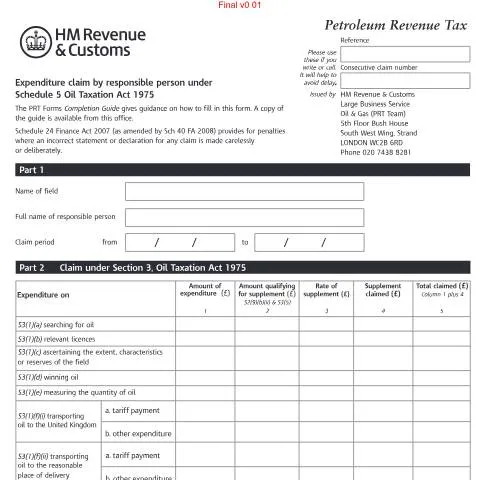
Navigating the Expenditure Claim Process for Petroleum Revenue Tax
The petroleum industry in the UK operates under strict regulatory measures, particularly when it comes to taxation. One critical aspect of this is the Petroleum Revenue Tax (PRT), which applies to profits derived from oil and gas extraction activities. To claim expenditure associated with PRT, individuals must complete the official form titled Claim Expenditure as a Responsible Person for Petroleum Revenue Tax. Understanding how to navigate this process can significantly impact your financial returns.
Understanding Who Qualifies as a Responsible Person
Only certain individuals can submit this expenditure claim. Typically, a responsible person may include directors, company secretaries, or individuals in charge of the financial accounts of an enterprise engaged in oil extraction. Below, we explore varying scenarios that define who can qualify:
- Corporate Entities: Companies involved in oil and gas extraction can designate a responsible person to manage PRT claims.
- Joint Ventures: In partnerships, any partner with a significant role in operations could be a responsible person.
- Subcontractors: Firms that subcontract oil extraction work may also nominate a responsible person from their management team.
- Foreign Companies: Non-resident companies engaged in UK oil extraction must appoint a UK-based responsible person for tax purposes.
This classification is crucial, as the responsibilities and liabilities, especially regarding tax compliance, fall on the shoulders of the designated responsible person.
Diving into the Form's Sections: What You Need to Know
The completeness and accuracy of the PRT30 HMRC form are vital for a successful claim. It is divided into several parts, each requiring specific data. Below, we unpack these sections to ensure clarity while filling out the form:
Part 1: Basic Claim Information
The first part of the form collects fundamental details about the claim:
- Consecutive Claim Number: Essential for tracking your claim; ensure it is unique for every submission.
- Name of Field: Specify the oil field related to your expenditure claim.
- Claim Period: Clearly state the period for which you are claiming. Remember, the tax year runs from 6 April to 5 April of the following year.
Failure to provide precise information in this section can lead to delays or even disallowance of the claim.
Part 2: Detailed Expenditure Breakdown
Here you will detail the various expenditures incurred during the claim period:
- Transport Costs: Document all costs related to transporting oil, including both to the UK and to a reasonable delivery location.
- Decommissioning Costs: Include expenses related to decommissioning operations, which are often significant.
- Storage Costs: Any expenditure for the initial treatment or storage of oil should be recorded here.
It's vital to ensure that the amounts are classified correctly and that they relate directly to qualifying expenditures, as incorrectly reported expenditure may result in penalties under Schedule 24 Finance Act 2007.
Common Pitfalls to Avoid
While filling out the form, the details matter. Here are some common slip-ups to be wary of:
- Misclassification of Expenditure: Ensure you're familiar with what qualifies as deductible expenditures under the Oil Taxation Act. Misreporting can lead to penalties.
- Incomplete Information: Each section must be fully completed; leaving any fields blank can lead to delays.
- Incorrect Dates: Always double-check that the claim period dates are accurate and formatted correctly.
Different Submission Channels: What's Your Best Bet?
HM Revenue & Customs offers multiple channels for submitting the PRT claim. Understanding these can help you avoid unnecessary delays:
Online Submission
Submitting your claim online is often the quickest route. The HMRC online services allow for immediate processing and can help you track your application status. However, you must register for the service.
Paper Submission
Filing by post is still an option, but this route generally entails longer waiting times. Ensure you send your claim to the correct address:
HM Revenue & Customs Large Business Service Oil & Gas (PRT Team) 5th Floor Bush House South West Wing, Strand LONDON WC2B 6RD
When using this method, consider using a tracked postal service to confirm your submission was received.
Essential Supporting Documents: Preparing Your Case
In many instances, additional documentation will be required to substantiate your claim. Below are examples of what you might need:
| Document Type | Description | Relevance |
|---|---|---|
| Invoices | Detailed invoices for all claimed expenditures | Proof of spending |
| Transport Contracts | Contracts related to transportation services | Verification of transport claims |
| Decommissioning Reports | Documents summarising decommissioning work | Justification of costs |
Gathering these documents proactively can expedite the claim assessment process and reduce the risk of rejection.
The Impact of Incorrect Claims: Avoiding Penalties
Making a claim for PRT without ensuring compliance can lead to serious consequences. As stipulated in the Finance Act 2007, submitting inaccurate claims can incur penalties. Here’s what to bear in mind:
- Careless Mistakes: If HMRC determines that inaccuracies were made carelessly, penalties may apply.
- Deliberate Errors: More severe penalties are imposed for deliberate misrepresentation, which can also lead to criminal charges in extreme cases.
It’s crucial to review all claims thoroughly and consider consulting a tax professional to mitigate risks.
Understanding the Review Process
Once submitted, your claim will undergo a review process by HMRC. Understanding what to expect during this phase can help manage expectations:
- Initial Assessment: HMRC will check for completeness and basic compliance with regulations.
- In-depth Review: If anything seems amiss, further investigations may be necessary, which can delay payments.
- Decision Notification: You will receive a formal notice detailing either the approval or rejection of your claim.
Staying informed during this process is essential, and keeping communication open with HMRC can be advantageous.
After Claim Submission: What’s Next?
Once your claim has been reviewed and a decision rendered, it’s crucial to understand the next steps:
- Monitor Payment: If approved, keep an eye on your bank account for the reimbursement.
- Keep Records: Retain copies of the submitted forms and correspondence for your records.
- Appeal Process: If your claim is denied, you have the right to appeal the decision; consult HMRC guidelines for the appropriate procedure.
By navigating these steps carefully, you can effectively engage in the PRT claims process and ensure your expenditures are validated and reimbursed.
Understanding the Role of a Responsible Person in Petroleum Revenue Tax Claims
In the context of Petroleum Revenue Tax (PRT), a ‘responsible person’ is typically defined as an individual or entity that holds the obligation to manage the tax affairs related to petroleum operations. This role is crucial as it encompasses the oversight of all related financial activities, including the filing of tax returns and the management of expenditure claims. Responsible persons must be familiar with the legislation and obligations stipulated in the Oil Taxation Act and associated guidelines published by HM Revenue & Customs (HMRC).
It is essential for responsible persons to maintain accurate records and ensure compliance with the specific requirements of PRT, including the eligibility criteria for claiming expenditure. Understanding who qualifies as a responsible person and the implications of this role is vital for the effective navigation of PRT. For example, partnerships and limited companies involved in oil exploration and production are required to designate a responsible person who will act on behalf of the partnership or company for tax matters. This includes submitting the PRT return, known as the PRT100, and any necessary claims for expenditure deductions.
Furthermore, responsible persons should ensure they are aware of the relevant deadlines, including the submission deadline of 31 January following the end of the tax year on 5 April. Failure to meet these obligations can lead to penalties and interest charges. Therefore, it is advisable for responsible persons to consult with tax professionals who specialize in PRT to ensure compliance and optimize expenditure claims.
Types of Expenditure Claims Under Petroleum Revenue Tax
The expenditure claims that a responsible person can make under PRT can be complex and varied. Understanding the eligible categories of expenditure is crucial for maximizing the tax efficiency of petroleum operations. Generally, expenditures can be categorized into two main types: capital expenditures and operational expenditures.
Capital expenditures typically relate to the costs incurred for acquiring, constructing, or improving physical assets used in oil extraction or production. This can include drilling rigs, production platforms, and pipelines. Such costs are significant because they can be claimed as deductions against PRT. It is important to categorize these assets correctly and maintain detailed documentation, including invoices, contracts, and payment records, to substantiate claims when needed.
Operational expenditures, on the other hand, encompass the day-to-day costs of running petroleum operations. This may include wages, utilities, maintenance, and consumables directly associated with production activities. Claims for operational expenditure must be clearly delineated from capital expenditures. This distinction is particularly important as capital expenditures can often yield higher deductions due to the nature of the assets being claimed. Responsible persons should ensure that they meticulously document these costs and retain relevant documentation for proof during any audits by HMRC.
Moreover, there are specific allowances, such as the Field Allowance, which provides additional deductions under certain conditions. For example, if production is taking place in specific geographical areas or in newly developed oil fields, the Field Allowance may apply, allowing further claims to be made. Compliance with these allowances requires an in-depth understanding of the legislation and regulations governing PRT.
Navigating Compliance and Audit Risks in Petroleum Revenue Tax
Compliance with the regulations surrounding Petroleum Revenue Tax is paramount for any responsible person managing expenditure claims. Since PRT is a niche area within the tax system, the risk of audits by HMRC can be higher, particularly for larger operations or those that have claimed significant amounts of expenditure. Therefore, it is crucial for responsible persons to adopt proactive measures to manage compliance and minimize audit risks.
One effective strategy is to implement a robust internal control system that ensures all expenditures are accurately recorded, classified, and justified. This includes establishing procedures for collecting and storing documentation related to each expenditure, such as contracts, invoices, and payment records. Regular internal reviews can help identify potential discrepancies early, allowing responsible persons to rectify any issues before HMRC's attention is drawn to them.
Additionally, staying updated with any changes in tax legislation or HMRC guidelines is critical, as tax laws can evolve and affect how claims are made. Subscribing to alerts from HMRC or engaging with industry associations that focus on petroleum taxation can provide valuable insights and updates. Responsible persons should also consider engaging with tax advisors who have specialized knowledge of PRT to ensure their claims are compliant and optimized.
Furthermore, understanding the potential penalties for non-compliance is essential. HMRC may impose penalties for late filing, inaccuracies in tax returns, or failure to comply with expenditure claim requirements. Being proactive in managing these risks not only safeguards against financial penalties but also enhances the credibility of the responsible person within the industry.