Understanding the VAT Registration Threshold for EU-to-Northern Ireland Distance Selling
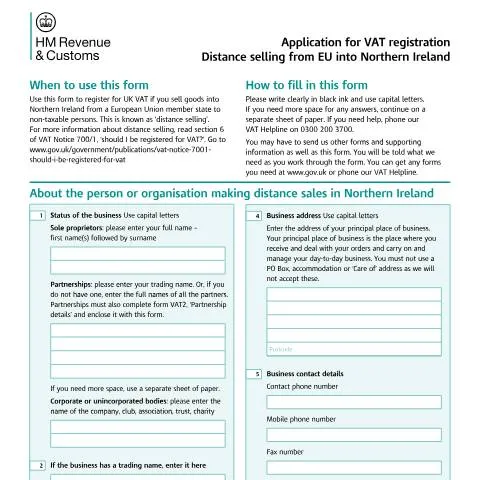
The VAT1A form addresses a specific cross-border trading scenario that emerged from Brexit arrangements: businesses based in European Union member states selling goods directly to non-taxable persons (typically consumers) in Northern Ireland. This registration requirement stems from the Northern Ireland Protocol, which maintains unique VAT arrangements that differ from the rest of the UK.
Distance selling into Northern Ireland triggers UK VAT obligations once your annual sales exceed the distance-selling threshold during a calendar year. The registration becomes mandatory from the precise date when cumulative sales cross this threshold, creating immediate compliance obligations that cannot be deferred until the following tax period.
Unlike standard UK VAT registration where businesses typically register before commencing trade, distance selling registration often occurs reactively—after the threshold breach has already happened. This creates urgency around accurate record-keeping and prompt submission, as HMRC expects registration within specific timeframes once the obligation arises.
Determining Your Registration Trigger Date and Obligations
The VAT1A form requires precise identification of when your registration obligation commenced, as this determines your VAT accounting start date and potential liabilities. Three distinct scenarios can trigger mandatory registration, each with different date calculations:
Threshold Breach Registration
If your distance sales value exceeded the threshold during a calendar year, you must register from the exact date when cumulative sales crossed this limit. This date becomes your VAT registration effective date, and you'll be liable for UK VAT on all subsequent supplies to Northern Ireland customers.
Voluntary Place of Supply Election
Businesses can voluntarily elect to make Northern Ireland the place of supply for their distance sales, even before reaching the threshold. Once this election is made, registration becomes compulsory from your first supply following the election date. This option provides certainty for businesses expecting significant Northern Ireland sales volumes.
Excise Goods Distance Sales
Distance sales of excise goods into Northern Ireland require immediate registration from the very first supply, regardless of value. This includes alcohol, tobacco products, and energy products, where special duty and VAT arrangements apply from day one of trading.
| Registration Trigger | Effective Date | Advance Planning Required |
|---|---|---|
| Threshold exceeded | Date threshold crossed | Continuous monitoring needed |
| Voluntary election | Date of first post-election supply | Strategic timing possible |
| Excise goods | Date of first supply | Must register before trading |
Completing Business Identity and Structure Information
Section 1 of the VAT1A form requires detailed business identification, with specific formatting requirements that vary significantly depending on your business structure. The form's emphasis on capital letters and precise naming conventions reflects HMRC's need for accurate database matching and correspondence addressing.
Sole Proprietor Details
Individual traders must provide their complete legal name in the prescribed format: first names followed by surname. This differs from many EU systems where trading names might take precedence. Your personal name becomes the registered entity for UK VAT purposes, even if you operate under a distinctive trading name.
Partnership Arrangements
Partnerships face additional complexity, requiring completion of the supplementary VAT2 Partnership Details form alongside the VAT1A. If your partnership lacks a formal trading name, you must list all partners' full names, which can create lengthy entries for larger partnerships. The partnership structure you register determines future compliance obligations and amendment procedures.
Corporate Entity Registration
Corporate bodies must provide Certificate of Incorporation details, including the certificate number, incorporation date, and country of incorporation. This information enables HMRC to verify your legal status and determine applicable compliance frameworks. EU companies should ensure their incorporation documentation clearly establishes their legal standing for cross-border trade purposes.
Principal Place of Business and Contact Requirements
The business address requirements in Section 4 reflect HMRC's need for a genuine operational base rather than administrative convenience. Your principal place of business must be where you receive and process orders, manage day-to-day operations, and maintain business control—not merely a postal address.
HMRC explicitly prohibits PO Box numbers, accommodation addresses, or 'care of' arrangements, as these don't provide sufficient operational transparency. This requirement can challenge EU businesses operating primarily through online platforms or third-party logistics providers, who must demonstrate genuine business substance at their declared address.
Contact details extend beyond basic phone and email requirements to include mobile numbers, fax capabilities, and website addresses. This comprehensive contact framework supports HMRC's multi-channel communication approach and enables rapid contact during compliance reviews or urgent queries.
Tax Representative and Agent Appointment Procedures
EU businesses typically require either a UK tax representative or authorised agent to manage their UK VAT obligations effectively. The VAT1A form's Section 6 establishes this crucial relationship, with different procedural requirements depending on your chosen arrangement.
UK Tax Representative Appointment
Appointing a UK tax representative creates a formal legal relationship where the representative assumes joint liability for your VAT obligations. This requires completing the additional VAT1TR Appointment of Tax Representative form, establishing clear authority boundaries and liability arrangements.
Tax representatives must be UK-established individuals or entities with appropriate professional qualifications and HMRC recognition. Their appointment enables direct HMRC communication and can facilitate faster registration processing, particularly for businesses lacking UK banking arrangements.
Agent Authorisation Process
Agent appointment offers a less formal alternative, requiring a signed letter of authorisation rather than joint liability arrangements. VAT Notice 700/1 paragraph 11.5 provides suggested wording for these authorisation letters, ensuring HMRC accepts your agent's authority to act on your behalf.
Agents typically handle routine correspondence and return submissions but cannot make fundamental business decisions or assume liability for your VAT obligations. This arrangement suits businesses maintaining direct control while requiring administrative support.
Banking Arrangements and Payment Infrastructure
Section 8's banking requirements highlight a practical challenge for EU businesses: HMRC strongly prefers UK bank accounts for VAT registration, as these facilitate faster processing and repayment procedures. Businesses lacking UK banking must provide written explanations for alternative arrangements.
The account must be held in the registered business name or your tax representative's name—not your agent's. This ensures proper fund attribution and prevents complications during VAT repayment processes. Some account types cannot process HMRC automated payments, requiring verification with your banking provider before registration submission.
Tax representative banking arrangements offer particular advantages, as HMRC can make repayments directly into the representative's account, streamlining cross-border fund transfers and reducing currency conversion delays that might affect EU-based accounts.
Business Activity Description and Compliance Framework
Section 7 requires comprehensive description of your distance selling activities, distinguishing between wholesale and retail operations. This classification affects your VAT obligations, compliance requirements, and potential scheme eligibilities under UK VAT legislation.
Wholesale distance selling typically involves business-to-business transactions where your Northern Ireland customers might be VAT-registered traders. These arrangements may require different documentation and reverse charge procedures depending on the goods supplied and customer status.
Retail distance selling focuses on direct consumer sales, where your customers are non-taxable persons unable to recover VAT on their purchases. This classification determines your pricing strategies, VAT treatment, and customer communication requirements under UK consumer protection legislation.
The goods description should specify product categories, as certain items face additional regulatory requirements beyond VAT registration. Excise goods, restricted items, or products requiring specific certifications may trigger supplementary compliance obligations that affect your registration timeline and ongoing operational requirements.
Record-Keeping Systems and Digital Compliance
Section 9's computer accounting requirements reflect HMRC's emphasis on digital record-keeping and Making Tax Digital (MTD) compliance preparation. Even businesses currently using manual systems should consider their future digital transition plans, as VAT registration may eventually require MTD-compatible software.
Spreadsheet systems qualify as computer accounting if you specify the software name and version. This includes widely-used applications that EU businesses might already employ for their domestic VAT compliance, potentially simplifying UK VAT record-keeping integration.
Future software changes must be reported to HMRC in writing, ensuring your compliance approach remains current and acceptable. This ongoing notification requirement highlights the importance of choosing scalable systems that can accommodate business growth and regulatory changes.
Submission Process and Registration Timeline Expectations
VAT1A submission requires careful coordination of multiple documents and supporting information, with HMRC providing specific guidance as you progress through the form completion process. The VAT Helpline (0300 200 3700) offers direct support for complex situations or technical queries during preparation.
Processing timelines vary depending on your business structure, banking arrangements, and documentation completeness. EU businesses with UK tax representatives and banking typically experience faster processing than those requiring alternative arrangements or additional verification procedures.
Once registered, your VAT obligations commence immediately from your determined effective date, regardless of when registration approval occurs. This retroactive liability emphasises the importance of maintaining accurate records and preparing for VAT obligations even before formal registration confirmation.
Early registration requests require particular justification and cannot be reversed once approved. Businesses considering earlier effective dates should carefully evaluate their compliance readiness and operational capacity to meet accelerated VAT obligations from their requested start date.
VAT Registration Thresholds and Calculation Methods for Distance Selling
Understanding the precise VAT registration thresholds for distance selling into Northern Ireland requires careful attention to how sales are calculated and aggregated. The standard UK VAT registration threshold of £85,000 applies to your total taxable supplies, but distance selling has specific nuances that affect threshold calculations.
When calculating your turnover for threshold purposes, you must include all distance sales to Northern Ireland consumers, regardless of where your business is established within the EU or Great Britain. This includes sales made through your own website, third-party platforms, and any other direct-to-consumer channels. However, business-to-business sales where the Northern Ireland customer provides a valid VAT number are generally excluded from distance selling calculations.
The calculation period runs on a rolling 12-month basis, meaning you must monitor your cumulative sales continuously rather than simply looking at calendar year figures. If you exceed the threshold at any point, you have 30 days from the end of the month in which you exceeded it to register for VAT. For instance, if your sales breach £85,000 on 15 March, you must register by 30 April.
HMRC requires you to maintain detailed records of all distance sales, including the delivery address, sale value, and customer type (consumer versus business). These records must clearly distinguish between sales to different parts of the UK, as different rules may apply to sales to Great Britain versus Northern Ireland, particularly regarding the Northern Ireland Protocol arrangements.
If you're established in an EU member state, you may also need to consider the EU distance selling thresholds, which could be €10,000 for Northern Ireland specifically. However, since Brexit, these arrangements have evolved, and you should verify current requirements with both HMRC and relevant EU authorities to avoid dual compliance issues.
Businesses approaching the threshold should implement robust monitoring systems. HMRC expects you to track your sales in real-time and register proactively rather than reactively. Late registration can result in penalties, and you may be liable for VAT on sales made from the point you should have registered, even if you weren't registered at the time.
Northern Ireland Protocol Implications and Special Administrative Arrangements
The Northern Ireland Protocol creates unique administrative complexities for VAT registration and compliance that don't apply elsewhere in the UK. Businesses engaging in distance selling to Northern Ireland must navigate a dual regulatory framework that maintains Northern Ireland's alignment with EU VAT rules in specific circumstances.
Under the Protocol, goods moving from Great Britain to Northern Ireland may be subject to different VAT treatment compared to purely domestic UK transactions. This affects how you calculate VAT on distance sales and may require separate VAT accounting procedures. For goods that are considered "at risk" of moving into the EU single market, EU VAT rules may continue to apply, creating potential complications for VAT registration and reporting.
Businesses must determine whether their goods qualify for "not at risk" status, which generally applies to goods consumed in Northern Ireland or processed there before any onward movement. This determination affects VAT liability and may influence your registration requirements. HMRC provides specific guidance on risk assessments, but businesses often need to make case-by-case evaluations based on their supply chains and customer bases.
The Trader Support Service (TSS), operated by HMRC, provides additional administrative support for businesses navigating these complexities. While primarily focused on customs declarations, TSS can offer guidance on VAT implications of Protocol arrangements. However, this service doesn't replace the need for proper VAT registration when thresholds are met.
Special administrative arrangements also exist for businesses that were already trading before the Protocol came into effect. These may include transitional relief measures or simplified procedures, but such arrangements are typically time-limited and subject to specific conditions. Businesses cannot rely on these indefinitely and must ensure they meet standard VAT registration requirements.
The digital interface between UK and EU systems adds another layer of complexity. Businesses may need to interact with both HMRC's VAT systems and EU VAT databases, particularly if they're also registered for VAT in EU member states. This dual reporting can create administrative burdens and potential for errors if systems aren't properly aligned.
Record-Keeping Requirements and Digital Compliance Obligations
VAT registration for distance selling into Northern Ireland triggers comprehensive record-keeping obligations that extend beyond standard VAT requirements. These obligations are particularly stringent due to the cross-border nature of the transactions and the need to demonstrate compliance with both UK and Protocol-related requirements.
You must maintain detailed transaction records that include customer delivery addresses, precise descriptions of goods sold, sale values in both the currency of sale and sterling, and evidence of delivery to Northern Ireland. These records must be sufficiently detailed to allow HMRC to verify that sales qualify as distance selling rather than other types of supply that might be subject to different VAT treatment.
Digital record-keeping is increasingly important, and HMRC expects businesses to implement systems capable of real-time reporting. Making Tax Digital (MTD) requirements apply to VAT-registered businesses, meaning you must use compatible software to maintain VAT records and submit returns. For distance sellers, this software must be capable of handling multiple jurisdictions and complex supply chain scenarios.
Customer verification procedures form a crucial part of record-keeping compliance. You must be able to demonstrate that customers are genuine consumers rather than businesses, and that goods are genuinely delivered to Northern Ireland addresses. This might involve retaining delivery confirmations, customer communications, and payment records that collectively prove the nature and destination of each transaction.
Cross-referencing requirements mean your VAT records must align with customs documentation, particularly for goods moving from Great Britain to Northern Ireland. Discrepancies between VAT and customs records can trigger compliance investigations, so maintaining consistency across all administrative systems is essential.
Data protection considerations under UK GDPR add another dimension to record-keeping obligations. Customer data collected for VAT compliance purposes must be processed lawfully, and you must implement appropriate security measures to protect personal information. This includes ensuring that VAT records containing customer details are stored securely and accessed only by authorized personnel.
Audit trail requirements are particularly stringent for distance sellers. HMRC expects complete documentation chains that track goods from initial supply through to final delivery in Northern Ireland. This includes supplier invoices, internal processing records, customer orders, dispatch documentation, and delivery confirmations. Electronic records must be backed up and preserved in formats that remain accessible throughout the required retention period.
Regular reconciliation procedures help ensure ongoing compliance. You should implement monthly checks that verify VAT calculations against underlying transaction data, confirm that all distance sales are properly captured, and identify any discrepancies that might indicate system errors or compliance gaps. These reconciliations should be documented and retained as part of your VAT records.