When Northern Ireland Inheritance Matters Cross Administrative Boundaries
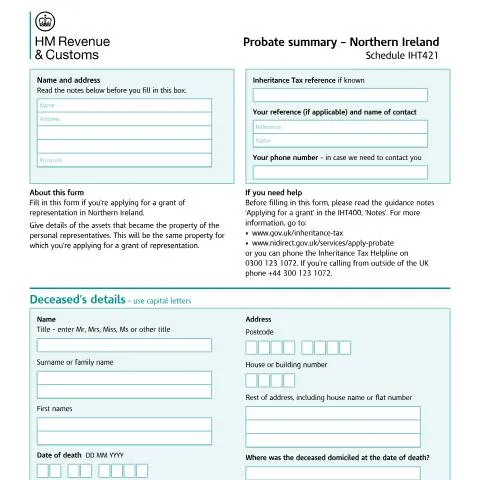
The death of a loved one in Northern Ireland creates a complex web of administrative obligations that extend far beyond the immediate grief. When assets require legal transfer and inheritance tax considerations arise, personal representatives find themselves navigating between two distinct systems: the Northern Ireland probate process and HMRC's inheritance tax framework. The IHT421 probate summary serves as the critical bridge between these jurisdictions, translating comprehensive inheritance tax calculations into the specific format required by Northern Ireland's probate courts.
This administrative translation becomes particularly crucial when estates contain substantial assets or when the deceased's domicile status creates complications. Unlike England and Wales, where probate and inheritance tax processes operate under more integrated procedures, Northern Ireland maintains its separate legal system, requiring this specialised summary document to ensure both HMRC and the Northern Ireland Courts and Tribunals Service receive consistent information about the same estate.
The form's timing often catches personal representatives off-guard. While inheritance tax calculations may be complete, the probate application cannot proceed without this carefully calibrated summary that excludes certain assets from the probate valuation whilst maintaining accuracy for tax purposes.
Decoding the Asset Exclusion Framework
The IHT421's most distinctive feature lies in what it deliberately omits. Unlike the comprehensive IHT400 inheritance tax return, this probate summary operates on a selective disclosure principle that can initially confuse even experienced solicitors. The form explicitly excludes five categories of assets that, whilst relevant for inheritance tax calculations, fall outside probate court jurisdiction.
Lifetime gifts represent the most significant exclusion category. These transfers, potentially made years before death, affect inheritance tax liability but never pass through the deceased's estate for probate purposes. Similarly, foreign assets often require separate legal processes in their respective jurisdictions, making their inclusion in Northern Ireland probate inappropriate.
The exclusion of assets held in trust reflects fundamental legal principles about beneficial ownership. Trust assets, while potentially subject to inheritance tax charges, don't form part of the deceased's personal estate requiring probate administration. Nominated assets, such as certain pension benefits or insurance policies with specified beneficiaries, bypass probate entirely through their contractual arrangements.
| Asset Category | IHT400 Inclusion | IHT421 Inclusion | Probate Relevance |
|---|---|---|---|
| UK bank accounts | Yes | Yes | Requires grant for access |
| Lifetime gifts (7 years) | Yes | No | Already transferred |
| Foreign property | Yes | No | Separate jurisdiction |
| Trust interests | Conditional | No | Trust administration |
| Joint property (survivorship) | Yes | Separate calculation | Automatic transfer |
The treatment of gifts with reservation and pre-owned assets requires particular attention. These complex arrangements, where the deceased retained some benefit from transferred property, create inheritance tax charges but don't necessarily create probate assets requiring administration.
Navigating the Domicile Determination Challenge
The IHT421's domicile section often becomes a stumbling block for personal representatives, particularly when the deceased had complex residential histories or international connections. Domicile determination affects both inheritance tax liability and probate court jurisdiction, making accuracy essential.
Domicile of origin typically derives from the father's domicile at birth, but subsequent changes through domicile of choice can alter this status. The deceased must have demonstrated clear intention to make Northern Ireland (or another jurisdiction) their permanent home, evidenced through actions rather than mere residence duration.
Common indicators supporting Northern Ireland domicile include property ownership, business interests, social connections, and stated intentions in wills or other documents. However, temporary residence, even extending over decades, doesn't automatically establish domicile of choice without accompanying intention evidence.
When domicile remains unclear, personal representatives should consider obtaining specialist advice before completing this section. Incorrect domicile determination can invalidate probate applications or create inheritance tax complications requiring costly rectification procedures.
Cross-Border Complexities
Deceased persons with Republic of Ireland connections face additional complications. While Northern Ireland and Republic of Ireland maintain separate legal systems, family and property connections often span both jurisdictions. The domicile determination must reflect legal rather than emotional or practical considerations.
Similarly, individuals with English, Welsh, or Scottish connections require careful analysis. Long-term residence in Northern Ireland doesn't automatically override domicile established elsewhere, particularly when family or business ties remain concentrated in other UK jurisdictions.
Mastering the Mathematical Translation Process
The IHT421's calculation section transforms comprehensive inheritance tax computations into probate-specific figures through a systematic reduction process. This mathematical translation requires careful attention to source document references and precise figure extraction.
Box 1 combines the UK estate total from IHT400 box 79 with additional assets from IHT404 box 13. These figures represent the gross UK estate before any deductions, establishing the starting point for probate calculations. Personal representatives must ensure these figures match exactly with their inheritance tax submissions to avoid processing delays.
The joint assets calculation in box 2 requires particular precision. These assets, passing automatically to surviving joint owners through survivorship rights, don't require probate administration but must be quantified to determine the net probate estate accurately.
Liability Calculations and Timing Issues
Box 4's liability calculation aggregates multiple IHT400 sections, combining funeral expenses, debts, and other deductions. The timing of liability recognition can affect these calculations, particularly when debts are disputed or when funeral expenses exceed initial estimates.
Outstanding mortgage balances, credit card debts, and professional fees incurred during estate administration all contribute to this total. However, personal representatives must distinguish between debts existing at death and expenses arising during administration, as these may require different treatment for probate purposes.
The final tax calculation in box 6 references multiple potential source documents, reflecting the complexity of inheritance tax computations. Whether drawing from the main IHT400 calculation, the detailed computation worksheet, or the IHT430 payment schedule, accuracy remains paramount.
Understanding Grant Applications and Court Interface
The IHT421 functions as supporting documentation for Northern Ireland grant applications, whether seeking probate grants for estates with valid wills or letters of administration for intestate estates. The probate court requires this summary to verify that inheritance tax obligations have been properly addressed before authorising asset transfers.
Personal representatives must coordinate their grant application timing with inheritance tax payment schedules. While the IHT421 can show zero tax liability in appropriate cases, substantial tax debts may require settlement or acceptable payment arrangements before probate courts will issue grants.
The form's reference to www.nidirect.gov.uk reflects Northern Ireland's separate digital infrastructure for court services. Unlike England and Wales, where gov.uk provides unified access, Northern Ireland maintains distinct online portals reflecting its devolved administrative arrangements.
Processing Timelines and Administrative Coordination
Inheritance tax stamps, applied by HMRC to completed IHT421 forms, serve as official confirmation that tax aspects have been properly addressed. These stamps don't guarantee tax liability accuracy but confirm that HMRC has reviewed the submitted information and finds it acceptable for probate purposes.
Personal representatives should anticipate potential delays when estates involve complex asset valuations or when HMRC requires additional information before applying their stamp. Professional valuations for property, business interests, or specialist assets can extend processing times significantly.
Avoiding Critical Calculation Errors and Omissions
The most frequent errors in IHT421 completion arise from misunderstanding the form's selective nature. Personal representatives sometimes attempt to include all estate assets, creating discrepancies with inheritance tax returns and confusing probate court assessments.
Double-counting joint assets represents another common pitfall. Assets passing by survivorship should appear in box 2's deduction rather than being excluded entirely, ensuring the mathematical relationship between gross and net probate assets remains accurate.
Currency conversion issues affect estates with foreign elements. While foreign assets are excluded from probate calculations, any UK bank accounts holding foreign currency require conversion to sterling using appropriate exchange rates, typically those prevailing at the date of death.
Documentation Coordination Challenges
Maintaining consistency between IHT400 submissions and IHT421 summaries requires systematic cross-referencing. Changes to inheritance tax returns after initial submission must be reflected in revised probate summaries to avoid administrative complications.
Personal representatives should maintain detailed working papers showing how IHT421 figures derive from comprehensive inheritance tax calculations. These records prove invaluable when courts or HMRC request clarification about apparent discrepancies.
Professional Support and Administrative Resources
The Inheritance Tax Helpline (0300 123 1072) provides essential support for complex IHT421 issues, particularly when estates involve unusual asset types or when domicile questions create uncertainty. International callers can access the same expertise through +44 300 123 1072, ensuring global accessibility for Northern Ireland estates with international dimensions.
HMRC's guidance emphasises reviewing IHT400 notes before attempting IHT421 completion, recognising that probate summaries represent advanced administrative territory requiring solid foundation knowledge. Personal representatives without prior inheritance tax experience should consider professional assistance rather than attempting complex calculations independently.
The integration between inheritance tax and probate processes continues evolving, with digital initiatives gradually streamlining administrative interfaces. However, Northern Ireland's separate legal system ensures the IHT421 will remain essential for coordinating between HMRC's UK-wide tax administration and Northern Ireland's distinct probate jurisdiction. Personal representatives who understand this form's precise role and calculation requirements can navigate estate administration more efficiently, ensuring both tax compliance and timely asset distribution to beneficiaries.
Completing IHT421 for Cross-Border Estates and International Assets
When dealing with estates that include assets outside Northern Ireland or involve beneficiaries residing abroad, completing Form IHT421 requires careful consideration of international tax implications and cross-border reporting requirements. These situations often arise in Northern Ireland given historical migration patterns and family connections across the Irish border, Great Britain, and further afield.
For assets located in the Republic of Ireland, you'll need to determine whether double taxation agreements apply and how valuations should be converted to sterling. Property values must be obtained from qualified valuers registered in the relevant jurisdiction, with conversion rates typically taken from the date of death rather than the probate application date. Bank accounts held in euros or other currencies require similar date-of-death conversions, though you should note any significant fluctuations that occurred between death and the probate application.
Assets held in trust structures, particularly those established in other jurisdictions, present additional complexity when completing IHT421. You must distinguish between assets where the deceased held a beneficial interest versus those where they served as trustee only. Discretionary trusts may require detailed analysis of the deceased's potential benefit, while fixed trusts need clear documentation of their specific entitlement percentage.
International business interests demand particular attention in the probate summary. Shareholdings in foreign companies must be valued according to local market conditions, with professional valuations often necessary for unlisted entities. Partnership interests in cross-border businesses require careful apportionment of assets and liabilities, especially where different accounting standards apply in various jurisdictions.
For digital assets and intellectual property with international reach, valuation becomes increasingly complex. Domain names, online business platforms, and licensing agreements may generate income streams across multiple territories, each potentially subject to different tax treatments. The IHT421 should reflect the global value while noting any territorial restrictions that might affect realisable worth.
When beneficiaries reside outside the UK, their details still require complete reporting on Form IHT421, but you should be aware that distribution mechanisms may differ significantly. Some jurisdictions impose withholding taxes on inherited assets, while others may not recognise UK probate grants without additional legal procedures. These factors don't affect the IHT421 completion but may influence estate administration timelines.
Specific Challenges for Agricultural and Business Property Relief Claims
Northern Ireland's significant agricultural sector means many estates qualifying for probate involve farming operations eligible for Agricultural Property Relief (APR) or Business Property Relief (BPR). Form IHT421 must accurately reflect these reliefs while providing sufficient detail for HMRC assessment of qualifying conditions.
Agricultural land and buildings qualify for APR at either 50% or 100% depending on occupation and tenancy arrangements. Owner-occupied farmland typically attracts 100% relief, while let agricultural property may qualify for 50% relief subject to specific conditions. The IHT421 must clearly distinguish between different categories of agricultural assets, including working farm buildings, farmhouses, and associated cottages or commercial properties that might not qualify for relief.
Diversified farming operations present particular challenges when completing the probate summary. Activities such as farm shops, holiday accommodation, renewable energy installations, or equestrian facilities may qualify for business relief rather than agricultural relief, or potentially no relief at all. Each revenue stream requires separate analysis, with the IHT421 reflecting appropriate relief claims for qualifying elements only.
For family farming partnerships, the deceased's share must be valued considering both the underlying agricultural assets and any partnership restrictions on transfer or sale. Partnership agreements often include provisions affecting valuation, such as pre-emption rights, restrictions on outside parties, or specific succession arrangements that might impact the estate's realisable value.
Business Property Relief applications require demonstration that qualifying businesses were actively trading rather than investment vehicles. Property rental businesses, for instance, rarely qualify for BPR unless they constitute furnished holiday lettings meeting specific criteria or involve significant additional services constituting a trading operation. The IHT421 should provide sufficient detail about business activities to support relief claims while avoiding over-elaboration that might raise unnecessary queries.
Shares in unquoted trading companies typically qualify for 100% BPR, but the relief depends on the company's activities throughout the two years preceding death. Companies holding significant investment assets or non-trading subsidiaries may see their relief reduced proportionally. When completing IHT421, you should ensure that company valuations reflect both the gross asset values and the percentage qualifying for relief, particularly where businesses combine trading and investment activities.
Mixed farming and property portfolios require careful segregation when claiming reliefs. A deceased person might own agricultural land qualifying for APR, commercial property qualifying for BPR, and residential investments attracting no relief. The probate summary must clearly categorise each asset type while demonstrating that relief claims meet the relevant qualifying conditions throughout the required ownership periods.
Navigating Contested Estates and Disputed Valuations
When completing Form IHT421 for estates subject to family disputes, potential claims, or valuation disagreements, the probate summary serves a crucial role in protecting the personal representatives while ensuring compliance with inheritance tax obligations. These situations require particular care in documentation and presentation of estate information.
Family provision claims under the Inheritance (Provision for Family and Dependants) (Northern Ireland) Order 1979 don't automatically affect IHT421 completion, but they may influence how certain assets should be valued or whether contingent liabilities should be recognised. If proceedings have commenced, you should note this fact without necessarily adjusting asset values, though legal costs may constitute deductible expenses if they relate to estate administration rather than defending the will's validity.
Disputed asset ownership frequently arises in family situations, particularly regarding jointly owned property, business interests, or assets where legal title doesn't clearly reflect beneficial ownership. The IHT421 should include all assets where the deceased held legal title, noting any known disputes without attempting to resolve complex ownership questions that courts may need to determine. However, you should clearly distinguish between assets included for probate purposes and those where beneficial ownership remains genuinely uncertain.
Professional valuations become particularly important when family members disagree about asset worth or when beneficiaries question the personal representatives' assessments. Independent valuations not only support IHT421 completion but also provide protection against later challenges regarding the representatives' conduct. For unique or specialised assets, obtaining multiple professional opinions may prove worthwhile, particularly where significant inheritance tax liability depends on valuation outcomes.
Claims against the estate from creditors or other third parties require careful consideration when preparing the probate summary. Known debts should be included as liabilities, but potential claims of uncertain value present more complex decisions. The IHT421 should reflect the estate's position based on available information, noting significant potential liabilities without necessarily providing full reserves unless legal advice suggests probable success for claimants.
When beneficiaries dispute will validity or challenge specific bequests, the probate application must still proceed based on the will as presented, though noting any ongoing proceedings. The IHT421 should reflect the estate distribution according to the will's terms while acknowledging that court proceedings might ultimately vary these arrangements. This approach ensures that inheritance tax calculations proceed on the most likely basis while preserving flexibility for subsequent adjustments if litigation outcomes require changes.
Estates involving allegations of undue influence, lack of capacity, or fraudulent conduct present additional complications for IHT421 completion. While these matters typically don't affect asset valuations directly, they may influence whether certain lifetime transfers should be treated as potentially exempt transfers or immediately chargeable gifts. Personal representatives should seek legal guidance when such allegations might affect inheritance tax calculations, ensuring that the probate summary reflects appropriate treatment of questioned transactions while avoiding prejudicial statements about ongoing investigations.