Understanding the HM Revenue & Customs Guidance on Registering for VAT When Supplying Goods Under Specific Directives
The process of registering for Value Added Tax (VAT) in the United Kingdom is a crucial step for businesses involved in supplying goods that fall under certain legal directives. HM Revenue & Customs (HMRC) provides detailed guidance to ensure that eligible businesses understand their obligations and the correct procedures to follow. This article offers an overview of the key points outlined in the official HMRC notes, focusing on who needs to register, the required information, and the procedural considerations involved.
Scope and Purpose of the Guidance
The official guidance aims to assist businesses in understanding when and how they should register for VAT, particularly when their activities involve relevant taxable supplies under specific legal frameworks. The document is designed for various types of entities, including sole traders, partnerships, corporate bodies, and unincorporated associations, clarifying the registration process and the necessary documentation. It also addresses cases where businesses transfer assets that have previously had VAT recovered, providing clarity on registration obligations in such scenarios.
Who Is Required to Register for VAT?
Businesses engaged in supplying goods within the UK that meet certain criteria are obliged to register for VAT. Specifically, if a business's taxable supplies are expected to exceed the VAT registration threshold within a 12-month period, registration becomes mandatory. The guidance also covers situations where a business anticipates making relevant taxable supplies, even if these have not yet occurred. Essential factors include:
- Making taxable supplies in the UK.
- Anticipated total value of supplies exceeding the registration threshold.
- Transfer of assets previously subject to VAT recovery.
It is important for businesses to assess their activities carefully to determine whether registration is necessary, as failure to comply can result in penalties and loss of VAT recovery rights.
Key Requirements for the Registration Application
The official HMRC notes specify the detailed information that must be provided when applying for VAT registration. This includes:
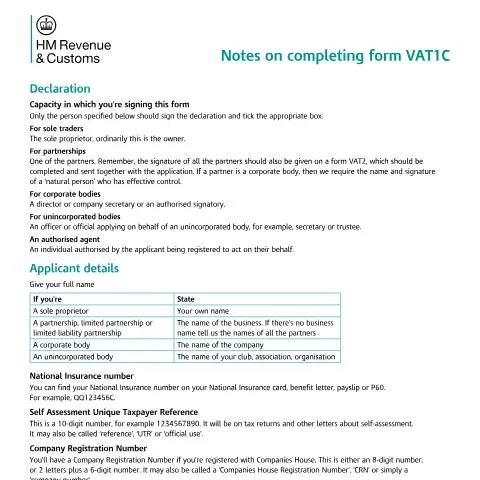
- Applicant Details: Full name, business name (if applicable), and relevant identifiers such as National Insurance number, Self Assessment Unique Taxpayer Reference (UTR), and Company Registration Number if registered with Companies House.
- Declaration Capacity: The individual signing the application must specify their capacity—whether as sole proprietor, partner, director, company secretary, unincorporated body officer, or authorised agent.
- Details of Relevant Supplies: Information about whether relevant taxable supplies have been made, the date of the first supply, and the expected annual value of supplies in the UK.
- Transfer of Assets: Disclosure of any transfer of assets where VAT has been recovered previously, including details of the transferor.
All applicants must ensure that the declaration is signed by an appropriate individual in the correct capacity, as this confirms the accuracy of the provided information and compliance with legal obligations.
Submission and Further Guidance
The completed application form, known as VAT1C, should be attached to the main VAT registration form and sent to HMRC at the designated address: BT VAT, HM Revenue & Customs, BX9 1WR. For additional support or inquiries, businesses can contact HMRC via the provided telephone number.
It is essential for applicants to keep accurate records of their submissions and any correspondence with HMRC. This documentation will be useful for future reference, especially in cases of audits or disputes regarding VAT obligations.
Conclusion
Registering for VAT is a significant step for UK businesses involved in supplying goods under specific directives. HMRC’s guidance emphasizes the importance of understanding eligibility criteria, accurately completing the registration process, and maintaining compliance with legal requirements. Businesses should carefully review the official notes and seek professional advice if necessary to ensure they meet all obligations and benefit from the VAT system appropriately.