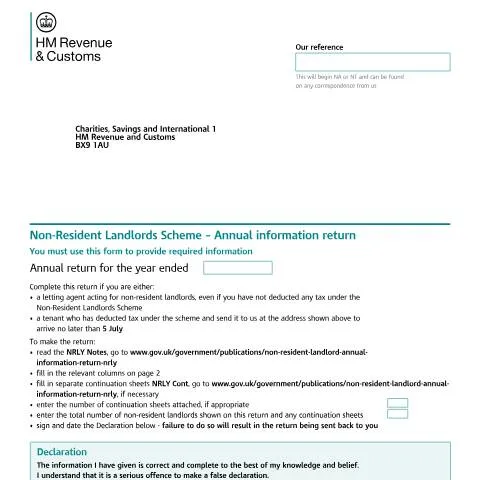
Understanding the Non-Resident Landlord Annual Information Return Framework
The Non-Resident Landlords Scheme operates as a cornerstone of the UK's property taxation system, ensuring proper tax collection from overseas property owners who may otherwise fall outside the standard PAYE or self-assessment mechanisms. The NRLY annual information return serves as the mandatory reporting bridge between letting agents, tenants, and HM Revenue & Customs, creating a comprehensive audit trail for rental income generated by non-resident landlords across the UK property market.
This return captures the full financial picture of non-resident property arrangements, from gross rental receipts to allowable expenses and tax deductions. The system recognises that property management often involves intermediaries—letting agents managing portfolios or tenants dealing directly with overseas landlords—each carrying distinct reporting responsibilities under the scheme.
The NRLY return operates on a strict annual cycle ending 31 March, with submissions required by 5 July following the tax year end. This timing aligns with the broader UK tax calendar whilst providing sufficient processing window for complex international property arrangements that may involve multiple currencies, jurisdictions, and regulatory frameworks.
Mandatory Reporting Obligations: Who Must Submit the NRLY
The NRLY return applies to two distinct categories of reporters, each with specific circumstances triggering the obligation. Letting agents must complete the return regardless of whether they have actually deducted tax during the year. This universal requirement ensures HMRC maintains visibility over all non-resident landlord arrangements, even where approval numbers permit gross rent collection without deduction.
Professional letting agents managing portfolios for overseas clients represent the primary reporting population. Their obligation extends beyond simple tax collection to comprehensive income reporting, covering gross rental receipts, allowable expenses, and detailed landlord identification. The requirement applies whether managing a single property for one non-resident owner or extensive portfolios across multiple properties and landlords.
Tenants who deduct tax directly constitute the second mandatory reporting category. These situations typically arise where tenants rent directly from overseas landlords without intermediary agents. Under the scheme, tenants must deduct basic rate tax from rental payments unless the landlord holds specific HMRC approval for gross payment.
Exemptions and Special Circumstances
Certain arrangements fall outside NRLY reporting requirements despite involving non-resident property owners. Corporate tenants renting commercial property may operate under different tax treaty provisions, whilst diplomatic missions and international organisations often benefit from specific exemptions under bilateral agreements.
Holiday letting arrangements present particular complexity, as short-term rental platforms may create reporting obligations depending on payment processing arrangements and the degree of agent involvement in rent collection and property management.
Navigating the NRLY Form Structure and Data Requirements
The NRLY return centres around a detailed matrix capturing essential information for each non-resident landlord arrangement. The main form accommodates multiple landlords through a structured table format, with continuation sheets (NRLY Cont) available for extensive portfolios exceeding the primary form capacity.
| Column | Information Required | Reporting Considerations |
|---|---|---|
| Column A | Landlord name and address | Full overseas address required; UK correspondence address acceptable |
| Column B | Gross rental income | Total receipts before expenses; includes deposits retained |
| Column C | Expenses claimed | Allowable deductions only; evidence requirements vary |
| Column D | Tax deducted | Actual deductions made during year; nil entries acceptable |
| Column E | HMRC NRL approval number | Where landlord approved for gross payment receipt |
Gross Income Calculation Complexities
Gross rental income encompasses more than monthly rent payments. Security deposits retained for property damage contribute to taxable income, whilst service charges collected on behalf of landlords require careful categorisation. Rent-free periods and tenant incentives create timing complexities, particularly where arrangements span multiple tax years.
Currency conversion presents additional challenges for agents managing properties for landlords based in different jurisdictions. HMRC expects consistent conversion methodology throughout the tax year, typically using average rates or specific transaction dates for major payments.
Allowable Expenses and Documentation Standards
Expense reporting requires robust documentation supporting deductibility claims. Property management fees, maintenance costs, and insurance premiums represent standard allowable expenses, whilst capital improvements and personal use adjustments require more complex treatment.
Letting agents often incur expenses directly before recharging landlords, creating timing differences between cash payments and tax year allocation. The NRLY return requires expenses allocated to the correct tax year regardless of payment timing, necessitating careful accrual accounting for cross-year transactions.
Tax Deduction Mechanisms and Quarterly Reporting Integration
The NRLY annual return integrates closely with quarterly NRLQ payments, creating a comprehensive reporting and payment framework. Agents and tenants deducting tax must remit collections quarterly using forms NRLQ1 through NRLQ4, covering periods ending June, September, December, and March respectively.
The annual return's reconciliation section requires total quarterly payments to match annual deductions reported across all landlord entries. Box A captures total tax from the detailed landlord matrix, whilst Box B records cumulative quarterly remittances. Discrepancies trigger HMRC enquiries and potential penalty assessments.
Approval Numbers and Gross Payment Arrangements
Non-resident landlords may apply for approval to receive rental income without tax deduction, typically where they demonstrate compliance with UK tax obligations or qualify under double taxation treaty provisions. Successful applicants receive HMRC NRL approval numbers beginning with specific prefixes indicating approval status.
Approved landlords still require NRLY reporting despite gross payment arrangements. The return captures full income and expense details whilst showing nil tax deductions, maintaining HMRC oversight of non-resident property activities regardless of collection methodology.
Submission Procedures and Processing Timescales
NRLY returns must reach HMRC's Charities, Savings and International team at the specified BX9 1AU address no later than 5 July following the tax year end. This deadline operates as an absolute requirement with no extension provisions for late submissions, unlike some other HMRC filing obligations that offer reasonable excuse defences.
Physical submission remains the standard method, with completed forms requiring original signatures on the declaration section. Electronic submission options exist for registered agents with appropriate HMRC online credentials, though many practitioners continue using postal submission to ensure delivery confirmation and maintain physical filing records.
Declaration Requirements and Legal Implications
The NRLY declaration carries significant legal weight, requiring submitters to confirm information accuracy and completeness under penalty of prosecution for false statements. Unsigned returns face automatic rejection, creating processing delays and potential penalty exposure for late submission following correction and resubmission.
The declaration extends beyond simple accuracy confirmation to encompass completeness obligations. Agents must ensure all non-resident landlord arrangements appear on the return, not merely those involving tax deductions or significant rental values.
Certificate Obligations and Landlord Communication Requirements
Agents and tenants deducting tax must provide annual certificates to affected landlords by 5 July, using form NRL6 to detail tax liability calculations. These certificates serve multiple purposes: enabling landlords to claim UK tax credits in their residence jurisdictions, supporting self-assessment filings where required, and providing audit trails for future HMRC enquiries.
The NRL6 certificate requirement operates independently of NRLY submission obligations, meaning agents must complete both processes to achieve full compliance. Certificate preparation requires detailed breakdown of rental income, allowable expenses, and tax deducted, mirroring NRLY content but formatted for landlord rather than HMRC consumption.
International Tax Credit and Treaty Considerations
Many non-resident landlords rely on UK tax certificates to claim foreign tax credits in their residence jurisdictions, making accurate and timely certificate provision crucial for maintaining international tax compliance. Double taxation treaties often specify certificate formats and content requirements, though the standard NRL6 typically satisfies most treaty obligations.
Agents managing properties for landlords in multiple jurisdictions must understand varying certificate requirements and timing constraints imposed by different tax authorities. Some jurisdictions impose strict deadlines for foreign tax credit claims, making prompt UK certificate provision essential for landlord tax planning.
Compliance Monitoring and Penalty Framework
HMRC operates extensive compliance monitoring for non-resident landlord arrangements, using NRLY returns as primary intelligence sources for identifying unreported rental activities and verifying reported income accuracy. Cross-referencing with property registration databases, Land Registry transactions, and rental platform data creates comprehensive oversight of the non-resident property sector.
Penalty exposure spans multiple compliance failures: late NRLY submission, incomplete or inaccurate returns, failure to deduct required tax, and inadequate certificate provision to landlords. Fixed penalties apply for late submission regardless of tax amounts involved, whilst percentage-based penalties relate to tax underpayments or reporting inaccuracies.
Record-Keeping Standards and Audit Preparation
Effective NRLY compliance requires comprehensive record-keeping extending beyond basic rental receipts and payment records. Tenancy agreements, expense invoices, bank statements, and correspondence with landlords form the documentary foundation supporting annual returns and defending against potential HMRC challenges.
Digital record-keeping systems increasingly support compliance obligations, though agents must ensure backup procedures and data security measures meet professional standards. HMRC enquiries typically request extensive supporting documentation, making organised record systems essential for efficient response and penalty avoidance.
The NRLY return represents more than administrative burden—it forms part of the UK's comprehensive approach to international tax compliance, ensuring overseas property investors contribute appropriately to UK public finances whilst maintaining clear audit trails for complex cross-border arrangements. Success requires understanding both technical requirements and broader compliance context within which the scheme operates.
Complex Property Scenarios and NRLY Obligations
Non-resident landlords often encounter complex property arrangements that require careful consideration when completing their NRLY return. Understanding how different ownership structures and property types affect your reporting obligations ensures accurate compliance with HMRC requirements.
Joint Ownership and Partnership Arrangements
When multiple non-residents jointly own a UK rental property, each individual must typically submit their own NRLY return reflecting their proportionate share of income and expenses. The allocation should match the legal ownership structure—whether as joint tenants (equal shares) or tenants in common (specified percentages).
For married couples or civil partners who jointly own property, you have the option to elect for unequal sharing of rental income if this reflects your actual beneficial ownership. This election must be made using Form 17 and affects how you report income across both your NRLY return and any subsequent Self Assessment filing.
Partnership arrangements between non-residents require the partnership itself to register for Self Assessment and file partnership returns, whilst individual partners still need to consider their NRLY obligations for their share of partnership rental income. The interaction between partnership reporting and individual NRLY requirements can be complex, particularly where partners have different tax residency statuses.
Corporate Ownership Structures
Non-resident companies owning UK rental property face different obligations than individual landlords. Companies incorporated outside the UK must register for Corporation Tax if they receive UK rental income, rather than using the NRLY system. However, if you're a non-resident individual who owns property through an overseas company structure, you may still have personal UK tax obligations depending on the arrangement.
Trust structures add another layer of complexity. Where non-resident trustees hold UK rental property, the trust may need to register for Self Assessment and file trust returns. Beneficiaries who are non-resident may also have reporting obligations depending on their entitlement to trust income and the type of trust arrangement in place.
Furnished Holiday Lettings and Specialist Properties
Properties qualifying as Furnished Holiday Lettings (FHL) have specific criteria that can affect your NRLY reporting. To qualify, your property must be commercially let as furnished accommodation for at least 210 days per year, with actual lettings of at least 105 days to the general public.
FHL properties receive different tax treatment, including potential access to business reliefs and different capital allowances rules. When completing your NRLY return, you should identify FHL income separately from standard residential lettings, as this may affect your overall UK tax position when you subsequently file Self Assessment returns.
Student accommodation, houses in multiple occupation (HMOs), and commercial property conversions each have specific considerations. HMO properties may require additional licensing costs and safety compliance expenses that are deductible against rental income. Student properties might have different letting patterns that affect how you calculate your annual rental yields and expense allocations.
International Tax Planning and Double Taxation Relief
Non-resident landlords must navigate the intersection between UK tax obligations and their home country tax systems. Understanding available reliefs and planning opportunities helps minimise overall tax burdens whilst maintaining full compliance with both jurisdictions' requirements.
Double Taxation Agreement Benefits
The UK maintains comprehensive double taxation agreements with over 130 countries, providing mechanisms to prevent the same income being taxed twice. These treaties typically allow you to claim credit in your home country for UK tax paid on rental income, though the exact relief available depends on your specific treaty provisions.
Some treaties provide for reduced UK tax rates on rental income, though these reductions rarely apply to residential property lettings. More commonly, treaties ensure you can claim foreign tax credit relief in your home country, reducing the effective double taxation burden.
When planning your tax affairs, consider the timing of income recognition in both countries. Some jurisdictions tax rental income on a cash basis (when received) whilst others use accruals accounting (when due). This timing difference can create opportunities for managing your overall tax liability through careful structuring of rental payments and expense timing.
Currency Considerations and Exchange Rate Planning
Non-resident landlords receiving UK rental income in sterling but paying tax in their home currency face exchange rate risks that can significantly impact their effective tax burden. HMRC requires UK tax calculations to be performed in sterling, using appropriate exchange rates for income and expenses incurred in foreign currencies.
For regular rental income, you should use the exchange rate prevailing when income is received or becomes due. For expenses paid in foreign currency, use the rate applicable when the expense was incurred. Where you make multiple similar transactions, HMRC permits the use of average exchange rates for the relevant period, which can simplify record-keeping.
Consider establishing UK bank accounts to receive rental income directly in sterling, reducing currency conversion costs and exchange rate exposure. This approach also simplifies your record-keeping and may provide better audit trails for HMRC compliance purposes.
Advance Planning for Tax Efficiency
Strategic timing of property improvements and major expenses can optimise your UK tax position. Capital expenditure on property improvements must be distinguished from revenue expenses that are immediately deductible. Revenue expenses include repairs that restore property to its previous condition, whilst improvements that enhance the property's value typically qualify for capital gains tax relief rather than immediate income tax deductions.
Consider timing major repairs and maintenance work to coincide with periods of higher rental income, maximising the benefit of expense deductions. However, ensure all expenses are genuinely incurred and properly documented, as HMRC may scrutinise large or unusual expense claims during compliance reviews.
For landlords approaching UK tax residence, timing of property disposals can be crucial. Disposing of properties whilst remaining non-resident may provide capital gains tax advantages, though recent changes to UK tax rules have reduced some historical benefits for temporary non-residents.
Technology, Record-Keeping, and Future Compliance Developments
The landscape of UK tax compliance continues evolving, with digital initiatives and enhanced reporting requirements reshaping how non-resident landlords manage their obligations. Staying ahead of these changes ensures continued compliance whilst potentially reducing administrative burdens.
Digital Record-Keeping Requirements
Making Tax Digital (MTD) initiatives are progressively extending to different tax areas, though current MTD requirements primarily affect VAT and some income tax scenarios. Non-resident landlords should anticipate potential future extensions of digital reporting requirements to rental income reporting.
Even without mandatory digital reporting, maintaining electronic records provides significant advantages for NRLY compliance. Digital systems can automatically categorise income and expenses, maintain audit trails, and generate reports that align with HMRC's preferred formats. Cloud-based systems also ensure your records remain accessible regardless of your global location.
Photograph receipts and invoices immediately, storing them with appropriate metadata including dates, property addresses, and expense categories. This approach creates comprehensive audit trails whilst protecting against document loss—particularly important when managing properties from overseas locations.
Emerging Compliance Technologies
HMRC increasingly uses data analytics and automated cross-checking to identify potential compliance issues. Your rental income reporting may be cross-referenced against Land Registry data, letting agent records, and other third-party information sources. Ensuring consistency across all your UK reporting helps avoid triggering automated compliance reviews.
Consider using property management software that integrates with accounting systems and can generate HMRC-compatible reports. Such systems often include features specifically designed for landlord tax compliance, including automatic categorisation of common rental expenses and generation of annual summaries suitable for tax return preparation.
Bank account integration can automatically import rental income and expense transactions, reducing manual data entry whilst improving accuracy. Many systems can also handle multi-currency transactions and apply appropriate exchange rates, simplifying compliance for non-resident landlords dealing with multiple currencies.
Anticipated Regulatory Changes
The UK government continues reviewing tax policies affecting non-resident property ownership, including potential changes to capital gains tax rates, annual tax on enveloped dwellings (ATED) thresholds, and reporting requirements. Staying informed about proposed changes helps you plan appropriate responses and maintain compliance with evolving requirements.
Brexit has created ongoing changes to how EU nationals' tax obligations are treated, with transitional arrangements gradually being replaced by permanent rules. Non-resident landlords from EU countries should monitor developments that might affect their UK tax status or available reliefs.
Environmental and energy efficiency requirements for rental properties continue evolving, with minimum energy performance standards potentially affecting lettability and associated compliance costs. These regulatory changes can impact both your rental income potential and deductible expenses, affecting your overall NRLY reporting position.
Consider joining professional landlord associations or engaging with tax advisers who specialise in non-resident property taxation. These resources provide ongoing updates about regulatory changes and practical guidance for maintaining compliance whilst optimising your tax position within the evolving UK tax framework.