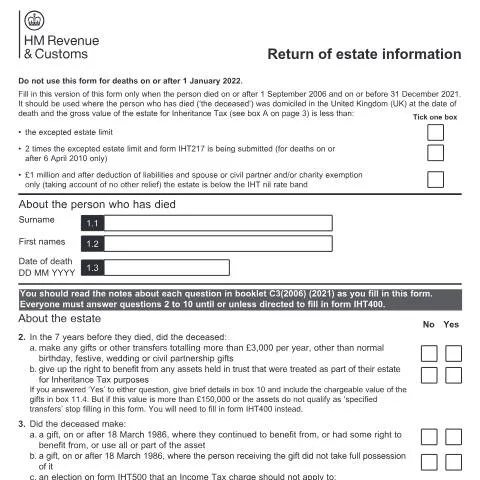
Understanding the C5(2006) Form: When Estate Reporting Takes a Different Path
When someone passes away in the UK, their estate typically faces scrutiny from HM Revenue & Customs regarding Inheritance Tax liability. However, not every estate requires the comprehensive IHT400 return that executors often dread. For certain qualifying estates, the Return of Estate Information C5(2006) offers a streamlined alternative that can significantly reduce administrative burden whilst ensuring compliance with tax obligations.
This form serves as a filtering mechanism within HMRC's inheritance tax framework, designed specifically for estates that fall below certain thresholds or meet particular criteria. Rather than requiring executors to navigate the complex 12-page IHT400 form, the C5(2006) allows qualifying estates to provide essential information through a more manageable process. The form's structure reflects HMRC's recognition that many estates pose minimal tax risk and can be processed efficiently without extensive documentation.
The significance of this form extends beyond mere administrative convenience. Successfully completing a C5(2006) return can expedite probate proceedings, reduce professional fees, and provide peace of mind for grieving families who might otherwise face months of complex tax calculations and valuations.
Eligibility Thresholds: Navigating the Three-Tier System
The C5(2006) form operates within a carefully structured eligibility framework that has evolved significantly since its introduction. Understanding these thresholds proves crucial for executors determining whether they can utilise this simplified route or must proceed with the full IHT400 return.
Primary Qualifying Conditions
The deceased must have been domiciled in the United Kingdom at the date of death for this form to apply. This requirement goes beyond mere residence and encompasses legal domicile, which can prove complex for individuals who have lived abroad or maintained connections to other jurisdictions.
Three distinct pathways allow estates to qualify for C5(2006) treatment:
| Qualifying Route | Gross Estate Limit | Additional Requirements |
|---|---|---|
| Standard excepted estate | Below excepted estate limit | None beyond basic criteria |
| Enhanced with IHT217 | Up to 2× excepted estate limit | Form IHT217 must be submitted (deaths after 6 April 2010) |
| Spouse/charity exemption route | Below £1 million gross | Net estate below nil rate band after spouse/civil partner and charity exemptions only |
The Excepted Estate Limits Framework
The excepted estate limits have undergone regular adjustments, typically announced during Budget statements and implemented through statutory instruments. These limits reflect broader economic conditions and align with changes to the Inheritance Tax nil rate band, though they don't always move in lockstep.
Executors must determine the applicable limit based on the specific date of death, as rates can change mid-tax year. The gross estate value calculation includes all assets owned by the deceased at death, regardless of whether they form part of the UK estate for probate purposes.
Critical Exclusions: When Simple Becomes Complex
The C5(2006) form contains multiple exclusionary criteria that can immediately disqualify an estate from this simplified process. These exclusions reflect areas where HMRC requires detailed scrutiny, often involving complex valuation issues or potential tax avoidance arrangements.
Seven-Year Gift History Complications
Question 2 addresses the deceased's gift-giving pattern during the seven years preceding death. The form specifically excludes "normal birthday, festive, wedding or civil partnership gifts" from the £3,000 annual threshold, recognising established social conventions around gift-giving.
However, determining what constitutes "normal" gifts can prove subjective. A £500 birthday gift might be normal within one family's context but excessive in another's circumstances. Executors must exercise judgment whilst erring on the side of caution, particularly where the deceased maintained generous gift-giving patterns.
The £150,000 chargeable value threshold for gifts provides a safety net, allowing estates with moderate gift histories to proceed with C5(2006) completion. Beyond this threshold, the complexity typically warrants full IHT400 scrutiny.
Reservation of Benefit Arrangements
Question 3 targets sophisticated tax planning arrangements where individuals attempt to reduce their taxable estate whilst retaining benefits from transferred assets. These "gifts with reservation" provisions can create significant complications, as the gifted assets may remain taxable as part of the estate despite apparent disposal.
Common scenarios triggering this exclusion include:
- Parents transferring property to children whilst continuing to live there without paying market rent
- Individuals placing assets into trust arrangements whilst retaining income or control rights
- Complex share arrangements where legal ownership transfers but economic benefit remains
The reference to form IHT500 elections addresses specific Income Tax reliefs that can interact with Inheritance Tax calculations, requiring specialist analysis beyond the C5(2006) scope.
Overseas Assets and Pension Complications
The £100,000 limit for overseas assets reflects HMRC's recognition that modest foreign holdings shouldn't automatically trigger complex reporting requirements. However, this threshold can be surprisingly easy to exceed, particularly for individuals with overseas property investments or significant foreign bank accounts.
Currency fluctuations can push estates above or below this threshold depending on exchange rates at the death date, creating potential uncertainty for executors working with foreign asset valuations.
Pension-related exclusions have become increasingly complex as pension freedoms have expanded. The form specifically addresses alternatively secured pension funds and recent pension changes, reflecting the potential for significant tax charges where pension benefits don't pass to surviving spouses or civil partners.
Completing the Asset Summary: Precision in Simplified Reporting
Section 11 of the C5(2006) form requires executors to provide a comprehensive asset summary despite the form's simplified nature. This section demonstrates how streamlined reporting doesn't equate to reduced accuracy requirements.
Cross-Referencing with Confirmation Processes
Box 11.1 references "figure from box 11 on C1(2021)", highlighting the integration between Scottish Confirmation procedures and English/Welsh probate processes. This cross-reference ensures consistency between court applications and tax reporting, reducing potential discrepancies that might trigger HMRC enquiries.
The separation between assets confirmed for probate purposes and additional items requiring tax consideration reflects the different legal frameworks governing asset transfer and tax liability.
Joint Assets and Survivorship Rights
Box 11.3 addresses jointly held UK assets passing automatically to survivors, typically involving joint bank accounts, jointly owned property, or investment accounts with survivorship clauses. While these assets don't require probate, they remain relevant for Inheritance Tax calculations.
Executors must carefully distinguish between true joint ownership with survivorship rights and assets held as tenants in common, where the deceased's share would form part of their estate requiring probate.
Valuation Responsibilities and Best Estimates
The form explicitly permits "best estimate" valuations where precise figures cannot be determined, acknowledging practical limitations facing executors. However, this flexibility comes with the responsibility to make "full enquiries" to ensure accuracy.
HMRC's acceptance of estimates doesn't diminish executors' duty to provide reasonable valuations based on available information. Professional valuations may still be necessary for significant assets, even within the simplified C5(2006) framework.
Strategic Timing and Form Selection Decisions
The C5(2006) form's temporal limitations create strategic considerations for executors, particularly regarding when to begin the completion process and how to coordinate with other administrative requirements.
The 2022 Transition and Historical Applications
The form's restriction to deaths between 1 September 2006 and 31 December 2021 reflects significant changes in HMRC's approach to estate reporting. Deaths from 1 January 2022 onwards require different procedures, though the underlying principles of simplified reporting for qualifying estates continue through alternative mechanisms.
This temporal restriction means executors dealing with recent deaths cannot utilise C5(2006), regardless of estate size or complexity. Understanding current alternatives becomes crucial for practitioners advising on contemporary estate administration.
Coordination with Probate Applications
Successful C5(2006) completion typically enables executors to proceed with probate applications more rapidly than estates requiring full IHT400 returns. However, coordination remains essential, particularly where asset valuations might affect both tax reporting and probate court requirements.
The form's acceptance by HMRC doesn't automatically guarantee probate court satisfaction, particularly where unusual assets or complex family circumstances require additional documentation for inheritance purposes.
Professional Guidance and Risk Management Considerations
While the C5(2006) form appears straightforward compared to comprehensive IHT400 returns, several factors suggest when professional assistance might prove valuable or even necessary.
Borderline Cases and Conservative Approaches
Estates approaching eligibility thresholds often benefit from professional analysis to determine the most appropriate reporting route. The penalties for incorrectly using simplified procedures when full returns were required can prove significant, both financially and in terms of administrative burden.
Conservative approaches might favour IHT400 completion even where C5(2006) eligibility appears clear, particularly where asset valuations remain uncertain or complex family arrangements exist.
Record-Keeping and Future Enquiry Preparation
HMRC retains enquiry powers even for accepted C5(2006) returns, making comprehensive record-keeping essential. Executors should maintain detailed supporting documentation for all valuations and decisions, even where the simplified form doesn't require submission of such evidence.
The form's acceptance doesn't preclude future HMRC investigation, particularly where estate circumstances change or additional information emerges after submission.
Long-Term Implications and Estate Planning Connections
Understanding C5(2006) eligibility criteria can inform broader estate planning strategies, helping individuals structure their affairs to qualify for simplified reporting procedures whilst minimising overall tax liabilities.
The form's exclusions highlight areas where lifetime planning might prove beneficial, such as managing gift patterns to remain within annual exemptions or structuring overseas investments to stay below reporting thresholds.
However, tax tail shouldn't wag the estate planning dog. Individuals should prioritise family security and practical considerations over administrative convenience, using simplified reporting opportunities as beneficial side effects rather than primary objectives.
The C5(2006) form represents HMRC's recognition that proportionate administration serves both taxpayer and revenue interests. For qualifying estates, it provides an efficient pathway through inheritance tax obligations whilst maintaining necessary oversight of potential liabilities. Success lies in careful eligibility assessment, accurate completion, and appropriate professional guidance where circumstances warrant additional expertise.
Special Valuation Challenges and Professional Expertise Requirements
The C5 (2006) form demands particular attention when dealing with assets that require specialist valuation, as HMRC expects professional standards to be met for complex estate components. Property valuations must reflect market conditions at the date of death, not current market values, which can create significant challenges in volatile property markets.
For residential property, you'll need a qualified surveyor's report, particularly for unique properties, those in conservation areas, or properties with unusual features such as listed building status. The valuation must account for any restrictions on sale, sitting tenants, or planning permissions that might affect marketability. Agricultural property requires specialist rural surveyors who understand Agricultural Property Relief (APR) criteria and can distinguish between agricultural and development value.
Business assets present complex valuation scenarios, especially for family companies or partnerships. Shares in unquoted companies require detailed financial analysis, often involving discounts for minority holdings or lack of marketability. Professional business valuers must consider earnings multiples, asset backing, and comparable transactions. Where Business Property Relief applies, the valuation methodology can significantly impact the inheritance tax liability.
Chattels and personal effects require careful categorisation on the C5 form. Items valued at £6,000 or less individually benefit from the chattels exemption, but related items must be grouped together. Valuable collections—whether art, antiques, jewellery, or vintage cars—need specialist auction house valuations or certified appraisals. The form requires detailed descriptions and supporting documentation for high-value items.
Foreign assets introduce additional complexity, requiring conversion to sterling at death-date exchange rates and consideration of double taxation agreements. Professional advice becomes essential when dealing with overseas property, foreign bank accounts, or international business interests, as valuation methods and reliefs vary significantly between jurisdictions.
Navigating Reliefs, Exemptions, and Complex Family Arrangements
The C5 (2006) form provides specific sections for claiming various reliefs and exemptions, each with distinct qualifying criteria and documentation requirements. Understanding these provisions can substantially reduce inheritance tax liabilities when properly applied and evidenced.
Spouse and civil partner exemptions require careful documentation of the relationship status and domicile position. Where the surviving spouse or civil partner is not UK-domiciled, the exemption is capped, currently at £325,000, requiring precise calculation of qualifying transfers. The form must clearly distinguish between exempt transfers to spouses and potentially taxable gifts to other family members.
Charitable exemptions demand proper identification of qualifying charities and accurate valuation of bequests. The reduced rate of inheritance tax (36% instead of 40%) applies when charitable legacies comprise at least 10% of the net estate after exemptions and reliefs. This calculation requires careful completion of specific sections within the C5 form and supporting schedules.
Business Property Relief (BPR) and Agricultural Property Relief (APR) sections require detailed evidence of qualifying criteria. For BPR, you must demonstrate that the business was trading (not investment-focused) and that the deceased held the qualifying interest for the required minimum period. The form requires breakdown of different relief percentages—100% for unincorporated businesses and controlling shareholdings, 50% for minority shareholdings in unquoted companies.
APR claims need comprehensive documentation of agricultural use, including tenancy agreements, farming records, and evidence of agricultural occupation or letting. The relief applies to agricultural value only, not development or hope value, requiring careful separation in valuations. Working farmers may qualify for 100% relief, while agricultural landlords typically receive 50% relief.
Transferable nil-rate band claims between spouses require completion of additional forms and historical information about the first spouse's death. The form must demonstrate that the first spouse's nil-rate band was not fully utilised, with calculations showing the available percentage for transfer. This can effectively double the inheritance tax threshold for surviving spouses, making accurate completion crucial for tax planning.
Post-Submission Procedures and Long-term Compliance Obligations
Submitting the C5 (2006) form marks the beginning of an extended compliance period rather than the conclusion of inheritance tax obligations. HMRC's acceptance of the return creates ongoing responsibilities that personal representatives must understand and manage effectively.
The inheritance tax account remains open for potential enquiries for up to four years from the end of the tax year in which the account was delivered, or up to six years in cases of negligent or deliberate understatement. During this period, HMRC may request additional information, supporting documentation, or professional valuations. Personal representatives should maintain comprehensive records, including all correspondence, professional reports, and decision-making rationale.
Corrective returns become necessary when errors are discovered or circumstances change after submission. The C4 (2021) form allows correction of inheritance tax accounts, but penalties may apply depending on the nature and timing of corrections. Innocent errors discovered promptly typically attract no penalties, while negligent or deliberate understatements face significant financial consequences.
Instalment payment arrangements require ongoing management where available for certain assets like land, buildings, or qualifying business interests. The C5 form establishes the basis for ten-year instalment payments, but personal representatives must ensure timely payment of annual instalments plus interest. Default on instalment arrangements can trigger immediate payment requirements for the full outstanding balance.
Conditional exemption maintenance agreements for heritage assets create perpetual obligations for beneficiaries. Where artwork, historic buildings, or significant chattels qualify for conditional exemption, the C5 form initiates a regime requiring ongoing compliance with public access, maintenance, and preservation requirements. Breach of these conditions can trigger retrospective inheritance tax charges on the full unexempted value.
Estate administration continues beyond probate grant, with potential implications for inheritance tax positions. Subsequent discoveries of assets, resolution of contingent liabilities, or changes in asset values may require supplementary returns. The deed of variation provisions allow beneficiaries to redirect inheritances within two years of death, potentially creating new inheritance tax implications requiring amended returns.
Professional indemnity considerations become relevant for solicitors, accountants, and other advisers involved in C5 form completion. The complexity of inheritance tax law and the significant financial consequences of errors make professional insurance essential. Regular continuing professional development ensures advisers maintain current knowledge of evolving legislation, HMRC practice, and case law developments affecting inheritance tax compliance.