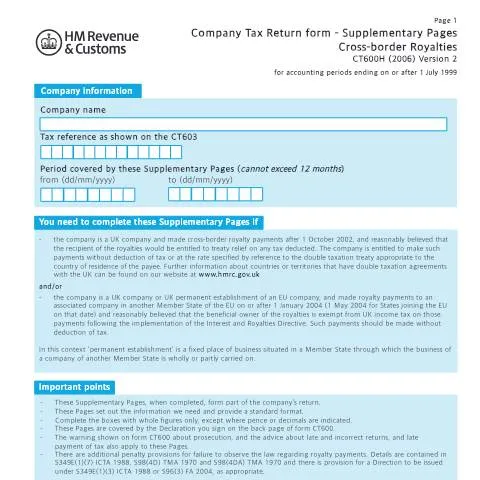
Navigating Cross-Border Royalty Payments Through CT600H
Understanding the complexities of international royalty payments can be daunting for businesses operating across borders. The CT600H (2006) Version 2 form, designed specifically for UK companies, offers a structured way to report cross-border royalty payments in compliance with HM Revenue & Customs (HMRC) regulations. This guide delves into the nuances of the CT600H, including who must file it, the steps to complete it, and the implications of its submission.
Understanding Tax Year and Reporting Periods
The reporting period for the CT600H must align with the company’s accounting periods that end on or after 1 July 1999. To ensure compliance, businesses should pay close attention to the UK tax year, which runs from 6 April to 5 April of the following year. This is crucial, as any discrepancies in reporting periods can lead to complications with HMRC.
- Determine your accounting period: Identify the end date of your company’s accounting period and ensure it does not exceed 12 months for this specific report.
- Filing window: Prepare your CT600H for submission in conjunction with your main CT600 Company Tax Return, which is due 12 months after the end of your accounting period.
Filing Deadlines and Consequences of Late Submission
The deadline for submitting the CT600 and associated supplementary pages, including the CT600H, is 31 January following the end of the accounting period. Late submissions can result in penalties, and it is vital for businesses to be aware of the following:
- Penalties for late filing can escalate rapidly, starting at £100 and increasing based on the duration of the delay.
- If you file more than 3 months late, the minimum penalty becomes 5% of the tax due at that time.
- Additional penalties may apply if submissions are inaccurate, as HMRC has strict guidelines regarding compliance.
Key Considerations for Completing the CT600H
When filling out the CT600H, it is imperative to methodically follow the guidelines provided by HMRC. The form is complex, and adherence to the instructions can significantly mitigate the risk of errors. Here are some essential considerations for successful completion:
Understanding Box 98
Box 98 on the CT600 is a crucial component where companies indicate that they have made cross-border royalty payments and have a reasonable belief that the recipient is entitled to treaty relief. This declaration is vital for compliance and integrity.
Detailed Information Required
Additional sections in the CT600H require detailed information about royalty payments:
- Name and Address of Recipient: Clearly state the full name and address of the individual or entity receiving the royalty payments.
- Type of Royalty: Specify the nature of the royalty to ensure proper categorization. Common types include copyrights, patents, and trademarks.
- Tax Relief Claimed: When completing the section on relief, be precise about the double taxation agreement or the Interest and Royalties Directive applicable to the payment.
Key Distinctions: CT600H vs. Other HMRC Forms
The CT600H is often confused with other tax-related forms; however, it serves a specific purpose distinct from other submissions. Here’s what sets it apart:
| Form Code | Primary Use | Key Features | Filing Deadline |
|---|---|---|---|
| CT600 | Standard Company Tax Return | Reports overall company profits and tax liabilities. | 12 months after accounting period ends |
| CT600H | Supplementary Pages for Cross-Border Royalties | Specific to royalty payments and treaty relief. | Same as CT600 |
| SA100 | Self Assessment Tax Return | Filed by individuals for personal income tax. | 31 January following the end of the tax year |
Consequences of Non-Compliance
The importance of accuracy and timeliness cannot be overstated. Failing to submit the CT600H or providing inaccurate information can have significant repercussions, including:
- Financial Penalties: As mentioned earlier, penalties can accrue rapidly, affecting the company’s financial health.
- Tax Investigations: HMRC may initiate a full investigation into the company's tax affairs, leading to further scrutiny and stress.
- Loss of Treaty Benefits: Incorrect filings can jeopardize the company's ability to benefit from double taxation treaties, resulting in higher tax liabilities.
Preparing Supporting Documentation
When completing the CT600H, it’s crucial to gather all necessary documentation to substantiate your claims. Depending on your situation, the following documents may be required:
- Agreements and Contracts: Any agreements that detail the royalty payments made should be included.
- Payment Records: Bank statements or transaction records that highlight the payments made during the reporting period.
- Tax Residency Certificates: If applicable, certificates that demonstrate the recipient's tax residency status can bolster your claims to relief.
Maintaining Records for Future Reference
Keep thorough records related to royalty payments and filings for at least six years. This not only aids in future submissions but also serves as a defense if HMRC raises any queries regarding your filings.
Tracking Your Submission with HMRC
After submitting the CT600H, businesses should monitor their status. Here’s how to manage follow-ups effectively:
- Utilize HMRC Online Services: Companies can track their submissions via the online portal, checking for updates or requests for additional information.
- Keep Correspondence: Maintaining a record of all correspondence with HMRC helps in understanding the status and any needed actions.
- Respond Promptly to Inquiries: If HMRC requests further information or clarification, responding promptly is crucial to avoid delays or complications.
Final Thoughts on Filing the CT600H
Successfully navigating the requirements of the CT600H can significantly impact the financial viability of a business engaged in cross-border activities. By understanding the form's specifications, deadlines, and the importance of accuracy, companies can ensure compliance while maximizing their benefits under international tax treaties.
Understanding Cross-Border Royalties in Corporation Tax
Cross-border royalties are payments made for the use of intellectual property, such as patents, copyrights, trademarks, and trade secrets, where the rights-holder resides in a different tax jurisdiction. In the context of UK Corporation Tax, it is crucial for businesses to accurately report these payments to ensure compliance with HM Revenue & Customs (HMRC) regulations.
When determining the tax obligations related to cross-border royalties, UK companies should consider the double taxation agreements (DTAs) in place between the UK and the country of the royalty recipient. These treaties often reduce withholding tax rates on royalties, thus providing a tax advantage for both parties involved. Businesses need to assess the specific provisions of the relevant DTA to understand how the payments will be taxed in both jurisdictions.
Additionally, entities must be aware of the transfer pricing rules which dictate that cross-border royalty payments should be made at arm's length. This means that the royalties should reflect the market value of the intellectual property rights being utilized. Failure to comply with these regulations may lead to adjustments by HMRC during audits, potentially resulting in additional tax liabilities and penalties.
Lastly, it is important for UK companies to maintain appropriate documentation to substantiate the amounts paid in royalties. This includes contracts, valuation reports, and financial records, which will be essential if HMRC questions the validity of the royalty expense during a review.
Key Considerations for Completing CT600H (2006) Version 2
The CT600H is specifically designed for companies that are claiming relief for research and development (R&D) or for those involved in the UK film industry, and it includes sections for reporting any cross-border royalty payments. When completing this form, companies must ensure that they provide accurate figures for their royalty expenses.
Firstly, it is important to differentiate between capital and revenue expenditures. Royalty payments are typically treated as revenue expenses, which means they can be deducted from the company's profits when calculating taxable income. However, if the payments are tied to the acquisition of an asset, they may need to be capitalized.
Moreover, companies should pay attention to the sections of the CT600H that specifically ask about the international aspects of their operations. This includes declaring any royalties received from abroad and the associated withholding tax that may have been deducted by the foreign entity. These figures must be reported accurately to claim any relief due under the DTA, which can reduce the corporation tax liability in the UK.
Furthermore, in the event of adjustments to the reported royalties during the tax year, it is imperative to keep records of how these adjustments were calculated and the reasons for any changes. This transparency is beneficial during HMRC audits and helps establish that the company is acting within the legal framework regarding its cross-border transactions.
Potential Challenges and Risks Associated with Cross-Border Royalties
Engaging in cross-border royalty transactions presents several challenges and risks that businesses must navigate. One significant risk is related to the complexity of international tax laws. Different countries have unique requirements and interpretations of tax treaties, which can lead to confusion about withholding tax rates and reporting obligations.
Another challenge arises from the potential for disputes between tax authorities. For instance, if HMRC and the foreign tax authority have differing views on the nature of a royalty payment or the tax treatment thereof, this could result in double taxation. Companies must be proactive in seeking professional advice and ensuring that they fully understand the implications of their cross-border transactions.
Moreover, HMRC has been increasingly focused on ensuring compliance with transfer pricing rules. Companies may face audits and reviews of their cross-border royalty payments, especially if the amounts are substantial. It is essential to conduct regular reviews of pricing policies and ensure they reflect market rates to mitigate the risk of adjustments by tax authorities.
Lastly, the evolving landscape of global tax regulations, including initiatives like the OECD’s Base Erosion and Profit Shifting (BEPS) framework, suggests that businesses must stay informed about changes that may affect how royalties are taxed internationally. Failing to adapt to these changes could result in increased scrutiny and potential penalties for non-compliance.