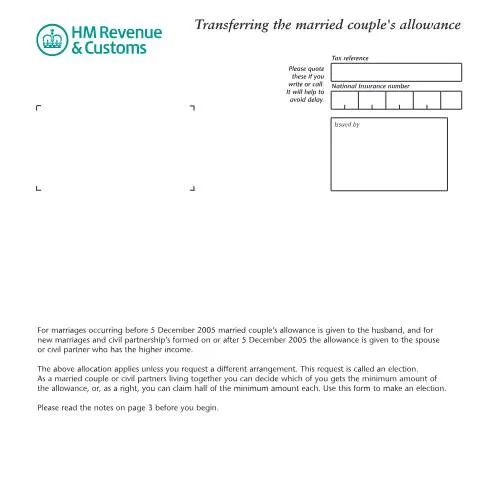
Understanding the Transfer Rules for Married Couple's Income Tax Allowance
The Transfer of Married Couple's Income Tax Allowance form represents a crucial yet often overlooked financial planning tool for eligible couples in the UK. When one partner in a marriage or civil partnership cannot fully utilise their married couple's allowance—perhaps due to lower income or non-taxpaying status—this HMRC mechanism allows strategic redistribution of tax benefits. The form's significance extends beyond simple paperwork: it can determine whether hundreds of pounds remain unused or translate into genuine tax savings.
This allowance transfer operates within specific parameters established by the Civil Partnership Act 2004, creating distinct pathways depending on when the relationship was formalised. For marriages before 5 December 2005, the husband automatically receives the allowance, whilst marriages and civil partnerships formed on or after this date allocate it to the higher earner. However, these default arrangements need not remain fixed—couples retain the right to elect alternative distributions that better suit their financial circumstances.
Eligibility Framework and Age-Related Requirements
The married couple's allowance operates under strict age criteria that determine both entitlement and allocation methods. Either spouse or civil partner must have been born before 6 April 1935 for the couple to qualify. This birth date threshold creates a diminishing pool of eligible couples as older generations pass on, making the allowance increasingly valuable for those who remain entitled.
The allowance structure comprises two distinct components: the minimum amount and an age-related addition. In the 2005-06 tax year, the minimum amount was worth £228, though current rates require verification with HMRC as they adjust annually. The age-related portion depends on the income of either the husband (for pre-December 2005 marriages) or the higher-earning partner (for later marriages and civil partnerships).
| Relationship Status | Default Allowance Recipient | Transfer Options Available |
|---|---|---|
| Married before 5 Dec 2005 | Husband automatically | Full transfer to wife or 50/50 split |
| Married/Civil Partnership 5 Dec 2005+ | Higher earner automatically | Full transfer to lower earner or 50/50 split |
Living arrangements play a critical role in maintaining eligibility. Couples must be living together for all or part of the tax year they're claiming the allowance for. Temporary separations may not automatically disqualify couples, but extended periods apart could affect entitlement and require careful documentation.
Strategic Allocation Decisions: When Transfer Makes Financial Sense
The decision to transfer married couple's allowance hinges on each partner's tax position and ability to utilise the relief effectively. The form warns that couples could be worse off if the person receiving the allowance doesn't pay tax or doesn't pay enough tax to use up the allowance received. This caveat demands careful analysis of both partners' income levels and tax liabilities.
Consider a scenario where the default recipient earns below the personal allowance threshold. Their unused married couple's allowance generates no tax benefit, representing lost value that could otherwise reduce the household's overall tax burden. Conversely, transferring the allowance to a partner paying income tax at basic or higher rates maximises its financial impact.
The 50/50 split option provides a middle ground, particularly valuable when both partners pay some income tax but at different rates. This election allows couples to optimise their combined tax position without completely surrendering the allowance from one partner to another. However, the age-related portion of the allowance always remains with the husband (pre-2005 marriages) or higher earner (post-2005 relationships), regardless of minimum amount transfers.
Income Fluctuation Considerations
Annual income variations add complexity to transfer decisions. A partner who currently pays little or no tax might experience increased earnings in future years, making them better positioned to utilise the allowance. Conversely, retirement, career breaks, or business fluctuations could shift optimal allocation patterns. The form's continuing operation until formally withdrawn means couples must actively monitor whether their initial election remains advantageous.
Completing the Form: Navigating Different Sections Based on Marriage Date
The form's structure reflects the dual regulatory framework created by the 2005 rule changes. Couples must first identify which sections apply to their situation based on their marriage or civil partnership date, as completing inappropriate sections could delay processing or require resubmission.
For marriages before 5 December 2005: Sections A or B apply, along with mandatory Section E for personal details. Section A facilitates complete transfer of the minimum allowance from husband to wife, requiring both signatures. Section B enables the wife to claim half the minimum amount independently, requiring only her signature but necessitating clear identification of the current allowance recipient.
For marriages and civil partnerships from 5 December 2005 onwards: Sections C or D become relevant, alongside Section E. These sections mirror the pre-2005 options but accommodate the higher/lower earner framework rather than gender-based allocation. Both partners must sign for complete transfers (Section C), whilst individual elections for 50% shares (Section D) require only the lower earner's signature.
Critical Information Requirements
Each section demands specific identifying information that must match HMRC records precisely. Tax references and National Insurance numbers serve as primary identifiers, whilst addresses must reflect current registered details. Discrepancies between form information and HMRC databases frequently trigger verification delays or rejection letters.
The Enter year this election is to operate from 6 April field requires particular attention. Elections typically operate from the start of the following tax year, but couples marrying or forming civil partnerships during the current tax year can implement immediate changes. This timing flexibility provides valuable planning opportunities for newly married couples optimising their first joint tax year.
Timing Regulations and Strategic Implementation Deadlines
HMRC imposes strict timing requirements that can invalidate late elections, regardless of their potential tax benefits. Elections must be submitted before the start of the first tax year they're intended to operate, creating a crucial 6 April deadline for most circumstances. However, the regulations provide alternative compliance routes for couples who miss the primary deadline.
The form specifies two acceptable approaches for timely submission:
- Return the completed form before 6 April, or
- Notify HMRC in writing before 6 April of the intention to make an election, then submit the completed form by 5 May at the latest
This dual pathway offers valuable flexibility for couples discovering optimization opportunities close to the tax year boundary. A simple letter or email to HMRC confirming election intentions can preserve rights whilst allowing additional time for form completion and signature gathering.
Newly married couples and those entering civil partnerships enjoy special timing privileges. Their elections can operate straightaway within the marriage or partnership year, bypassing standard advance notice requirements. This immediate implementation recognises the practical challenges of tax planning during relationship transitions and wedding preparations.
Continuation and Withdrawal Mechanisms
Once established, elections continue automatically for subsequent tax years until formally withdrawn or replaced. This perpetual operation eliminates annual paperwork requirements but demands ongoing monitoring of tax position changes. Couples whose circumstances shift significantly may find their original election no longer serves their interests.
Withdrawal procedures mirror the original election requirements regarding signatures. Individual elections (50% splits) require only the original signatory's withdrawal signature, whilst joint elections (complete transfers) need both partners' agreement to terminate. Importantly, withdrawals only take effect from the following tax year, preventing mid-year adjustments that could complicate HMRC processing.
Processing Procedures and Official Response Mechanisms
HMRC processes transfer elections through dedicated teams familiar with the allowance's complexities and historical rule variations. The form includes specific reference fields—tax reference and National Insurance number—that expedite processing when quoted in correspondence. These identifiers help avoid delays that frequently occur when HMRC cannot immediately locate relevant records or match form submissions to existing taxpayer files.
Upon successful processing, HMRC issues formal acknowledgement confirming the election's acceptance and operational date. This acknowledgement document serves as crucial evidence for future tax calculations and should be retained alongside other important tax records. The acknowledgement specifies exactly how the minimum allowance will be allocated and confirms that any age-related portion remains with the original recipient.
The form's official use sections reveal HMRC's internal processing requirements, including cross-referencing with other HMRC offices and initialling procedures that ensure proper coordination across different tax administration teams. These internal mechanisms help prevent conflicts between different HMRC departments handling various aspects of the couple's tax affairs.
Verification and Amendment Procedures
HMRC may request additional verification if form details conflict with existing records or raise queries about eligibility or living arrangements. Common verification triggers include mismatched addresses, inconsistent National Insurance numbers, or unclear signatures that don't match previous correspondence. Prompt response to verification requests prevents election delays that could affect the intended tax year implementation.
Amendment requests after submission require careful handling, as HMRC cannot simply modify elections informally. Significant changes typically necessitate formal withdrawal of the original election followed by fresh submission, potentially affecting timing requirements if attempted close to tax year boundaries.
Integration with Broader Tax Planning and Self Assessment Obligations
Married couple's allowance elections intersect with various other tax obligations and planning opportunities that couples must coordinate carefully. Self Assessment taxpayers must ensure their returns reflect current allowance allocations accurately, particularly when elections change between tax years. Discrepancies between elected allowance distributions and Self Assessment claims can trigger HMRC inquiries and potential penalties.
The allowance interacts with other age-related reliefs and allowances that eligible couples might claim. Personal allowances, pension contributions, and charitable giving reliefs all influence optimal tax planning strategies. Couples maximising multiple reliefs simultaneously may find that married couple's allowance transfers produce different benefits than initially calculated, requiring periodic review of their overall tax position.
PAYE taxpayers experience allowance changes through coding adjustments that HMRC implements following successful elections. These coding changes affect monthly take-home pay rather than requiring end-of-year calculations, providing immediate benefit recognition. However, mid-year elections or changes may create temporary coding complications that resolve in subsequent tax years.
Record-Keeping and Documentation Requirements
Maintaining comprehensive records of allowance elections and changes supports both ongoing tax compliance and potential future HMRC inquiries. Essential documentation includes original election forms, HMRC acknowledgement letters, and any correspondence regarding verification or amendments. These records prove particularly valuable if couples need to demonstrate election timing or resolve disputes about allowance entitlement.
The continuing nature of elections means that documentation from several years previously may suddenly become relevant if HMRC reviews historical tax calculations or if couples need to withdraw long-standing elections. Digital copies provide reliable backup for physical documents that may deteriorate or become misplaced over time.
Optimisation Strategies for Different Household Financial Scenarios
The married couple's allowance transfer mechanism serves diverse household financial situations, each requiring tailored approaches to maximise benefit. High-earning couples where one partner significantly out-earns the other often benefit from maintaining default allocations, as the higher earner can typically utilise both their own reliefs and the transferred allowance effectively.
Households with one non-working or low-earning partner present clear transfer opportunities. When the default allowance recipient cannot utilise the relief due to insufficient tax liability, complete transfer to the working partner maximises household tax savings. This scenario commonly occurs where one partner has retired whilst the other continues working, or during career breaks for childcare or education.
The 50/50 split option suits couples with similar but moderate incomes where both pay some income tax but neither has substantial tax liabilities. This approach ensures both partners benefit from allowance portions whilst avoiding complete concentration of relief with one individual. It also provides flexibility if income patterns shift gradually over time.
Business Ownership and Self-Employment Considerations
Self-employed individuals and business owners face additional complexity when optimising married couple's allowance elections. Variable annual profits, timing differences between business income and tax payments, and interaction with other business reliefs all influence optimal allocation decisions. Partners running businesses may find their ability to utilise allowances fluctuates significantly between profitable and loss-making years.
Couples where one partner operates through limited companies must consider dividend timing and personal salary levels when planning allowance transfers. The interaction between personal allowances, dividend allowances, and married couple's allowance can create optimization opportunities that require careful coordination with broader tax planning strategies.