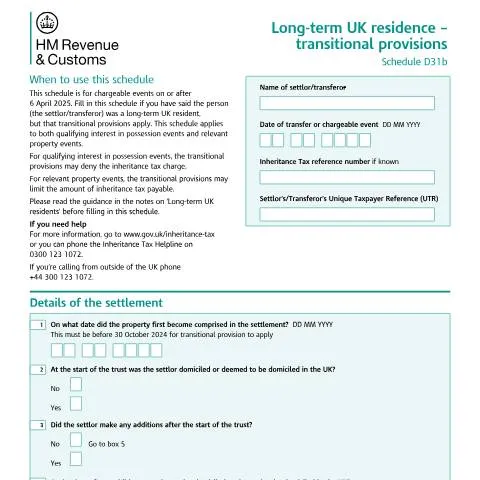
Navigating the D31b Schedule: What You Need to Know
Completing the D31b Schedule is a critical step for individuals who are long-term UK residents and are involved in qualifying interest in possession or relevant property events. If you find yourself in the position of having to fill out this document, understanding its nuances can significantly impact your obligations regarding inheritance tax. The D31b form is not just a bureaucratic hurdle; it plays a pivotal role in determining your tax liability under UK law.
Understanding Your Position: The Importance of Long-Term Residency
At the heart of filling out the D31b Schedule is the concept of long-term residency in the UK. If you've declared yourself a long-term UK resident, this form serves to clarify the transitional provisions that apply to your circumstances. Here are key points to consider:
- Definition of Long-Term Resident: Generally, a long-term resident is someone who has resided in the UK for more than 15 years or has established a legal domicile here.
- Transitional Provisions: If certain criteria are met, you may be eligible for relief from inheritance tax, particularly concerning the timing of when properties were settled.
Specifics matter. For example, if the property in question became part of the settlement before 30 October 2024, you should proceed with the D31b form to explore any potential tax relief.
The Trigger: When to Use Schedule D31b
The circumstances under which you are required to file this schedule are specific and, in some cases, time-sensitive. This document is essential when:
- There is a chargeable event occurring on or after 6 April 2025.
- You have stated that the settlor or transferor was a long-term UK resident, and you need to apply transitional provisions.
For individuals involved in qualifying interest in possession events, the transitional provisions might deny inheritance tax charges altogether, while for relevant property events, these provisions could limit how much tax you owe. Therefore, it is vital to ensure you understand whether these qualifiers apply to your situation.
Detailed Breakdown of D31b: Filling the Schedule
When you begin to fill in the D31b Schedule, each section is designed to capture essential information regarding the property, parties involved, and nature of the chargeable events. Here’s a step-by-step guide to navigating the form:
Key Information Section
Begin by filling in the basic details:
- Name of Settlor/Transferor: Who is the individual responsible for the settlement?
- Date of Transfer: Document the exact date of the chargeable event.
- Inheritance Tax Reference Number: Include this if you have it, as it will help HMRC track your submission.
- Unique Taxpayer Reference (UTR): Essential for identification purposes.
Details of the Settlement Process
This section is crucial for determining your eligibility for transitional provisions:
- What date did the property first become part of the settlement? (Must be before 30 October 2024)
- Was the settlor domiciled in the UK at the start of the trust?
- If additions were made post the trust’s initiation, was the settlor domiciled at that time?
Interest in Possession: Understanding Your Rights
If the event falls under the category of qualifying interest in possession, you will need to answer additional queries concerning:
- The date you became beneficially entitled to the interest.
- Whether anyone has purchased an interest in possession within the settlement.
Be prepared to provide any additional information, as HMRC may require clarification on these points.
Relief Claimed and Tax Implications
Understanding how to calculate and claim any tax relief is paramount. You will be asked to provide detailed information about:
- The number of complete quarter years between 6 April 2025 and the date of the charge.
- The applicable cap for foreign property.
The form simplifies your calculations by providing specific boxes for you to fill in related monetary amounts and relief calculations.
Common Scenarios: Who Is Affected?
There are particular profiles that might find themselves frequently needing to complete the D31b form. Consider the following:
- U.K. Domiciled Individuals: Those who are domiciled in the UK may face different implications compared to non-domiciled individuals.
- Foreign Residents: If a settlor is not domiciled but has assets in the UK, understanding the transitional relief is essential.
- Minors or Beneficiaries: Special care must be taken for those who are underage or legally incapacitated.
Each scenario has its own subtleties, so ensure you consult the guidance notes provided by HMRC for clarification.
Preparation: Gathering Necessary Documentation
The proficiency with which you complete the D31b will depend on effective preparation. Collect the following documentation ahead of time:
- Proof of Residency: Documentation proving long-term residency or domicile status in the UK.
- Trust Deeds: All relevant trust documents to verify the creation and terms of trust.
- Tax Records: Historical tax payments can help in calculating relief if applicable.
Be thorough; incomplete submissions can delay processing and potential tax relief.
Submitting the D31b Schedule: What to Expect
Once you have completed the D31b Schedule, the next step is submission. While the form provides a clear pathway, here are some essential points to remember:
- Ensure that all sections are filled out accurately. Mistakes could lead to tax liability discrepancies.
- The D31b should be submitted alongside other relevant forms, especially if part of a larger inheritance tax filing.
- Maintain copies of everything submitted for your records.
Upon submission, you will typically receive confirmation from HMRC regarding your submission. However, keep in mind that depending on the complexity of your claim, processing times may vary.
Implications of Non-Submission or Inaccurate Filing
Ignoring the D31b Schedule or failing to file it accurately can lead to serious ramifications:
- Increased Tax Liabilities: Without the appropriate relief claimed, your tax burden may be significantly higher.
- Penalties: HMRC may impose penalties for late or incorrect submissions, adding to your financial responsibilities.
Therefore, understanding the importance of this document and ensuring its correct completion is paramount to managing your financial health effectively.
Further Resources: Seeking Guidance
Should you require assistance with the D31b Schedule, you are encouraged to take advantage of HMRC's resources:
- Visit the official Inheritance Tax section on the UK government website for comprehensive guidelines.
- Contact the Inheritance Tax Helpline for personalized assistance – reachable at 0300 123 1072.
Remember that seeking guidance can help you navigate the complexities of inheritance tax regulations effectively.
Understanding the Role of the Transferor and Settlor in UK Taxation
In UK tax law, the terms "transferor" and "settlor" are crucial when discussing the implications of long-term residency on taxation. A transferor is generally an individual who transfers assets to a trust, while a settlor is the person who creates the trust, setting the rules and conditions under which the assets will be managed. In cases where the transferor or settlor is a long-term UK resident, it becomes essential to report this information to HMRC, especially under specific transitional provisions.
For long-term residents, the tax implications can differ significantly compared to short-term residents or non-residents. Long-term UK residents are typically subject to UK tax on their worldwide income, which impacts the tax treatment of any assets transferred to a trust. When you report a transferor or settlor as a long-term UK resident, it is important to provide HMRC with detailed information, including their National Insurance number and the nature of the assets involved. Often, documentation such as proof of residency, tax returns, and other supporting materials may be requested by HMRC to ensure compliance.
Transitional Provisions and Their Impact on Reporting
Transitional provisions are temporary measures that facilitate the adjustment to new tax rules. When it comes to reporting a transferor or settlor who is a long-term UK resident, these provisions can offer a significant advantage. For example, if the transfer occurred before new regulations took effect, transitional provisions might allow some leniency in reporting requirements or tax liabilities. Understanding when these provisions apply is essential for accurate reporting and to ensure that you are not inadvertently subject to higher taxes or penalties.
There are specific criteria that must be met for transitional provisions to be applicable. These may include the timing of the transfer, the residency status of the transferor or settlor at the time of the transfer, and the nature of the trust being established. It is advisable to consult the latest guidance from HMRC or seek professional advice if you are unsure whether transitional provisions apply to your case. Remember, keeping detailed records of transactions and communications with HMRC will greatly assist in clarifying any uncertainties related to your reporting obligations.
Common Pitfalls When Reporting to HMRC
While the process of informing HMRC about a transferor or settlor who is a long-term UK resident may seem straightforward, there are several common pitfalls that individuals should be aware of. Failing to accurately identify the residency status of the transferor or settlor can lead to significant complications, including misclassification of tax liabilities. One of the key challenges is ensuring that the residency status is determined according to the latest statutory residency tests, which may require a nuanced understanding of both physical presence and ties to the UK.
Another frequent mistake is neglecting to update HMRC with any changes to the transferor or settlor's circumstances. If, for instance, a long-term UK resident becomes a non-resident due to a change in their living situation, this must be communicated to HMRC promptly. Failing to do so may result in penalties or incorrect tax assessments.
Lastly, individuals often underestimate the importance of providing complete and accurate information. Incomplete forms or missing documentation can lead to delays in processing and additional queries from HMRC. Therefore, it is advisable to double-check all submitted information and maintain a robust filing system with copies of forms submitted and correspondence with HMRC. Engaging a tax professional familiar with trusts and long-term residency can also provide peace of mind and ensure that you comply with all relevant requirements.