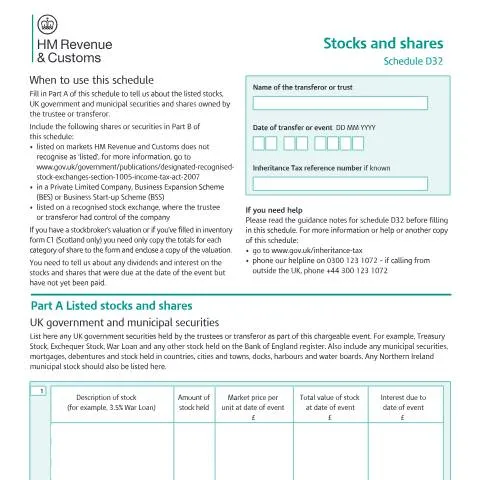
Trust Securities Disclosure: When Inheritance Tax Meets Complex Investment Holdings
When a trust holds significant investment portfolios or when substantial shareholdings transfer between parties, HMRC requires detailed disclosure through the D32 schedule. This specialised form captures the intricate landscape of securities ownership within inheritance tax events, distinguishing between various categories of investments that attract different tax treatments. The form becomes particularly crucial when trustees manage diverse portfolios spanning government securities, listed shares, and complex unlisted holdings that may qualify for business relief or instalment payment arrangements.
The D32 schedule operates within the broader inheritance tax framework, typically accompanying main event forms such as IHT400 when a chargeable transfer occurs. Unlike standard asset declarations, this form requires granular detail about each security type, market valuations at specific dates, and accrued dividends or interest that remain unpaid at the point of the taxable event.
Decoding the Two-Part Structure: Listed Versus Unlisted Securities
The D32 schedule divides securities into two distinct categories, each requiring different levels of scrutiny and potentially qualifying for different tax reliefs. This bifurcation reflects HMRC's recognition that various investment types carry different risk profiles and liquidity characteristics.
Part A: The Straightforward Listed Holdings
Part A captures what HMRC considers standard, liquid investments. This section encompasses UK government and municipal securities, including Treasury Stock, Exchequer Stock, War Loan, and other instruments held on the Bank of England register. Municipal securities from countries, cities, towns, and specialised bodies like dock authorities or water boards also fall within this category.
The second component of Part A addresses listed stocks and shares that did not confer control. This broad category includes shares listed on the Stock Exchange Daily Official List, Individual Savings Account holdings (including uninvested cash), unit trusts with their full designation, investment trusts, Open-Ended Investment Companies, and foreign shares listed on UK exchanges.
| Investment Type | Reporting Requirements | Special Considerations |
|---|---|---|
| UK Government Securities | Description, amount held, market price, total value | Include accrued interest to event date |
| Listed Shares (Non-Control) | Company name, share type, holdings, market value | Foreign shares only if UK-listed |
| Unit Trusts | Full name including manager, unit type | Specify accumulation or income units |
| ISA Holdings | Underlying investments plus uninvested cash | Exclude insurance policies or other cash |
Part B: Complex Holdings Requiring Enhanced Scrutiny
Part B addresses securities that HMRC considers more complex or potentially qualifying for special reliefs. These include Alternative Investment Market listings, OFEX-traded securities, private limited company shares, Business Expansion Scheme or Business Start-up Scheme holdings, and any listed shares where the trustees or transferor maintained control of the company.
The control element proves particularly significant. Even shares listed on recognised exchanges must be reported in Part B if the holding conferred control, fundamentally altering the tax treatment and potentially affecting business relief eligibility.
Navigating Business Relief Complexities and Exclusions
Business relief represents one of the most valuable inheritance tax reliefs available, potentially reducing the taxable value of qualifying business assets by 50% or 100%. However, the D32 schedule highlights several scenarios where business relief becomes unavailable or requires careful consideration.
Shares subject to binding sale contracts at the event date typically lose business relief eligibility, unless the sale forms part of a company reconstruction or amalgamation. This provision prevents taxpayers from claiming relief on assets already committed to disposal, ensuring the relief applies only to genuine business holdings retained for operational purposes.
Traded unlisted shares present particular complexity. While appearing to qualify for business relief as unlisted securities, shares quoted on recognised foreign exchanges may lose this advantage. The determination requires checking both the company's trading status and whether any foreign exchange listing appears on HMRC's recognised exchanges list.
The business relief assessment for traded unlisted shares requires a two-step verification: first confirming the company's foreign exchange listings through their corporate website, then cross-referencing those exchanges against HMRC's official recognised list.
Professional Valuations and the C1 Inventory Exception
The D32 form acknowledges that detailed individual security listings may prove unnecessarily burdensome when professional valuations already exist. Where trustees or transferors possess stockbroker valuations or have completed the Scottish inventory form C1, they may simply transfer the category totals rather than itemising each holding.
This provision recognises the professional expertise of qualified stockbrokers and the comprehensive nature of Scottish inventory procedures. However, the professional valuation must be enclosed with the form, allowing HMRC to verify the categorisation and valuation methodology if required.
The flexibility extends beyond mere convenience. Professional valuations often capture market nuances and timing considerations that individual taxpayers might overlook, potentially providing more accurate assessments for inheritance tax purposes. The stockbroker's professional indemnity insurance also provides additional assurance regarding valuation accuracy.
Accrued Income and Timing Considerations
Securities often generate income through dividends, interest, or other distributions that may be declared but unpaid at the relevant tax event date. The D32 schedule specifically requires disclosure of such accrued amounts, recognising them as part of the deceased's or transferor's estate value.
This requirement captures the economic reality that declared dividends or interest represent established entitlements, even when payment remains outstanding. The timing proves crucial: only amounts due at the event date require inclusion, not future distributions or potential income.
Different securities follow varying distribution patterns. UK government securities typically pay interest semi-annually, while company dividends may follow quarterly, semi-annual, or annual cycles. Unit trust distributions might occur monthly or quarterly, requiring careful attention to ex-dividend dates and payment schedules.
Currency and Valuation Date Precision
All valuations must reflect the market position at the specific event date, typically the death date or transfer date. This requirement can prove challenging for securities trading in volatile markets or foreign currencies, where values fluctuate significantly between trading sessions.
Foreign securities listed on UK exchanges require sterling valuations, typically using the closing exchange rate on the relevant date. Where securities trade in multiple currencies or across different time zones, the UK market closing price generally provides the appropriate reference point.
Instalment Payment Arrangements for Substantial Unlisted Holdings
Recognising that unlisted securities may prove difficult to liquidate quickly, HMRC permits instalment payment arrangements in specific circumstances. These arrangements acknowledge the practical challenges of raising immediate cash from illiquid investments while ensuring tax collection proceeds in manageable stages.
Qualification for instalment payments requires meeting multiple criteria simultaneously. The inheritance tax liability on the shares must exceed £20,000, and the holding must represent at least 10% of the company's nominal share capital value, or 10% of ordinary share capital if the shares are ordinary shares. Additionally, the taxpayer must demonstrate that immediate full payment would create undue hardship.
The undue hardship test requires objective evidence rather than mere assertion. HMRC typically expects detailed financial statements showing that immediate payment would necessitate asset sales at disadvantageous prices or create genuine financial distress. Professional advice often proves valuable in presenting the hardship case effectively.
| Instalment Qualification Criteria | Threshold | Evidence Required |
|---|---|---|
| Tax liability on shares | Over £20,000 | D32 valuation calculations |
| Shareholding percentage | 10% of nominal value | Company records or share certificates |
| Undue hardship | Objective demonstration | Financial statements, professional advice |
| Business relief status | Must not qualify | HMRC assessment based on company nature |
Integration with Main Inheritance Tax Returns
The D32 schedule functions as a supporting document to main inheritance tax forms, typically the IHT400 series. The form's design includes specific boxes directing where totals should be transferred to the main return, ensuring accurate consolidation of the estate's total value.
Each section of the D32 form corresponds to specific boxes on the main inheritance tax return. UK government and municipal securities transfer to their designated box, while listed shares without control transfer to their corresponding section. This systematic approach reduces transcription errors and ensures comprehensive asset capture.
The dividend and interest totals require particular attention, as they typically transfer to a combined box covering all investment income due at the event date. This consolidation means the D32 form often works alongside other income schedules, creating a comprehensive picture of the estate's income-generating assets.
Cross-Reference Requirements and Consistency Checks
HMRC's processing systems perform automated consistency checks between the D32 schedule and main returns. Significant discrepancies or missing cross-references can trigger queries or delays in processing. Ensuring mathematical accuracy and proper cross-referencing proves essential for smooth processing.
The inheritance tax reference number, when known, provides crucial linking between documents. This reference enables HMRC to associate the D32 schedule with the correct case file, particularly important for complex estates requiring multiple supporting schedules.
Technical Guidance and Professional Support Channels
HMRC provides comprehensive guidance notes specifically for the D32 schedule, covering technical aspects of security classification, valuation principles, and relief eligibility. These notes prove particularly valuable for borderline cases where security classification may be unclear or where multiple tax reliefs might apply.
The inheritance tax helpline offers specialist support for D32 queries, staffed by advisors familiar with securities classification and valuation issues. For complex cases involving substantial portfolios or unusual securities, telephone guidance can clarify reporting requirements before form submission.
The gov.uk inheritance tax pages provide regularly updated information about recognised stock exchanges, business relief eligibility, and valuation principles. This online resource proves particularly valuable for checking the status of foreign exchanges or understanding recent legislative changes affecting securities taxation.
Professional advisors often prove invaluable for complex D32 submissions, particularly where substantial business relief claims or instalment payment requests are involved. Their expertise in valuation principles, relief eligibility, and HMRC procedures can significantly improve submission quality and reduce processing delays.
Common Mistakes and How to Avoid Them on Form D32
Completing Form D32 accurately requires attention to detail, and certain errors crop up repeatedly in submissions to HMRC. Understanding these common pitfalls can save significant time and prevent delays in processing.
One frequent mistake involves misclassifying the nature of share ownership. Trustees often confuse beneficial ownership with legal ownership when declaring assets. If the trust holds shares as nominee for beneficiaries, this must be clearly distinguished from situations where the trust itself is the beneficial owner. The form requires specific details about the capacity in which shares are held, and incorrect categorisation can trigger unnecessary enquiries.
Valuation errors represent another significant area of concern. Some declarants use outdated share prices or fail to account for corporate actions such as stock splits, bonus issues, or rights offerings that occurred during the relevant period. For listed securities, HMRC expects valuations based on closing prices from recognised stock exchanges on the relevant dates. For unlisted shares, professional valuations may be necessary, particularly for substantial holdings or complex ownership structures.
Incomplete disclosure of overseas holdings frequently causes complications. The form requires comprehensive reporting of foreign securities, including details of the jurisdiction, local tax identification numbers where applicable, and conversion rates used for sterling equivalents. Failure to declare foreign withholding taxes or tax credits can result in double taxation issues later.
Another common oversight involves inadequate documentation of transfers between connected parties. When shares move between family trusts or related entities, HMRC requires clear evidence of the commercial rationale and proper valuation methodology. Transfers at undervalue without legitimate commercial reasons may trigger anti-avoidance provisions.
Timing issues also create problems, particularly around the tax year-end of 5 April. Share transactions executed close to this date require careful consideration of settlement dates versus trade dates. The form must reflect the legal position as at the relevant snapshot date, not simply when contracts were agreed.
Record-keeping deficiencies often emerge during HMRC reviews. Trustees should maintain comprehensive documentation including purchase contracts, transfer documents, dividend statements, and correspondence with investment managers. Digital records are acceptable, but HMRC may request physical documentation during investigations.
Special Considerations for Different Types of Securities
Form D32 accommodates various categories of securities, each requiring specific treatment and disclosure approaches. Understanding these distinctions ensures appropriate reporting and compliance with HMRC requirements.
Exchange-traded funds (ETFs) and investment trusts require particular attention due to their hybrid nature. While technically shares in the fund management company, they provide exposure to underlying asset classes including bonds, commodities, or overseas equities. HMRC treats these as shares for Form D32 purposes, but the underlying exposure may have implications for other tax returns, particularly regarding foreign income or capital gains.
Preference shares present unique challenges, especially those with conversion features or variable dividend rights. The form requires disclosure of the specific rights attached to each class of shares, including voting rights, dividend preferences, and liquidation priorities. Convertible preference shares must be valued considering both their current preference characteristics and the embedded option value.
Employee share schemes create additional complexity, particularly for trusts established to benefit employees or their families. Shares acquired through Save As You Earn schemes, share incentive plans, or enterprise management incentives may have restrictions on transfer or sale. These restrictions affect valuation and must be clearly disclosed on Form D32.
Unlisted securities require enhanced disclosure due to valuation difficulties and potential connected party relationships. HMRC expects detailed information about the company's business activities, recent transactions in the shares, and any relationships between the trust and the company. Professional valuations are often essential, particularly for inheritance tax purposes or when significant transactions occur.
Overseas securities introduce additional layers of complexity, particularly regarding tax treaties and foreign tax credits. The form must specify the country of incorporation, local listing details, and any foreign taxes paid or withheld. Currency conversion requires careful attention to the rates used and the dates of conversion, particularly for securities trading in volatile currencies.
Derivative instruments such as options or warrants over shares may require disclosure depending on their nature and the trust's involvement. Options granted by the trust over its own shareholdings definitely require reporting, while purchased options may need disclosure if they represent significant economic exposures.
Rights issues and bonus shares create timing complications, particularly when they occur near year-end dates. The form must reflect the legal position at the relevant snapshot date, which may differ from the economic position if rights have been announced but not yet exercised or allotted.
Interaction with Other HMRC Reporting Requirements
Form D32 operates within a broader framework of HMRC reporting obligations, and understanding these interconnections helps ensure comprehensive compliance while avoiding duplication or inconsistencies.
Trust and estate tax returns (Forms SA900 series) must align with D32 disclosures. Income from shares declared on Form D32 should correspond with dividend income reported on the trust's self-assessment return. Discrepancies between these forms often trigger HMRC enquiries, particularly where substantial dividend flows are involved.
Capital gains tax reporting requires careful coordination with Form D32 share valuations. Disposal values used for capital gains calculations must be consistent with market values declared on D32, particularly for unlisted securities where valuation methodology becomes crucial. HMRC may challenge inconsistent valuations across different returns.
The Register of People with Significant Control (PSC Register) requirements may overlap with D32 disclosures where trusts hold substantial shareholdings in UK companies. Companies must maintain accurate PSC registers reflecting trust ownership structures, and inconsistencies with D32 submissions may prompt corporate compliance investigations.
Anti-avoidance provisions such as the settlements legislation or transfer pricing rules may apply to trust shareholdings, particularly where shares are held in family companies or there are transactions between connected parties. Form D32 submissions may trigger reviews under these provisions, especially where unusual pricing or transaction patterns emerge.
International reporting obligations add further complexity for trusts with overseas beneficiaries or foreign share holdings. The Common Reporting Standard (CRS) may require additional disclosures to overseas tax authorities, and Form D32 information may be shared under tax information exchange agreements.
Inheritance tax reporting intersects significantly with Form D32, particularly for relevant property trusts or when chargeable events occur. Share valuations declared on D32 may be scrutinised during inheritance tax investigations, and consistent valuation methodologies across all HMRC submissions become essential.
The Disclosure of Tax Avoidance Schemes (DOTAS) rules may apply where sophisticated share arrangements are implemented through trusts. Form D32 submissions involving complex structures may prompt HMRC to investigate whether DOTAS disclosure obligations have been met.
VAT implications may arise for trusts involved in share dealing activities, particularly where the trust operates investment management services or charges fees to beneficiaries. While Form D32 itself doesn't directly impact VAT obligations, the pattern of share trading it reveals may indicate VAT registration requirements.
Employment tax considerations become relevant where trusts hold shares in companies that employ beneficiaries or connected persons. HMRC may examine D32 submissions alongside PAYE records to identify potential benefit-in-kind issues or disguised remuneration arrangements.