Understanding the European Union Savings Directive: Tax Certificate (EUSD (SWT)1) from HM Revenue & Customs
The European Union Savings Directive (EUSD) was established to improve tax transparency and combat tax evasion across member states. For UK residents holding savings income from EU countries, HM Revenue & Customs (HMRC) provides a specific certificate known as the EUSD (SWT)1 to prevent the deduction of withholding tax at source. This guide explains the purpose of the certificate, who should apply for it, and how to complete the application process.
What is the EUSD (SWT)1 Tax Certificate?
The EUSD (SWT)1 is a formal document issued by HMRC that confirms a taxpayer's eligibility to benefit from the provisions of the European Savings Directive. Its primary function is to prevent the automatic deduction of withholding tax on interest income earned from savings held in certain EU member states. By obtaining this certificate, UK taxpayers can ensure that their savings income is taxed appropriately and avoid unnecessary withholding at source.
Scope and Applicability
This certificate is relevant for individuals who:
- Are UK residents with savings income from an EU country that is subject to withholding tax.
- Have investments or accounts with a paying agent (such as a bank or financial institution) in an EU country.
- Want to benefit from the provisions of the European Savings Directive to avoid or reduce withholding tax deductions.
It is important to note that the certificate applies on a specified period, typically up to three years, and must be renewed if the taxpayer continues to receive relevant income beyond this period.
Who Should Complete the Application?
Individuals holding savings accounts with an EU-based paying agent, and who wish to prevent withholding tax deductions, should complete the EUSD (SWT)1 form. Each paying agent and each account require a separate application. The form must be submitted to the taxpayer's local HMRC tax district for processing.
Key Information Required for the Application
Applicants need to provide comprehensive personal and account details, including:
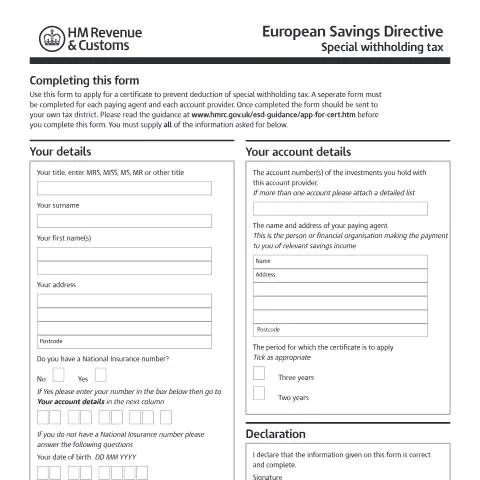
- Personal details: Title, surname, first name(s), address, and date of birth (if no National Insurance number is available).
- National Insurance number: If applicable, this should be included to facilitate identification.
- Account details: The account number(s) of the investments held with the account provider.
- Details of the paying agent: Name and address of the entity making the payments.
- Application period: The desired validity period for the certificate, either two or three years.
Steps to Complete the Application
Before completing the form, applicants are advised to review the guidance available on HMRC’s official website at www.hmrc.gov.uk/esd-guidance/app-for-cert.htm. This ensures that the application is accurate and complete. The main steps include:
- Fill in personal details, including any relevant National Insurance number or, if absent, provide date and place of birth.
- Provide account details for each relevant investment.
- Enter the details of the paying agent, including name and address.
- Select the certificate validity period (two or three years).
- Declare that all information provided is correct and complete by signing and dating the form.
Implications for the Taxpayer
Obtaining the EUSD (SWT)1 certificate ensures that the taxpayer's savings income is not subject to unnecessary withholding tax, provided the information remains valid and accurate. It simplifies the tax process and helps maintain compliance with UK and EU tax regulations. However, taxpayers should keep in mind that the certificate's validity is limited, and renewal is necessary to continue benefiting from the exemption or reduction of withholding tax.
Additional Considerations
HMRC handles these applications in accordance with specific internal procedures, including Memo SCS033/06 and NWB289/08. It is essential to ensure all details are correct to avoid delays or rejection of the application. Once approved, the certificate will be sent to the applicant, who should then provide it to their paying agent in the relevant EU country.
In summary, the EUSD (SWT)1 is a valuable document for UK residents with savings income from the EU, helping to prevent double taxation and facilitate compliance with international tax agreements. Proper completion and timely renewal of this certificate are key steps in managing cross-border savings income effectively.