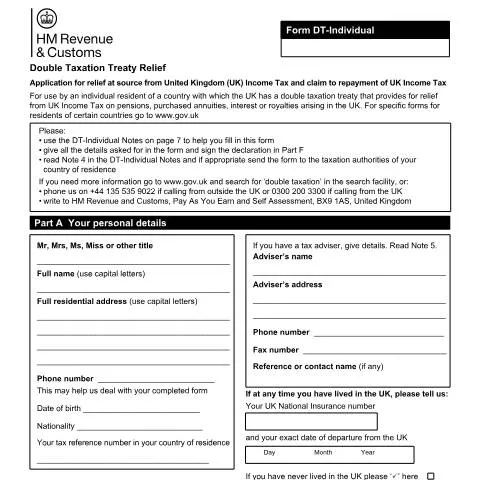
When Double Taxation Relief Becomes Essential: Understanding the DT-Individual Framework
Living abroad whilst receiving UK income creates a complex web of tax obligations that can result in paying tax twice on the same earnings. The Form DT-Individual serves as your pathway to claiming relief under double taxation treaties, specifically designed for individuals resident in countries that have established tax agreements with the United Kingdom. This mechanism prevents the harsh reality of being taxed both by HMRC and your country of residence on identical income streams.
The form addresses four primary income categories: pensions, purchased annuities, interest payments, and royalties arising in the UK. Unlike general tax returns, this document requires certification from your local tax authorities, creating a bilateral verification process that ensures genuine residency claims whilst protecting both jurisdictions from tax avoidance schemes.
Recent changes to the Statutory Residence Test have made accurate completion increasingly critical, as incorrect declarations can trigger retrospective tax assessments and potential penalties. The form's complexity reflects the sophisticated nature of international tax law, where seemingly minor details about property ownership or business activities can fundamentally alter your tax position.
Residency Requirements and the Critical Certification Process
The cornerstone of any successful DT-Individual application lies in establishing genuine tax residency in your treaty country. This extends far beyond simply living somewhere; you must demonstrate that you fall within the specific definition of residence outlined in the relevant double taxation agreement between the UK and your country.
The certification section at the bottom of page one requires completion by your local tax authorities, creating an official government-to-government communication. This isn't merely bureaucratic procedure—it serves as legal confirmation that you're subject to tax in your country of residence on the income declared in the form.
Understanding Split Year Treatment and Departure Timing
Questions 4 and 5 in Part B.1 address the sophisticated concept of split year treatment, particularly relevant for individuals who have recently departed the UK. If you left during the current tax year, you must confirm whether you qualify for split year treatment under the Statutory Residence Test. Crucially, claiming split year treatment commits you to remaining non-resident for the entire following tax year—any change must be immediately reported to HMRC.
For those who departed in previous years, the form requires confirmation of your expected non-resident status for the current tax year. This forward-looking assessment acknowledges that residency status can shift based on circumstances like temporary returns to the UK or changes in your overseas arrangements.
| Departure Scenario | Key Consideration | Form Impact |
|---|---|---|
| Current tax year departure | Split year treatment eligibility | Must confirm non-residence for following year |
| Previous year departure | Ongoing non-resident status | Forward-looking assessment required |
| Multiple departures/returns | Statutory Residence Test application | Complex residency determination needed |
Navigating Property Ownership and UK Ties
Question 3 addresses one of the most common complications in residency claims: continued property ownership in the UK. The form requires detailed disclosure not just of ownership, but of the availability and use of any UK property. This includes properties owned jointly with spouses or civil partners, reflecting the interconnected nature of family tax planning.
If you retain a UK property but let it to tenants, you must provide expected annual rental income. This information helps HMRC assess whether the property represents a genuine commercial investment or maintains residential ties that could affect your tax status. Properties that remain available for your personal use carry different implications than those genuinely let on commercial terms.
The Significance of Property Disposal and Timing
The form specifically asks for the date when a property was "last available for your use," recognising that the timing of disposal can be crucial for treaty relief claims. A property sold immediately after departure demonstrates cleaner residential ties than one retained for months or years. Similarly, the end of a tenancy agreement that makes a property available again can trigger renewed UK residential connections.
Business Activities and Independent Services: The Fixed Base Test
Question 6 introduces the concept of independent personal services from a fixed base, a technical term that can dramatically alter your treaty position. This goes beyond simple employment relationships to encompass consultancy work, professional services, or any regular business activities conducted from a permanent UK location.
The "fixed base" concept varies between treaties but generally requires a permanent facility regularly available for business use. This could include a rented office, a room in a client's premises used regularly, or even a home office if used consistently for UK business activities. The key distinction lies between occasional business visits and maintaining a permanent business presence.
Trade Versus Professional Services Distinctions
The form distinguishes between "trade or business" and "independent personal services," reflecting different treaty articles with varying relief provisions. Trading activities typically involve buying and selling goods or providing commercial services, whilst independent personal services cover professional activities like consultancy, legal advice, or technical services. Understanding which category applies affects both the treaty article invoked and the relief available.
Special Tax Benefits and Remittance-Based Taxation
Questions 7, 8, and 9 form an interconnected sequence addressing sophisticated tax planning arrangements that could undermine treaty relief claims. These provisions target situations where individuals claim UK treaty relief whilst simultaneously benefiting from preferential tax treatment in their residence country.
Question 7 requires disclosure of any special tax benefits that reduce or eliminate tax on UK income in your residence country. This includes specific legislative provisions, tax holidays for new residents, or preferential regimes for certain types of income. The requirement to identify the specific legislation demonstrates HMRC's need to verify these claims independently.
Remittance Basis Complications
Questions 8 and 9 address remittance-based taxation systems, where individuals are taxed only on income actually brought into their country of residence. If you're subject to such a system, you must declare whether you remit all UK income to your residence country. Partial remittance creates complex calculations where treaty relief may apply proportionally.
The £0 option in question 9 acknowledges that some individuals may choose not to remit UK income at all, potentially avoiding residence country tax entirely. However, this doesn't automatically disqualify treaty relief claims—the key test remains whether you're genuinely resident and potentially subject to tax in the treaty country.
Completing the Technical Details and Supporting Evidence
Part A requires specific formatting requirements that reflect HMRC's processing systems. The insistence on capital letters for names and addresses ensures accurate data capture, whilst the phone number request facilitates direct communication during processing. Including your tax reference number from your country of residence helps establish your genuine tax status there.
The tax adviser section in Part A serves multiple purposes beyond simple contact details. HMRC may communicate directly with professional advisers, and the reference or contact name helps identify specific individuals within larger firms. This becomes particularly important for complex cases requiring detailed technical discussions.
Historical UK Connections and National Insurance Numbers
The National Insurance number requirement applies only to individuals with previous UK residence, serving as a unique identifier linking current claims to historical tax records. The exact departure date becomes crucial for calculating treaty relief periods and ensuring accurate application of the Statutory Residence Test.
For individuals who have never lived in the UK, the simple tick box acknowledges this status whilst avoiding unnecessary data requests. This distinction helps HMRC route applications appropriately and apply relevant processing procedures.
Processing Pathways and Administrative Coordination
The form accommodates two distinct processing routes reflecting different administrative arrangements between countries. Some tax authorities send completed forms directly to HMRC at the specified BX9 1AS address, whilst others process applications domestically before communicating with the UK authorities through separate channels.
The certification section creates a formal government-to-government communication, with the official stamp requirement ensuring authentic documentation. Tax authorities must specify whether you're subject to tax on all declared income or only on amounts remitted to the country, acknowledging different taxation bases across jurisdictions.
Timing Considerations and Processing Delays
Unlike many HMRC forms with statutory deadlines, DT-Individual applications can be submitted when relief is needed, though earlier submission generally ensures smoother processing. The form's design anticipates that some applicants may need relief before receiving income, whilst others claim retrospective relief on income already received.
Processing times vary significantly based on the complexity of individual circumstances and the administrative efficiency of coordination between tax authorities. Simple cases with clear residency and straightforward income streams typically process faster than complex situations involving multiple income types or sophisticated tax planning arrangements.
The telephone numbers provided—+44 135 535 9022 for international callers and 0300 200 3300 for UK-based callers—offer direct access to specialist teams familiar with double taxation treaty applications. These dedicated lines can provide guidance on form completion, processing status updates, and clarification of complex technical requirements that may not be immediately apparent from the form itself.
Claiming Relief for Different Types of Income Under Double Taxation Treaties
The Form DT-Individual accommodates various income categories, each subject to specific treaty provisions and relief mechanisms. Understanding how different income streams are treated under double taxation agreements is crucial for accurate completion and optimal tax efficiency.
Employment Income and Cross-Border Workers
Employment income presents particular complexities under double taxation treaties, especially for individuals working across borders. Most UK treaties follow the OECD Model, which generally taxes employment income in the country where the work is performed. However, significant exceptions apply for short-term assignments, typically when employment in the other country doesn't exceed 183 days in any twelve-month period, the employer isn't resident in that country, and remuneration isn't borne by a permanent establishment there.
Cross-border workers—those living in one country whilst working in another—often benefit from specific treaty provisions. For instance, under the UK-France treaty, frontier workers may elect to be taxed only in their country of residence, provided they return there daily or at least once weekly. When completing Form DT-Individual for employment income, you must specify the exact nature of your work arrangement, including days spent in each jurisdiction and employer details.
Particular attention is required for benefits in kind, stock options, and pension contributions. These elements may be treated differently under various treaties, with some allowing relief only for cash remuneration whilst subjecting benefits to local taxation rules. Directors and senior executives often face enhanced scrutiny, with some treaties containing anti-avoidance provisions that override standard employment income rules for individuals in controlling positions.
Investment Income: Dividends, Interest, and Royalties
Investment income typically benefits from reduced withholding tax rates under double taxation treaties, but the relief mechanisms vary significantly. Dividend income from overseas companies often qualifies for reduced withholding tax, commonly 5% for substantial holdings (usually 10% or more) and 15% for portfolio investments. However, the definition of beneficial ownership is crucial—merely holding shares through nominees or complex structures may disqualify you from treaty benefits.
Interest income presents its own challenges, with many treaties providing for complete exemption from source country taxation, particularly for bank interest and government securities. However, interest on loans secured by real estate or paid by associated enterprises may remain subject to higher withholding rates. When claiming relief on Form DT-Individual, you must demonstrate that you're the beneficial owner of the income and that any intermediary structures serve genuine commercial purposes.
Royalty payments for intellectual property often qualify for reduced rates or complete exemption, but the scope varies considerably between treaties. Some distinguish between industrial royalties (often fully exempt) and copyright royalties (subject to reduced rates), whilst others treat all royalties uniformly. Software licensing payments require particular care, as different treaties may classify these as royalties, business profits, or even technical service fees, each carrying different relief entitlements.
Real Estate Income and Capital Gains
Property-related income generally remains taxable in the country where the real estate is situated, regardless of your residence status. However, treaty relief may be available for the administrative burden and compliance costs. Some treaties provide for reduced withholding taxes on rental income or allow for net taxation rather than gross withholding, significantly improving cash flow for property investors.
Capital gains on real estate almost universally remain taxable in the source country, but treaties often provide relief from double taxation through the credit method in your residence country. When disposing of UK residential property as a non-resident, you must navigate both the UK's capital gains tax obligations and potential taxation in your country of residence. Form DT-Individual can help establish your treaty entitlements and ensure appropriate relief is claimed.
Indirect property holdings through companies or funds may qualify for different treatment. Some treaties extend real estate provisions to shares in property-rich companies, whilst others treat these as normal share disposals. The threshold for property-richness varies between treaties, typically ranging from 50% to 90% of company value derived from real estate.
Interaction with Domestic Tax Reliefs and Anti-Avoidance Rules
Treaty relief doesn't operate in isolation but interacts complexly with domestic tax provisions, often creating unexpected outcomes that require careful navigation when completing Form DT-Individual.
Remittance Basis and Treaty Protection
UK residents claiming the remittance basis face particular complications when seeking treaty relief. Whilst treaties generally override domestic law, the interaction with remittance basis taxation creates grey areas. Foreign income that would otherwise qualify for treaty relief might still be subject to UK taxation if remitted, even where the treaty appears to allocate taxing rights exclusively to the source country.
The remittance basis charge, payable by long-term UK residents, adds another layer of complexity. This charge applies regardless of treaty provisions, meaning you might pay both the remittance basis charge and foreign taxes on the same income. Form DT-Individual cannot provide relief from the remittance basis charge itself, only from the underlying income tax that would arise on remittance.
Temporary non-residents returning to the UK face additional complications. The temporary non-residence rules can clawback certain gains and income, potentially overriding treaty protections obtained whilst non-resident. These anti-avoidance provisions operate independently of treaty relief mechanisms, creating potential for unexpected tax liabilities that Form DT-Individual cannot address.
Controlled Foreign Company Rules and Treaty Override
The UK's Controlled Foreign Company (CFC) rules can override treaty benefits in specific circumstances, particularly for individuals with significant interests in overseas companies. Where CFC rules apply, income may be attributed to UK shareholders regardless of treaty provisions that would normally prevent such attribution. This creates a complex interaction where treaty relief might be available for the underlying foreign taxes whilst the income remains taxable in the UK under domestic anti-avoidance rules.
Transfer pricing adjustments present similar challenges. Where HMRC makes transfer pricing adjustments affecting overseas transactions, the resulting tax may not qualify for treaty relief if the adjustment creates income that wasn't actually received overseas. This can leave taxpayers facing UK taxation without corresponding foreign tax credits, despite apparent treaty protection.
The general anti-abuse rule (GAAR) and targeted anti-avoidance rules (TAARs) can also impact treaty claims. Whilst treaties themselves are protected from GAAR challenges, arrangements designed primarily to access treaty benefits may be vulnerable. This is particularly relevant for artificial structures designed to channel income through treaty countries without genuine economic substance.
Mutual Agreement Procedures and Dispute Resolution
When treaty interpretation disputes arise, the mutual agreement procedure (MAP) provides a mechanism for resolution between tax authorities. However, accessing MAP requires careful documentation and adherence to strict procedural requirements. Form DT-Individual serves as preliminary documentation, but MAP cases require comprehensive evidence of the dispute and its treaty basis.
The UK has committed to mandatory binding arbitration under many recent treaties, providing taxpayers with additional certainty. However, arbitration is typically only available after the MAP process has been exhausted, usually taking several years. During this period, you may need to pay disputed taxes whilst the case progresses, requiring careful cash flow management.
Advance pricing agreements (APAs) can provide certainty for ongoing transactions, particularly for businesses with complex transfer pricing arrangements. Whilst individual taxpayers rarely need formal APAs, the principles apply to any ongoing arrangement where treaty interpretation might be disputed. Early engagement with HMRC through formal or informal channels can prevent future disputes and ensure treaty relief is correctly applied from the outset.
Special Considerations for Specific Taxpayer Categories
Different categories of taxpayers face unique challenges when claiming treaty relief, requiring tailored approaches to Form DT-Individual completion and supporting documentation.
High Net Worth Individuals and Complex Structures
High net worth individuals often hold investments through complex international structures, creating multiple layers of potential treaty claims. Trust arrangements, in particular, require careful analysis to determine the appropriate treaty claimant. UK resident trusts may claim treaties as UK residents, but the analysis becomes complex where trustees are resident in multiple jurisdictions or where the trust has a mixed residence profile.
Offshore trusts with UK beneficiaries face particular scrutiny. The trust's residence for treaty purposes may differ from its residence for UK domestic purposes, potentially affecting available reliefs. Where UK beneficiaries receive distributions from offshore trusts, the interaction between trust taxation and treaty relief requires specialist analysis, particularly given the UK's complex trust anti-avoidance rules.
Family investment companies and other holding structures require careful consideration of their treaty entitlements. The principal purpose test (PPT) contained in many modern treaties can deny benefits where obtaining treaty relief was a principal purpose of the structure, even if genuine commercial reasons also exist. This creates a facts-and-circumstances test that requires detailed documentation of commercial rationale and substance requirements.
Entrepreneurs and Business Owners
Business owners with international operations face unique treaty considerations, particularly around the allocation of business profits and the permanent establishment threshold. The OECD's recent work on digitalisation has created additional uncertainty around where business profits should be taxed, particularly for digital businesses serving multiple markets from a single location.
Entrepreneurs' Relief (now Business Asset Disposal Relief) and its interaction with treaty provisions requires careful analysis. Whilst the relief applies to UK capital gains, treaty provisions might allocate taxing rights to other jurisdictions, potentially creating mismatches. Some treaties contain specific provisions for business disposals that may override or interact with domestic reliefs.
Share option schemes for internationally mobile employees create particular complexity. The timing of taxation may differ between jurisdictions, with some countries taxing on grant, others on vesting, and still others on exercise or disposal. Treaties typically don't address these timing mismatches directly, potentially leaving individuals facing taxation in multiple jurisdictions on the same economic benefit without corresponding relief.
Pensioners and Retirees
Pension income presents unique treaty considerations, particularly given the variety of pension arrangements and their different treatment across jurisdictions. UK government service pensions typically remain taxable only in the UK under most treaties, regardless of the recipient's residence. However, private pensions may be taxable in the country of residence, creating potential for relief from UK withholding taxes.
State pension entitlements often benefit from exclusive residence country taxation, but the interaction with social security coordination agreements adds complexity. EU coordination rules continue to apply during the transition period but may change thereafter, potentially affecting both pension entitlements and tax treatment.
Pension transfers between jurisdictions require careful treaty analysis, particularly given the different tax treatment of pension contributions and withdrawals across countries. Some transfers that appear tax-neutral domestically may trigger tax charges overseas, whilst others may qualify for rollover relief under specific treaty provisions. The UK's pension flexibility rules, allowing unrestricted access to pension funds from age 55, have created new planning opportunities but also additional treaty complexity where recipients are resident overseas.